Many buyers assume a shirt can move from idea to shipment very quickly. But in real manufacturing, production time depends on much more than sewing. Fabric sourcing, sample approval, trim preparation, cutting, printing, finishing, inspection, and packing all affect the final timeline.
The time it takes to produce a shirt depends on the shirt type, fabric availability, sample approval speed, order quantity, and production method. In most factory programs, total lead time can range from a few weeks to more than a month, while more complex shirts, custom trims, or slower approval cycles can extend the schedule further.
At Fusionknits, shirt production time is treated as a full process timeline, not just a sewing timeline. A realistic delivery plan should include development, material preparation, bulk production, quality control, and shipment readiness.
Why is there no single production timeline for a shirt?
A shirt may look simple in the final form, but the manufacturing route behind it can vary a lot. That is why one shirt can be produced much faster than another, even if the two products appear similar at first.
There is no single production timeline for a shirt because lead time depends on development stage, material sourcing, construction complexity, decoration method, production capacity, and customer approval speed. Shirt production is a sequence of connected stages, not one isolated factory action.
From a manufacturing perspective, the biggest timing mistake is to look only at sewing days. Sewing is only one part of the schedule. If the fabric is delayed, the trim is not ready, or the sample is not approved, the production line cannot move forward in a stable way.
At Fusionknits, delivery planning usually begins with a full order map. The team reviews the product type, fabric status, trim requirement, decoration process, order quantity, and target shipping date before confirming a timeline.
Main factors that change shirt production time
- Shirt category
- Fabric sourcing method
- Sample approval cycle
- Trim availability
- Decoration requirement
- Order quantity
- Factory capacity
- Inspection and packing standard
Why timelines often become unrealistic
Development is underestimated
Some buyers only count the factory sewing time and ignore the sample and approval stage.
Material lead times are ignored
Even if the production line is ready, the shirt cannot begin without the right fabric and trims.
Too many changes happen mid-process
Late comments on fit, color, print, or packaging can quickly delay the whole order.
A simple timeline view
| Timeline factor | Why it matters |
|---|---|
| Development stage | Decides when production can actually begin |
| Material readiness | Controls the start of bulk production |
| Construction complexity | Affects production speed |
| Order quantity | Changes line loading and production days |
| Approval speed | Influences every next step |
That is why professional factories do not treat shirt timing as one number. They treat it as a controlled workflow.
How long does shirt development usually take before bulk production starts?
Before the shirt enters bulk production, it usually needs to go through product development. This stage is often one of the most underestimated parts of the total lead time.
Shirt development usually takes from several days to several weeks before bulk production starts, depending on whether the style is simple or custom, whether the materials are already confirmed, and how many sample revisions are needed. Without approved development, bulk production cannot move safely.
For a basic repeat style with known fabric and trims, development may move relatively fast. But for a new style, the process usually includes pattern making, first sample sewing, sample comments, revisions, and final approval. Every round of changes adds time.
At Fusionknits, development lead time is reviewed as part of total delivery planning because a bulk order is only as fast as the approval process allows.
Common development stages before bulk
- Style review
- Fabric and trim confirmation
- Pattern making
- First sample
- Fit comments
- Revised sample if needed
- Final approval
Why development can take longer than expected
More revisions are needed
A shirt may need multiple adjustments in fit, collar shape, sleeve length, or fabric behavior.
Material confirmation is delayed
If swatches, lab dips, or trims are not approved early, the next step slows down.
Packaging comments arrive late
Even final labels and folding instructions can affect the timeline.
Development timing overview
| Development stage | Timing effect |
|---|---|
| Simple repeat style | Faster |
| New custom style | Slower |
| One sample round | Shorter lead time |
| Multiple revision rounds | Longer lead time |
This is why the real production calendar should begin before cutting and sewing, not after.
How long does fabric sourcing and trim preparation take?
Fabric and trims are often the foundation of the production schedule. Even when the style is already approved, the factory cannot move into bulk until the materials are ready.
Fabric sourcing and trim preparation can take from a short ready-stock period to several weeks, depending on whether the fabric is in stock, custom dyed, printed, washed, or made to order. Custom labels, buttons, packaging, and other trims can also affect the final schedule.
A ready-made stock fabric may shorten the timeline significantly. But if the shirt uses custom-dyed fabric, special finishing, yarn-dyed checks, or brand-specific trims, the lead time becomes longer. In many orders, materials—not sewing—decide when the production line can actually start.
At Fusionknits, fabric and trim readiness are checked early because material delay is one of the most common reasons a shirt order misses its target shipment date.
Material steps that affect lead time
- Fabric booking
- Lab dip approval
- Bulk dyeing
- Fabric finishing
- Fabric inspection
- Label production
- Button and accessory sourcing
- Packaging preparation
Why material planning matters so much
No fabric means no cutting
The garment cannot move into bulk without main material approval.
Trim delays can stop final packing
A shirt may be sewn, but still not ready to ship if labels or packaging are missing.
Shade and consistency control take time
Fabric cannot be rushed if quality stability is expected.
Material timing by condition
| Material condition | Lead time effect |
|---|---|
| In-stock fabric | Faster |
| Custom-dyed fabric | Longer |
| Custom trims | Longer |
| Standard trims | Faster |
The strongest delivery plans usually begin with accurate material timing, not with optimistic bulk sewing assumptions.
How long does actual shirt production take in the factory?
Once the style is approved and materials are ready, the order enters bulk production. This is the stage most buyers think of first, but it is still only one part of the full process.
Actual shirt production in the factory can take from a few days to a few weeks depending on shirt complexity, order quantity, line capacity, decoration method, and inspection requirements. Simpler shirts move faster, while more structured shirts or larger orders require more time.
A basic knit shirt with simple sewing and no special finishing can move faster than a woven shirt with cuffs, collar stand, embroidery, or garment wash. The number of garment parts and operations affects line speed directly.
At Fusionknits, bulk production timing is usually divided into cutting, sewing, finishing, and inspection so the schedule can be reviewed more accurately.
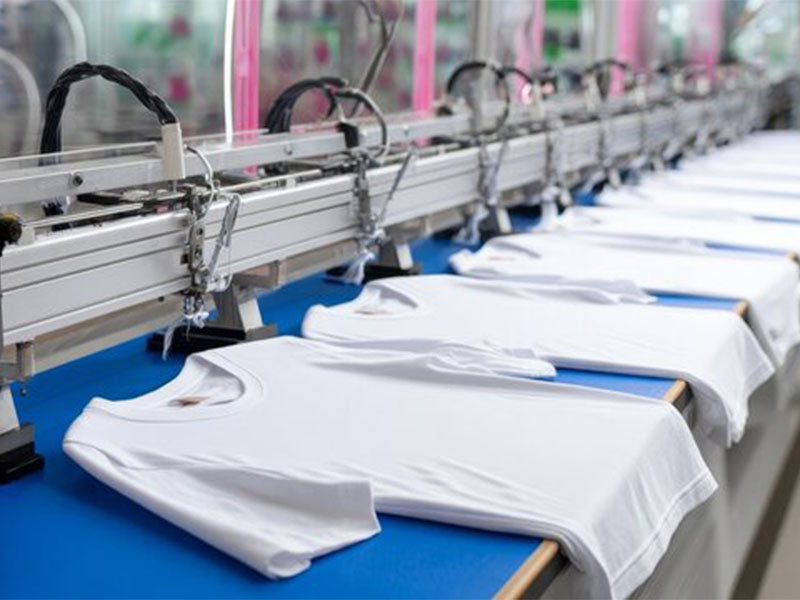
Main bulk production stages
- Fabric relaxation if needed
- Cutting
- Bundling
- Sewing
- Decoration or print application where required
- Thread trimming
- Pressing
- Final inspection
- Packing
Why production speed changes between shirts
Operation count matters
A shirt with more components needs more handling and more operator time.
Line loading matters
A factory may not assign the same number of workers to every order.
Decoration adds time
Printing, embroidery, washing, or special finishing can extend the route.
Bulk production timing view
| Production condition | Lead time effect |
|---|---|
| Basic knit shirt | Faster |
| Woven shirt with more details | Slower |
| Small quantity | Sometimes faster, but not always |
| Large quantity | Longer total days, better efficiency per unit |
This is why bulk sewing time should be seen as part of the total calendar, not the whole calendar.
Does shirt type change the production timeline?
Yes. Shirt type has a direct effect on both development time and bulk production time. The category of the shirt changes the number of parts, the sewing route, and the quality control requirements.
Yes, shirt type changes the production timeline because different shirts require different fabrics, trims, patterns, and sewing operations. A simple T-shirt usually moves faster than a polo shirt or a woven button-up shirt, while more structured or premium shirts usually require more time.
At Fusionknits, the product category is one of the first points reviewed before confirming a delivery schedule. A buyer should not expect the same lead time for all shirts just because they belong to the same broad apparel family.
How different shirt types affect timing
Basic T-shirt
Usually has the shortest route because the construction is more direct.
Polo shirt
Usually takes longer because of the collar, placket, and added trim work.
Woven shirt
Usually takes longer because of the collar parts, cuffs, buttons, and more detailed sewing operations.
Usually takes even longer if the product uses custom washes, embroidery, special stitching, or more demanding quality standards.
Shirt category and timing direction
| Shirt type | General timeline direction |
|---|---|
| Basic T-shirt | Shorter |
| Polo shirt | Medium |
| Woven shirt | Longer |
| Premium or fashion shirt | Longest in many cases |
This is why delivery planning should always start with the actual garment category rather than a generic shirt assumption.
How do order quantity and MOQ affect production time?
Quantity affects shirt timing in two ways. It changes material planning, and it changes factory loading. A very small order and a large volume order do not move through the factory in the same way.
Order quantity affects production time because it changes how materials are sourced, how the production line is loaded, and how many days are needed for cutting, sewing, finishing, and packing. Larger orders usually need more total time, while smaller orders can move faster if materials and approvals are ready.
But quantity is not always as simple as “smaller is faster.” A small order may still move slowly if it has many custom requirements or if it does not fit easily into the factory production calendar. In the same way, a large order may still move efficiently if the line is planned well and the product is stable.
At Fusionknits, quantity is reviewed together with order complexity, not separately.
Why quantity changes the timeline
- Larger fabric volume takes longer to prepare
- More units need more cutting and sewing time
- More cartons need more packing time
- More inspection coverage may be required
- Factory scheduling becomes more important
Why MOQ also matters
Small runs can carry more preparation burden
The sample, trim setup, and development work still exist even for a small quantity.
Larger runs support better line stability
A longer production run can sometimes be managed more efficiently once the line is set.
Quantity and timing overview
| Order size | Timing effect |
|---|---|
| Small custom run | Can be fast, but depends on setup |
| Medium order | Often the most balanced |
| Large bulk order | Longer total production time |
| Reorder in same style | Often faster than first order |
This is why quantity should always be discussed together with development status and material readiness.
How do printing, embroidery, and washing affect lead time?
Decoration and finishing can add a lot of value to a shirt, but they also add time. In many cases, special treatment is one of the biggest reasons a shirt takes longer than expected.
Printing, embroidery, and washing affect lead time because they add extra production stages, approval needs, and quality control requirements. A plain shirt usually moves faster, while decorated or garment-washed shirts need a longer and more controlled route.
At Fusionknits, the timeline for a decorated shirt is always reviewed more carefully because every extra process creates another point where delay or correction may happen.
Decoration methods that can extend timing
- Screen printing
- Embroidery
- Heat transfer
- Garment wash
- Enzyme wash
- Special dye or finishing effect
Why these stages add time
They require preparation
Artwork approval, embroidery files, or print strike-offs may be needed before bulk starts.
They create extra handling
The shirt may move from sewing to decoration, then to finishing, then to inspection.
They increase quality checkpoints
The print, embroidery, or wash result must match the approved standard.
Process add-on timing direction
| Added process | Timing impact |
|---|---|
| Plain shirt | Faster |
| Simple print | Slightly longer |
| Embroidery | Longer |
| Garment wash | Longer |
| Multiple special effects | Longest |
A stronger lead-time plan always includes the full decoration route, not only the garment assembly route.
How much time is needed for finishing, inspection, and packing?
Many buyers focus on cutting and sewing, but the order is not complete when the last seam is sewn. Finishing, inspection, and packing are still required before the shipment is ready.
Finishing, inspection, and packing usually take additional time after sewing because the shirt must be cleaned, pressed, checked, folded, labeled, packed, and prepared for shipment. These final stages are essential for quality control and delivery readiness.
At Fusionknits, final preparation is treated as part of production, not as a separate warehouse task. A shirt is only considered complete when it meets the approved quality standard and is packed according to the customer’s requirements.
Final stages after sewing
- Thread trimming
- Pressing
- Appearance review
- Measurement check
- Final inspection
- Folding
- Polybag packing
- Carton packing
- Shipping mark confirmation
Why these final steps matter
They protect quality
A shirt can be sewn correctly and still fail if it is packed or inspected poorly.
They affect customer experience
Packaging accuracy supports retail presentation and warehouse handling.
They prevent avoidable shipment problems
Wrong carton count, wrong labels, or poor folding can create downstream issues.
Final-stage timing view
| Final stage | Why it adds time |
|---|---|
| Pressing and finishing | Improves appearance and readiness |
| Final inspection | Protects against shipment defects |
| Folding and packing | Required for shipment compliance |
| Carton marking | Supports logistics accuracy |
A realistic shirt timeline always keeps room for these final control stages.
How can buyers reduce shirt production lead time without creating risk?
Faster production is possible in some cases, but real speed comes from better planning, not from pressure alone. Trying to rush the factory without controlling the process usually creates defects or delivery problems.
Buyers can reduce shirt production lead time by confirming materials early, approving samples quickly, limiting unnecessary revisions, choosing realistic quantities, and aligning decoration and packaging requirements before bulk starts. The safest speed comes from clear preparation.
At Fusionknits, the fastest orders are usually not the ones with the most urgent requests. They are the ones with the clearest product direction and the fewest preventable changes.
Practical ways to reduce timeline risk
- Confirm fabric direction early
- Approve lab dips and trims quickly
- Keep sample comments clear
- Avoid late design changes
- Use realistic quantity planning
- Align packaging instructions before finishing
- Choose suppliers with suitable capacity
Why planning improves speed more than pressure
Fewer corrections are needed
A stable order moves faster than an unstable one.
Material booking starts earlier
Clear decisions allow the factory to secure fabric and trims sooner.
The line can be scheduled more accurately
A well-defined order is easier to fit into factory planning.
Lead-time improvement guide
| Better practice | Result |
|---|---|
| Early material confirmation | Faster production start |
| Clear sample approval | Less revision delay |
| Stable specification | Better factory planning |
| Realistic shipping target | Lower risk of rush problems |
A strong production timeline is usually the result of stronger coordination, not simply faster sewing.
Conclusion
The time it takes to produce a shirt depends on the full manufacturing route, not just the sewing stage. Development, fabric sourcing, trim preparation, bulk production, decoration, finishing, inspection, and packing all affect the final lead time. A simple shirt can move relatively quickly, while a more detailed or custom shirt usually needs more time because it passes through more processes and more approval stages.
From a professional manufacturing perspective, the most realistic way to plan shirt timing is to treat the order as a complete workflow. Shirt type, order quantity, material readiness, and approval speed all influence the delivery schedule in important ways.
At Fusionknits, the strongest timelines are built through early material planning, clear development control, stable production scheduling, and disciplined final inspection. When these stages are aligned well, shirt production becomes more predictable, more efficient, and more reliable for both the buyer and the factory.