A T-shirt looks like one of the simplest garments in apparel, but the production system behind it is not simple. A factory does not rely on one machine to make a T-shirt. It relies on a sequence of machines for fabric preparation, cutting, sewing, finishing, inspection, and packing. If one machine in that chain is missing or poorly managed, the final garment quality can drop very quickly.
T-shirt manufacturing requires a combination of machines rather than one single machine. In most factory setups, the main machines include fabric inspection equipment, cutting machines, overlock machines, flatlock or coverstitch machines, lockstitch machines, rib attaching support, steam ironing equipment, finishing equipment, and packing tools. The exact machine list depends on the T-shirt type, production volume, and quality standard.
At Fusionknits, T-shirt manufacturing is treated as a system. A good T-shirt is not produced by sewing alone. It is produced through a complete workflow where the right machines support the right process at the right stage.
Why does T-shirt manufacturing need more than one machine?
Many people imagine T-shirt production as a sewing task only. In reality, sewing is only one part of the process. Fabric must be inspected, prepared, cut, sewn, finished, checked, and packed before the product is ready.
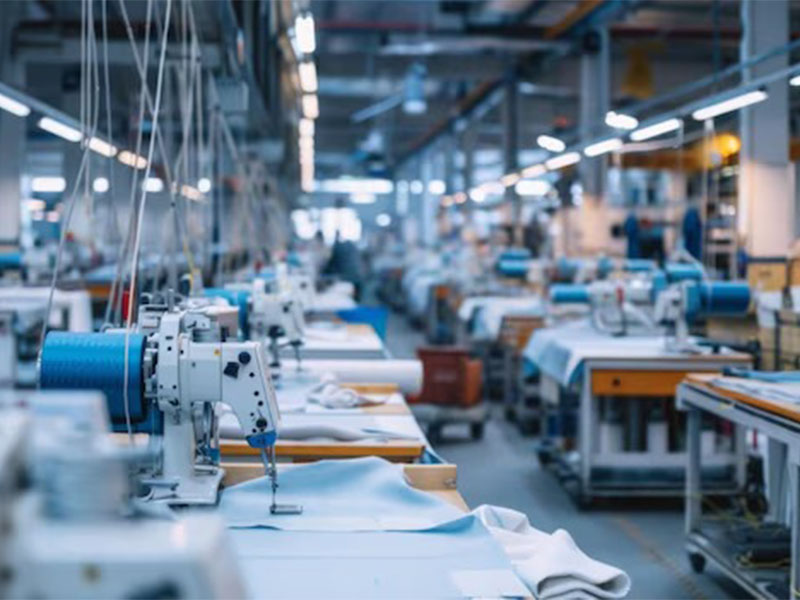
T-shirt manufacturing needs more than one machine because the garment moves through several production stages, and each stage requires different technical functions. Cutting, joining seams, hemming, attaching neck rib, finishing, and packing all require different machines or equipment support.
From a manufacturing perspective, the T-shirt production line should be seen as a connected process rather than one machine station. A factory may use one machine for body seam joining, another for hemming, another for neck rib attachment, and another for pressing or finishing. The machine structure depends on the product and production method.
At Fusionknits, machine planning is usually linked to product type, order volume, and workmanship standard. A basic cotton T-shirt and a performance T-shirt may share some machines, but not always the exact same full route.
Why multiple machines are necessary
- Fabric needs to be inspected before cutting
- Panels need to be cut accurately
- Different seams need different stitch types
- Hems require different finishing from side seams
- Rib attachment needs stability and control
- Final garments need finishing and packing support
Why machine specialization matters
Each stitch type serves a different purpose
A seam-joining machine and a hemming machine are not interchangeable.
Production speed depends on process flow
When the right machine is assigned to the right step, line efficiency improves.
Quality depends on suitable equipment
The wrong machine can create puckering, seam weakness, skipped stitches, or poor garment appearance.
A simple process view
| Production stage | Machine requirement type |
|---|---|
| Fabric preparation | Inspection and handling equipment |
| Cutting | Cutting machines and tables |
| Sewing | Seam-specific garment machines |
| Finishing | Pressing and trimming equipment |
| Packing | Folding and packing support tools |
That is why a T-shirt factory is built around a machine system, not a single machine.
What machines are needed before sewing starts?
Before a T-shirt reaches the sewing line, the fabric must be checked and prepared correctly. This stage often receives less attention, but it has a strong influence on garment consistency.
Before sewing starts, T-shirt manufacturing usually requires fabric inspection equipment, fabric spreading tables, marker planning support, and cutting equipment. These machines and tools help control fabric quality, panel accuracy, and production efficiency before assembly begins.
A T-shirt can still become defective even if the sewing quality is good, simply because the fabric was cut badly or the rolls were not checked properly. Fabric flaws, shade differences, and off-grain cutting can all create serious production problems.
At Fusionknits, pre-sewing equipment is treated as part of quality control because cutting accuracy creates the foundation for later sewing stability.
Common equipment used before sewing
- Fabric inspection machine
- Fabric spreading table
- Cutting table
- Straight knife cutting machine
- Band knife cutting machine in some setups
- Pattern marker system
- Bundle sorting tools
Why fabric inspection equipment matters
It helps detect fabric faults
The factory can identify holes, stains, shade variation, or weaving issues before cutting.
It reduces waste
Problems found early are cheaper to manage than problems found after sewing.
It supports better quality control
A clean starting point leads to better output consistency.
Why cutting equipment matters so much
Accurate cutting protects fit
Poorly cut panels create measurement problems and seam distortion later.
Marker efficiency affects cost
Fabric usage is one of the biggest cost factors in T-shirt production.
Bundle accuracy supports line organization
Cut panels need to be sorted cleanly by size and color before sewing begins.
Pre-sewing equipment overview
| Equipment | Main function |
|---|---|
| Fabric inspection machine | Checks fabric quality before use |
| Spreading table | Prepares layers for cutting |
| Cutting table | Supports panel layout and cutting |
| Straight knife machine | Cuts layered fabric panels |
| Marker planning tools | Improves material efficiency |
A better T-shirt line usually begins with stronger control before the first stitch is made.
What is the main sewing machine used for T-shirt side seams?
One of the most important sewing operations in a T-shirt is seam joining. The garment body and sleeve seams must be clean, flexible, and durable, especially because knit fabric needs stretch support.
The main sewing machine used for T-shirt side seams is usually an overlock machine, also called a serger. This machine is widely used because it joins knit fabric panels efficiently while also trimming and overlocking the edge to help prevent fraying and seam failure.
The overlock machine is one of the most essential machines in T-shirt production. It is commonly used for shoulder seams, sleeve seams, and side seams depending on the garment structure and factory setup.
At Fusionknits, the overlock machine is one of the core sewing units in knitwear production because it supports both seam strength and productivity.
Why overlock machines are important in T-shirt production
- Suitable for knit fabric
- Fast seam joining
- Edge trimming and stitching in one step
- Good seam flexibility
- Common in body assembly
Why knit garments need this machine
Knit fabric stretches
The seam needs to move with the fabric instead of breaking under stress.
Edges need clean control
Even though knit fabrics do not fray like woven fabrics in the same way, they still need clean seam finishing and stable joining.
Speed matters in bulk production
Overlock machines support efficient output in high-volume lines.
Overlock machine role
| Machine | Main use in T-shirts |
|---|---|
| Overlock machine | Joining side seams, shoulders, sleeves, seam edges |
For most standard T-shirt factories, the overlock machine is one of the main sewing machines that cannot be removed from the line.
What machine is used for hemming sleeves and bottom hems?
Joining seams is not enough to complete a T-shirt. The hemline and sleeve openings still need to be finished properly. These areas require a different stitch type from the main body seams.
The machine commonly used for hemming T-shirt sleeves and bottom hems is a coverstitch machine, also called a bottom hemming machine in many factories. This machine creates the clean double-needle look often seen on T-shirt hems while keeping the seam flexible for knitwear.
A T-shirt hem must look neat and perform well in repeated wear and washing. The coverstitch machine is widely used because it creates a professional appearance while supporting the stretch behavior of jersey fabric.
At Fusionknits, coverstitch machines are used heavily in T-shirt finishing because hemming quality affects both visual presentation and comfort.
Why coverstitch machines matter
- Creates clean hem appearance
- Supports stretch in knit garments
- Common for sleeve hems
- Common for bottom hems
- Gives a retail-standard finishing look
Why hemming cannot rely on the same machine as seam joining
Hem structure is different
A hem is a turned edge, not a seam joining two panels together.
Appearance matters more
The visible finish of the hem is part of the final garment quality.
Comfort matters too
A badly hemmed sleeve or bottom opening can feel bulky or uneven.
Coverstitch machine role
| Machine | Main use in T-shirts |
|---|---|
| Coverstitch machine | Sleeve hems and bottom hems |
This is why T-shirt production usually needs both overlock and coverstitch machines as separate core sewing units.
What machine is used for attaching the neck rib?
The neck area is one of the most sensitive parts of any T-shirt. Even if the body is sewn well, a poor neckline can damage the appearance of the whole garment.
The neck rib of a T-shirt is usually attached using an overlock machine or a specialized rib attaching setup, depending on the factory workflow. In many factories, overlock machines are used for neckband joining, followed by topstitching or coverstitch finishing where needed.
The collar or neck rib requires good tension control. If the rib is too loose, the neckline looks weak. If it is too tight, the garment may pucker or distort. That is why the rib attachment process depends not only on the machine type, but also on machine setting and operator skill.
At Fusionknits, neckline construction is treated as a key quality point because the collar is often the first part a buyer notices.
Why neck rib attachment needs careful machine control
- Neckline shape affects garment appearance
- Rib tension affects recovery
- Poor collar joining causes puckering or waviness
- The neckline must stay stable after washing
Machines used in neckline construction
Overlock machine
Often used to attach the rib to the body opening.
Coverstitch or topstitch support
Used in some styles to finish or reinforce the neckline.
Lockstitch in certain details
Can be used for label attachment or specific neckline finishing support.
Neckline equipment view
| Machine | Main neckline role |
|---|---|
| Overlock machine | Joins rib to neck opening |
| Coverstitch machine | Finishing in some constructions |
| Lockstitch machine | Supporting operations in some cases |
A strong neckline usually depends on machine accuracy, rib quality, and operator control working together.
Is a lockstitch machine also needed in T-shirt manufacturing?
Yes. Even though overlock and coverstitch machines are the core knitwear machines, lockstitch machines still play an important supporting role in many factories.
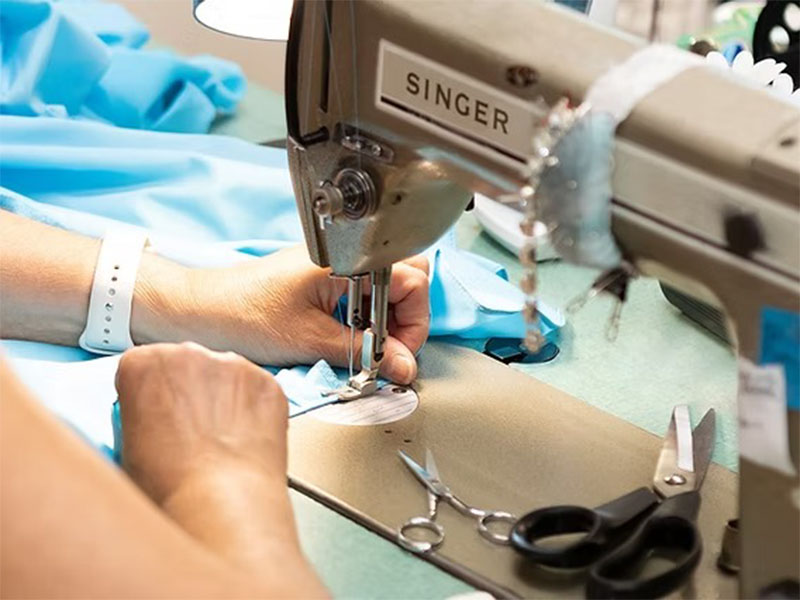
Yes, a lockstitch machine is also needed in T-shirt manufacturing because it is used for supporting operations such as label attachment, reinforcement work, certain topstitching details, and other construction points that need a stable straight stitch.
The lockstitch machine is one of the most basic garment sewing machines in the apparel industry. In T-shirt production, it is not usually the main seam machine, but it is still important for support work and finishing accuracy.
At Fusionknits, lockstitch machines are part of the standard machine mix because a T-shirt line usually needs more than seam and hem machines alone.
Common uses of lockstitch machines in T-shirts
- Main label attachment
- Care label attachment
- Reinforcement stitching
- Certain decorative topstitch details
- Small supporting construction work
Why lockstitch machines still matter
Not every operation needs stretch stitching
Some operations need cleaner control instead of seam elasticity.
Label positioning needs precision
A clean straight stitch is often more suitable for label work.
Factories need flexibility
A T-shirt line still includes small operations outside main seam assembly.
Lockstitch machine role
| Machine | Main use in T-shirts |
|---|---|
| Lockstitch machine | Labels, reinforcement, support stitching |
A professional T-shirt factory usually includes lockstitch units even though knitwear production is led by overlock and coverstitch equipment.
What finishing equipment is needed after sewing?
A T-shirt is not complete when sewing ends. After the sewing line, the garment still needs finishing, appearance correction, and inspection support before it is ready for packing.
After sewing, T-shirt manufacturing usually requires thread trimming tools, steam irons or steam generators, ironing tables, stain-cleaning support, inspection tables, and folding equipment. These tools help improve garment appearance and prepare the product for shipment.
A well-sewn T-shirt can still look weak if it is not finished correctly. Loose threads, wrinkles, dirt, or poor folding all reduce product value in the eyes of the buyer and end customer.
At Fusionknits, finishing equipment is treated as a quality stage, not only a cosmetic step.
Common finishing equipment in T-shirt production
- Thread trimming tools
- Steam iron
- Steam generator
- Vacuum ironing table in some setups
- Stain removal tools
- Inspection table
- Folding table
- Polybag packing tools
Why finishing equipment matters
It improves first impression
Appearance has a strong effect on product evaluation.
It supports quality control
The finishing stage often reveals defects that were missed earlier.
It prepares the garment for logistics
A properly folded and packed garment protects both presentation and handling.
Finishing equipment overview
| Equipment | Main function |
|---|---|
| Steam iron | Removes wrinkles and shapes garment |
| Steam generator | Supplies steam for finishing |
| Inspection table | Supports quality checking |
| Folding table | Prepares garments for packing |
| Trimming tools | Removes loose threads |
A T-shirt becomes commercially ready only after finishing and inspection are completed correctly.
What extra machines might be needed for printed or special T-shirts?
Not every T-shirt leaves the factory as a plain garment. Many shirts include printing, embroidery, washing, or special finishing, and these additions can expand the machine list significantly.
Printed or special T-shirts may require extra equipment such as screen printing machines, heat presses, DTF equipment, DTG printers, embroidery machines, washing equipment, or special finishing systems depending on the decoration or treatment required.
A plain basic T-shirt and a branded graphic T-shirt may share the same sewing route, but their full production systems are not the same. Once decoration is added, the factory must include the right extra equipment or use an external specialist partner.
At Fusionknits, additional machine planning depends on the decoration route, because each special treatment changes the production flow.
Extra equipment often used in special T-shirt production
- Screen printing press
- Flash cure unit
- Conveyor dryer
- Heat press
- DTF printer and powder system
- DTG printer and pretreatment unit
- Embroidery machine
- Garment washing machine
Why these extra machines matter
Decoration affects product value
The print or embroidery must match the quality level of the garment.
Special treatment adds production steps
The T-shirt does not move directly from sewing to packing in these cases.
Method and machine must match
A print route should be supported by the correct technical equipment, not improvised.
Special production equipment view
| Extra process | Machine requirement |
|---|---|
| Screen print | Press, flash cure, dryer |
| DTF | Printer, powder unit, heat press |
| DTG | Printer, pretreatment, curing support |
| Embroidery | Embroidery machine |
| Garment wash | Industrial washing equipment |
A shirt factory should always review the full production requirement, not just the sewing requirement.
Does a small workshop need the same machines as a factory?
No. The machine principle is similar, but the scale is different. A workshop, sample room, and full factory do not all need the same number of machines or the same production system.
A small workshop does not need the same number of machines as a factory, but it still needs the key machine types required for the garment. Even a small setup usually needs cutting support, an overlock machine, a coverstitch machine, a lockstitch machine, and finishing equipment if it wants to produce T-shirts correctly.
A sample room may work with fewer machines because it handles lower volume. A bulk factory needs multiple units of the same machine type to support production flow and target output.
At Fusionknits, the difference between a small setup and a factory is usually capacity and workflow scale, not the complete removal of key machine categories.
What changes between workshop and factory
- Number of machines
- Speed of line output
- Specialization of operators
- Internal process division
- Volume handling
What usually stays necessary
Core sewing types remain the same
T-shirts still need seam joining, hemming, and support stitching.
Finishing is still important
Even small orders need pressing and quality review.
Basic cutting support is still needed
Accurate cutting remains essential at every scale.
Scale comparison
| Production level | Machine setup direction |
|---|---|
| Small workshop | Fewer machines, same key categories |
| Sample room | Flexible setup for development |
| Bulk factory | Multiple dedicated machines and full line organization |
The scale may change, but the production logic stays similar.
How should a business choose the right machine setup for T-shirt manufacturing?
The best machine setup depends on production goal. A sample room, a startup workshop, and a bulk export factory do not need exactly the same machine structure.
A business should choose the right machine setup for T-shirt manufacturing based on product type, production volume, decoration needs, quality target, and available technical skill. The strongest setup is the one that supports the actual production model rather than buying machines without a process plan.
At Fusionknits, machine planning is always linked to real operational needs. If the goal is bulk T-shirt production, the setup must support line balancing and output speed. If the goal is sample development, flexibility may matter more than volume.
Questions that help define the machine setup
- What type of T-shirt will be made?
- What monthly or daily output is expected?
- Will the garments be plain or decorated?
- What quality standard is required?
- Will the business focus on samples or bulk orders?
- Is fabric cutting done in-house?
A practical machine planning guide
For basic T-shirt sewing
Overlock, coverstitch, and lockstitch machines are the main core.
For complete in-house production
Cutting equipment and finishing equipment should also be included.
For decorated garments
Printing or embroidery systems must be added where needed.
Setup guide by production model
| Production model | Machine direction |
|---|---|
| Sample room | Flexible sewing mix with basic cutting and finishing |
| Small workshop | Core sewing machines and simple finishing setup |
| Bulk T-shirt factory | Full line with multiple core machines and support stations |
| Decorated garment factory | Core sewing plus print or embroidery systems |
A stronger machine setup comes from matching equipment to workflow, not from buying the most machines possible.
Conclusion
T-shirt manufacturing does not require one single machine. It requires a group of machines that support each stage of production, including fabric inspection, cutting, seam joining, hemming, neckline construction, finishing, and packing. In most cases, the most important sewing machines are the overlock machine, coverstitch machine, and lockstitch machine, while cutting equipment and finishing tools are also essential parts of the full process.
From a professional manufacturing perspective, the right machine setup depends on the type of T-shirt, the production scale, and the quality standard expected by the market.
At Fusionknits, T-shirt production is always treated as a system where machines, process flow, and operator skill work together. When the machine setup matches the actual production need, the factory can produce T-shirts more efficiently, more consistently, and with stronger commercial quality.