Cardigans may look simple at first, but in professional knitwear development, they cover a wide range of product types. Length, closure, gauge, fit, collar shape, stitch texture, and yarn weight can all change the identity of the garment. That is why one cardigan can feel like a light layering basic, while another works more like a winter statement piece or even a soft jacket.
Different types of cardigans include button-front cardigans, open-front cardigans, zip-up cardigans, cropped cardigans, longline cardigans, oversized cardigans, fitted cardigans, shawl-collar cardigans, chunky cardigans, and textured or patterned cardigans. Each type serves a different purpose in fit, styling, seasonality, and commercial positioning.
At Fusionknits, cardigan classification is not only a fashion topic. It is also a product development issue. Different cardigan types require different yarn strategies, gauge choices, front-opening construction, and finishing control. Understanding these categories clearly helps buyers build better collections and helps brands create more balanced knitwear assortments.
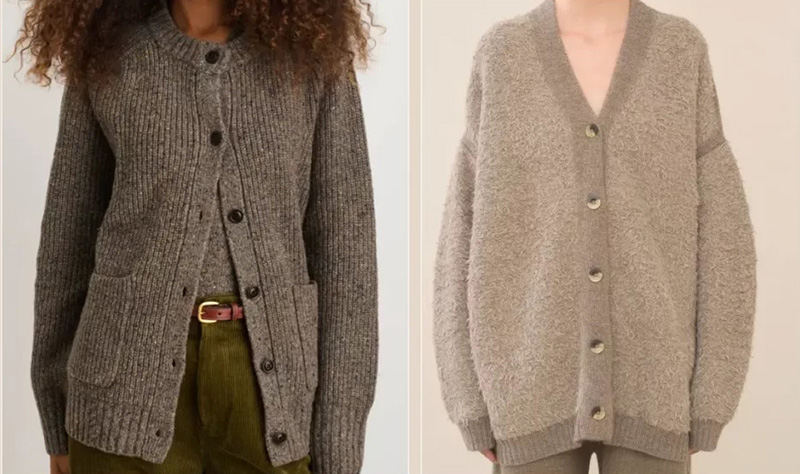
Why are there so many different types of cardigans?
A cardigan is defined broadly as a front-opening knitwear garment, but that basic definition still allows many design variations. Once the front opening is established, the product can evolve in multiple directions through silhouette, structure, and intended use.
There are many different types of cardigans because the category is flexible by design. A cardigan can change through length, fit, closure, collar shape, knit weight, and stitch texture, which allows it to serve many different functions across casualwear, fashion, officewear, and seasonal layering.
From a manufacturing perspective, this flexibility is one reason cardigans remain commercially important. A fine-gauge office cardigan, a chunky winter cardigan, and a cropped fashion cardigan all belong to the same broad family, but they do not follow the same product logic. Their materials, knitting programs, trims, and finishing expectations can be completely different.
At Fusionknits, cardigan development often starts by identifying the role of the garment before choosing the yarn or stitch. The type of cardigan should be clear first, because category direction affects nearly every production decision after that.
Why cardigan types vary so much
- Front openings allow multiple closure options
- Knitwear supports many weights and textures
- Length can shift the garment’s role
- Fit changes styling and consumer use
- Collar and trim details can redefine the product
- Seasonal needs change yarn and gauge direction
Why this matters in manufacturing
One cardigan type cannot represent the whole category
Different cardigan styles require different patterns, machine settings, and finishing processes.
The market uses cardigans for many different needs
Some are soft daily basics. Some are premium office layers. Some are trend-driven statement pieces.
Better classification improves sourcing accuracy
When the cardigan type is clear, yarn and construction decisions become easier to control.
A simple cardigan-category view
| Cardigan variable | Product effect |
|---|---|
| Length | Changes styling and coverage |
| Closure | Changes structure and wear use |
| Fit | Changes silhouette and market position |
| Knit weight | Changes seasonality and function |
| Collar or placket | Changes overall product identity |
That is why the cardigan category becomes much wider than many people first expect.
The button-front cardigan is one of the most classic and commercially recognizable cardigan types. It is often the first shape people imagine when they hear the word cardigan.
A button-front cardigan is a knitwear garment with a full or partial front opening closed by buttons. It is one of the most traditional cardigan types and is commonly used in casualwear, officewear, schoolwear, and premium basics because it offers both versatility and a clear front structure.
From a manufacturing standpoint, button-front cardigans need careful placket stability, accurate button spacing, and proper buttonhole reinforcement. The front opening must remain balanced so the garment looks clean both when buttoned and when worn open.
At Fusionknits, the button-front cardigan is often treated as a foundational product because it works well across many markets and many yarn directions.
- Front placket
- Button closure
- Ribbed or finished opening edge
- Flexible layering use
- Strong category familiarity
They are easy to merchandise
Customers understand the style immediately.
They work across many categories
The same basic construction can be adapted for fashion, basics, workwear, or seasonal knitwear.
They support multiple fit directions
A button-front cardigan can be fitted, boxy, oversized, cropped, or longline.
Button-front cardigan overview
| Feature | Product effect |
|---|---|
| Buttons | Clear traditional cardigan identity |
| Placket | More structured front appearance |
| Closed-front option | More styling flexibility |
| Open wear option | More layering value |
This is why the button-front cardigan remains one of the most widely used cardigan types.
What is an open-front cardigan?
An open-front cardigan removes the need for buttons or zippers and focuses more strongly on easy layering and softer drape. It is one of the simplest cardigan types in visual terms, but it still needs strong edge control.
An open-front cardigan is a cardigan with no front closure. It is designed to hang open naturally, which makes it especially useful for layering, casualwear, and relaxed dressing. This cardigan type usually depends more on drape, front edge finishing, and silhouette balance than on trim details.
At Fusionknits, open-front cardigans often require strong attention to front-edge behavior because the garment must still look clean without the structure of a button band or zipper. The choice of yarn and stitch becomes especially important in this category.
Typical features of open-front cardigans
- No button or zipper closure
- Soft front drape
- Relaxed or fluid silhouette
- Strong layering function
- Lower visual hardware complexity
Why open-front cardigans are popular
They feel easy to wear
Customers can throw them on quickly over many different outfit bases.
They support casual dressing well
This type often works strongly in soft lifestyle and everyday categories.
They let the knit itself stand out
Without trims dominating the front, the yarn, stitch, and shape become more visible.
Open-front cardigan overview
| Feature | Product effect |
|---|---|
| No closure | Simpler visual identity |
| Open drape | Softer and easier layering |
| Front edge exposure | Higher need for clean finishing |
| Relaxed styling | Strong casual appeal |
That is why open-front cardigans are often chosen for softer, more effortless knitwear programs.
What is a zip-up cardigan?
A zip-up cardigan sits between a classic cardigan and a soft knit jacket. It often feels more modern, more structured, and sometimes more sporty than button-front alternatives.
A zip-up cardigan is a cardigan with a front zipper instead of buttons. This cardigan type often looks cleaner, more directional, or more utility-driven, and it can work especially well in modern casualwear, men’s knitwear, sport-influenced categories, and elevated layering programs.
From a production perspective, zip-up cardigans need accurate zipper insertion, strong front balance, and controlled opening stability. A poorly inserted zipper can distort the whole front body.
At Fusionknits, zip-up cardigans are often developed when the product direction needs a stronger front line and a more contemporary edge.
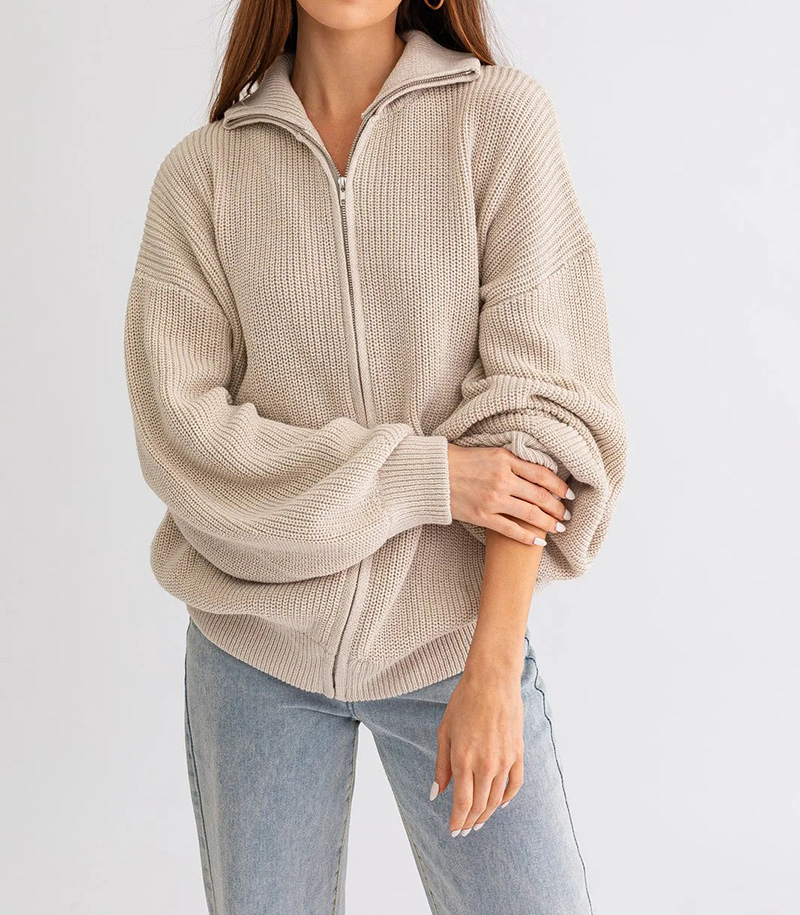
Typical features of zip-up cardigans
- Front zipper closure
- More structured opening
- Often cleaner visual line
- Sometimes more jacket-like identity
- Strong use in modern layering categories
Why zip-up cardigans are useful
They feel more current in some markets
A zip front can modernize the cardigan quickly.
They support stronger front stability
Compared with softer open-front styles, zip constructions often feel more controlled.
They can bridge categories
Some zip-up cardigans sit between knitwear and light outerwear.
Zip-up cardigan overview
| Feature | Product effect |
|---|---|
| Zipper | Stronger front structure |
| Clean line | More modern visual identity |
| Better closure control | Easier temperature adjustment |
| More jacket influence | Strong in men’s and utility categories |
This is why zip-up cardigans are important in contemporary knitwear development.
What are cropped and longline cardigans?
Length is one of the strongest ways to divide cardigan types because it changes both styling behavior and commercial use. A cropped cardigan and a longline cardigan can belong to the same category, but they do not behave like the same product.
Cropped cardigans are shorter cardigans that usually end around the waist or above the hip, while longline cardigans extend further down the body, sometimes to mid-thigh or below. These two types serve different purposes in proportion, layering, and outfit construction.
Cropped cardigans often feel younger, sharper, and more fashion-led. Longline cardigans often feel softer, more relaxed, and more coverage-driven. Both types can work well, but their yarn and fit logic should be handled differently.
At Fusionknits, length direction is treated as a key structural choice, not just a styling detail.
What cropped cardigans usually offer
- Stronger waist emphasis
- More fashion-forward silhouette
- Good pairing with high-waist bottoms
- Lighter visual weight
- Useful in spring and transitional collections
What longline cardigans usually offer
- More body coverage
- Strong layering value
- Softer silhouette
- Strong use in cozy or relaxed categories
- More visible drape behavior
Length-based cardigan comparison
| Length type | Typical effect |
|---|---|
| Cropped cardigan | Sharper, younger, more proportion-focused |
| Hip-length cardigan | Versatile and broadly commercial |
| Longline cardigan | Softer, more relaxed, more coverage-focused |
This is why length alone can create very different cardigan categories in the market.
What are fitted, classic, and oversized cardigans?
Fit is another major way to separate cardigan types. The same yarn and front opening can create very different products depending on whether the cardigan is fitted, standard, or oversized.
Fitted cardigans sit closer to the body and often feel cleaner or more refined, classic cardigans follow a balanced standard fit suitable for many uses, and oversized cardigans use extra body width and softer proportion for a more relaxed or trend-driven look.
Each fit type carries a different market message. Fitted cardigans often support more polished styling. Classic fits remain the safest broad-market option. Oversized cardigans often lead more strongly in trend-driven or comfort-led categories.
At Fusionknits, fit type is always linked to yarn behavior because the same fit direction does not perform equally in every material or gauge.
Main cardigan fit categories
- Fitted cardigan
- Classic or regular-fit cardigan
- Relaxed cardigan
- Oversized cardigan
- Boxy cardigan
Why fit changes the cardigan category so much
It changes silhouette language
The same closure can feel elegant, basic, or fashion-led depending on fit.
It changes consumer use
A fitted cardigan may act more like a top, while an oversized cardigan behaves more like a soft layer.
It changes development requirements
Oversized knitwear often needs stronger control in shoulder, sleeve, and edge balance.
Fit comparison
| Fit type | Typical market role |
|---|---|
| Fitted cardigan | Cleaner, dressier, more shape-focused |
| Classic cardigan | Broadest commercial use |
| Oversized cardigan | Relaxed, trend-led, layering-heavy |
| Boxy cardigan | Modern, slightly architectural look |
That is why fit is one of the most important ways to classify cardigan types.
What are shawl-collar, V-neck, and collar-based cardigans?
Neckline and collar details can shift a cardigan’s identity very quickly. Some cardigans stay minimal around the neck, while others use collars to add structure and visual character.
Shawl-collar cardigans use a folded collar that rolls around the neckline for a richer and warmer look, V-neck cardigans follow a simpler front-opening neckline that works well in classic and layered categories, and other collar-based cardigans may use stand collars or knit-jacket-inspired necklines for more structure.
At Fusionknits, collar development requires careful attention because neck structure affects drape, front balance, trim behavior, and market identity. A shawl collar in a chunky yarn behaves very differently from a V-neck in fine-gauge merino.
Common neckline and collar cardigan types
- V-neck cardigan
- Round-neck cardigan
- Shawl-collar cardigan
- Stand-collar cardigan
- Collarless minimal cardigan
Why collar details matter so much
They change the style category
A shawl-collar cardigan often feels richer and more winter-oriented than a simple V-neck.
They change front construction
More collar structure means more technical balance work.
They change visual weight
The neckline often controls how heavy or light the cardigan feels visually.
Collar-based cardigan overview
| Collar type | Product effect |
|---|---|
| V-neck | Classic and versatile |
| Round neck | Cleaner and softer |
| Shawl collar | Richer, warmer, more substantial |
| Stand collar | More structured and modern |
That is why collar choice is one of the clearest ways to create different cardigan families.
What are chunky, fine-gauge, and textured cardigans?
Knit weight and stitch texture also create major cardigan categories. Even if two cardigans share similar shape and closure, their market role changes greatly when the knit structure changes.
Chunky cardigans use heavier yarns and often create warmer, more textured garments, fine-gauge cardigans use lighter yarns for smoother and more refined layering, and textured cardigans use stitch variation such as cable, rib, pointelle, or pattern work to create more visible surface identity.
From a manufacturing perspective, these categories can require completely different machines, yarn counts, and finishing controls. A fine-gauge cardigan often supports polished and office-friendly use. A chunky cardigan often supports stronger winter styling. A textured cardigan may carry more fashion value because the knit itself becomes a design feature.
At Fusionknits, knit weight and texture are often the true drivers of cardigan identity, especially in seasonal collection planning.
Main knit-structure cardigan types
- Fine-gauge cardigan
- Mid-gauge cardigan
- Chunky cardigan
- Cable-knit cardigan
- Rib-knit cardigan
- Patterned or textured cardigan
Why knit structure defines the product
It changes warmth
Heavier structures usually support colder-season use.
It changes drape
Fine knits move differently from bulky textures.
It changes product value perception
Texture often adds more visible craftsmanship and design interest.
Knit-structure comparison
| Knit type | Typical effect |
|---|---|
| Fine-gauge cardigan | Clean, light, refined |
| Mid-gauge cardigan | Broadly versatile |
| Chunky cardigan | Cozy, warmer, visually strong |
| Textured cardigan | More tactile and design-led |
This is why knit weight and texture are key ways to classify different cardigan types.
How should buyers choose the right cardigan types for a collection?
A cardigan assortment should not be built around one shape alone. The strongest collection usually mixes types that serve different markets, climates, and styling roles.
Buyers should choose cardigan types by balancing fit, length, closure, knit weight, and target use. A strong collection often includes a classic core cardigan, a softer open-front or layering option, and one more directional fashion or texture-led cardigan to create both commercial stability and visual interest.
At Fusionknits, the best cardigan assortments are usually the ones that separate product roles clearly. Not every cardigan should try to do everything. Some should be core basics. Some should support trend. Some should carry warmth, and some should carry styling value.
Useful assortment questions for buyers
- Does the collection need a classic button-front core?
- Is there enough variation in fit and length?
- Are there cardigans for different seasons?
- Does the assortment balance basics and fashion?
- Do the yarn and stitch directions support the target market?
Why assortment balance matters
It improves collection depth
A broader range of cardigan types creates stronger category coverage.
It reduces internal duplication
Too many cardigans with the same role weaken sell-through potential.
It supports more customer needs
Different customers use cardigans for different reasons.
Cardigan assortment guide
| Assortment type | Benefit |
|---|---|
| Classic core cardigan | Broad commercial stability |
| Open-front layer | Soft casual flexibility |
| Cropped or oversized option | Trend relevance |
| Chunky or textured cardigan | Seasonal and visual strength |
That is how different cardigan types become useful not only in design, but also in real collection building.
Conclusion
Different types of cardigans include button-front cardigans, open-front cardigans, zip-up cardigans, cropped cardigans, longline cardigans, fitted cardigans, oversized cardigans, shawl-collar cardigans, fine-gauge cardigans, chunky cardigans, and textured cardigans. These categories are shaped by closure, fit, length, collar detail, knit weight, and stitch structure. Even though they all belong to the same broad knitwear family, each type serves a different purpose in styling, seasonality, and product development.
At Fusionknits, cardigan classification is an important part of professional knitwear planning. The strongest cardigan programs are not built from one repeated silhouette, but from a clear mix of product types that answer different market needs.
When buyers understand the real differences between cardigan categories, they make better sourcing decisions, build stronger assortments, and develop knitwear collections with better balance, better clarity, and better commercial performance.