A shirt may look simple on a store rack. But in industrial manufacturing, it moves through many controlled steps. If one stage is weak, the final product can fail in fit, quality, consistency, or delivery.
A shirt is manufactured in industry through a structured process that includes product development, fabric sourcing, pattern making, sampling, fabric inspection, cutting, sewing, finishing, quality control, packing, and shipment. Each step is managed with technical standards to keep the product stable in bulk production.
At Fusionknits, we see shirt manufacturing as a system, not a single sewing task. A good shirt is built through planning, process control, and stable execution across the whole production line.
How does industrial shirt manufacturing begin?
Industrial shirt manufacturing begins with product definition. Before fabric enters the cutting room, the factory needs a clear technical direction for the shirt.
Industrial shirt manufacturing begins with development planning. The factory confirms the style, fabric, fit, size chart, construction details, decoration method, and target market before production starts, because these points shape all later manufacturing decisions.
A buyer may provide a reference photo, a tech pack, or a physical sample. But from a factory view, these inputs still need to be translated into production language. Two shirts may look similar in appearance, but they may require different fabric types, sewing methods, interlining choices, and finishing standards.
At Fusionknits, we start with a product review process. We check the visual design, but we also check the technical side. This helps us see whether the shirt can be produced efficiently and consistently in bulk.
Key details confirmed at the development stage
- Fabric composition
- Fabric weight
- Weave or knit structure
- Fit type
- Size specification
- Collar and cuff design
- Button and trim details
- Logo or decoration method
- Packaging standard
- Target quantity and lead time
Why this early stage matters
If development is unclear, the project becomes unstable later. Sampling takes longer. Material choices become less accurate. The production line may follow assumptions instead of approved standards.
| Development item | Why it matters in production |
|---|---|
| Fabric type | Affects comfort, performance, cost, and sewing behavior |
| Fit specification | Determines pattern structure and size consistency |
| Collar and cuff details | Change construction complexity and appearance |
| Trims and accessories | Affect sourcing, lead time, and finishing |
| Packaging requirement | Influences final presentation and packing workflow |
A well-defined start helps the factory reduce errors and protect the buyer from avoidable delays.
How do factories select the right fabric for a shirt?
Fabric selection is one of the most important parts of shirt manufacturing. It affects appearance, durability, drape, comfort, and production stability.
Factories select shirt fabric by matching the product purpose with the correct composition, weight, texture, construction, and finishing. A dress shirt, a casual shirt, a work shirt, and a performance shirt each require different material solutions.
Fabric should not be chosen by price alone. A lower-cost fabric may seem attractive during quotation, but it can create problems during cutting, sewing, washing, or wearing. Industrial manufacturing requires fabric that not only looks right, but also behaves consistently on the production floor.
At Fusionknits, we evaluate fabric from both a product angle and a process angle. We need to know how it performs in the sewing line, how it reacts to pressing, and how stable it remains after washing and packing.
Common fabric types used in shirt manufacturing
- 100% cotton woven fabric
Common for casual and dress shirts. It offers comfort, breathability, and a natural hand feel. - Cotton polyester blend
Useful for easier care, better wrinkle resistance, and lower cost. - Linen or linen blends
Often used for summer shirts. They provide breathability but need extra control in handling and finishing. - Performance or technical fabrics
Used for functional shirts with moisture management, stretch, or quick-dry performance.
Main fabric factors checked by manufacturers
Fabric weight
Light fabrics suit formal and summer styles. Mid-weight fabrics suit casual or all-season use. Heavier fabrics work better for workwear or overshirts.
Surface texture
A smooth surface supports clean appearance. Textured fabrics may suit casual or fashion-driven products.
Shrinkage control
Shrinkage affects sizing and garment stability after washing.
Colorfastness
The fabric must hold color under washing, rubbing, and light exposure.
Fabric stability
The material should perform well during spreading, cutting, sewing, and pressing.
| Shirt type | Common fabric choice | Main priority |
|---|---|---|
| Dress shirt | Fine cotton or cotton blend | Clean appearance and comfort |
| Casual shirt | Cotton woven or textured blend | Comfort and relaxed style |
| Work shirt | Durable blend or heavier woven | Strength and consistency |
| Performance shirt | Technical blend with stretch | Function and mobility |
A professional factory should be able to explain not only which fabric can be used, but also why that fabric suits the manufacturing and market goals of the shirt.
Why are pattern making and sample development essential?
Pattern making and sampling turn a design idea into a real garment that can be checked, worn, measured, and corrected before bulk production.
Pattern making and sample development are essential because they allow the factory to test fit, balance, construction details, and fabric behavior before the order moves into full-scale production. This stage helps reduce risk and improve consistency.
A shirt has more structure than many basic garments. Collar stand, placket width, yoke shape, cuff proportion, sleeve pitch, and hem curve all affect the final appearance. A small pattern issue can become a large bulk issue once production volume increases.
At Fusionknits, we treat sampling as a technical validation stage. It is where design intent meets production reality. A good sample helps both the factory and the buyer confirm what needs to be approved and what needs to be adjusted.
What factories review during sampling
- Measurement accuracy
- Overall fit
- Collar shape
- Cuff proportion
- Placket alignment
- Pocket placement
- Sleeve balance
- Stitch appearance
- Wash performance
- Trim compatibility
Why sample revisions are normal
The first sample often shows the direction, not the final result. The shirt body may need adjustment. The collar may need more structure. The cuff may need a different width. Fabric behavior may also change after washing or pressing.
This is why revisions are part of normal industrial development, not a sign of poor control.
Common sample issues found before bulk production
| Sample issue | Bulk risk if not corrected |
|---|---|
| Collar shape too soft | Weak appearance in retail |
| Front placket not straight | Poor visual balance |
| Sleeve length off spec | Fit complaints |
| Chest too tight or too loose | Wrong market positioning |
| Fabric shrinkage too high | Size instability after wash |
This stage helps the factory reduce waste later. It also helps the buyer approve the product with greater confidence.
What happens during fabric inspection and cutting preparation?
Before the shirt enters sewing production, the fabric must be inspected and prepared carefully. This stage supports consistency in shade, measurement, and panel accuracy.
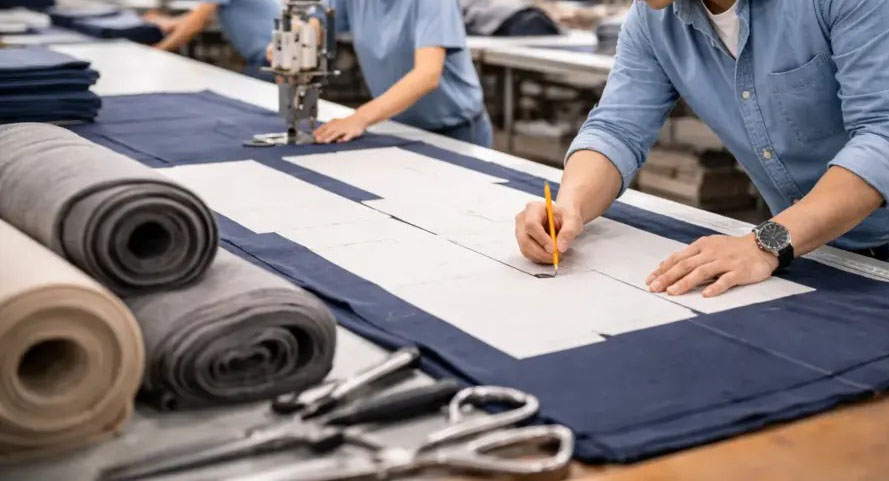
During fabric inspection and cutting preparation, factories check the fabric rolls, group shades, relax the material when needed, confirm markers, and prepare the lay plan. These steps reduce cutting errors and help maintain quality in bulk production.
In industrial shirt manufacturing, cutting is more than separating fabric into parts. It is a precision stage. If the fabric is cut incorrectly, later operations cannot fully correct the issue.
At Fusionknits, we pay close attention to preparation before cutting because fabric defects, shade variation, and poor marker planning can spread across the entire order if not controlled early.

Main steps before cutting begins
- Inspect fabric rolls
- Check for shade variation
- Relax the fabric if required
- Confirm pattern marker
- Plan fabric lays
- Cut panels by size
- Sort bundles for sewing
Why fabric inspection matters
A shirt often includes multiple visible panels such as front body, back body, collar, cuff, yoke, and sleeves. If fabric defects or shade differences appear across these parts, the final shirt may look inconsistent.
Risks controlled at this stage
- Shade difference
- Fabric flaws
- Off-grain cutting
- Marker inefficiency
- Panel mismatch
- Size mixing in bundles
| Cutting control point | Why it matters |
|---|---|
| Fabric inspection | Reduces visible defects in final garments |
| Shade grouping | Keeps garment panels visually consistent |
| Marker planning | Improves material efficiency |
| Cut precision | Protects fit and assembly accuracy |
| Bundle control | Supports smooth sewing line organization |
Strong cutting preparation creates better conditions for sewing quality and production efficiency.
How is a shirt assembled on an industrial sewing line?
A shirt is assembled through a sequence of specialized sewing operations. Each operation is controlled to maintain structure, appearance, and productivity.
A shirt is assembled on an industrial sewing line by joining prepared fabric panels in a planned order, usually including collar construction, yoke joining, placket making, sleeve setting, side seam closing, cuff assembly, hemming, and trim attachment.
Industrial sewing lines divide the shirt into operations so workers and machines can focus on repeatable tasks. This improves speed and consistency. But it also means the process must be organized carefully. One poor operation can affect the next several steps.
At Fusionknits, we manage sewing quality through operation control, machine setup, and in-line checking. Shirt construction requires more precision than many basic tops because it includes shaped parts, topstitching, and visible structural details.
Common sewing operations in shirt manufacturing
- Join shoulder or yoke panels
- Make front placket
- Attach collar stand and collar
- Attach sleeves
- Close side seams
- Make and attach cuffs
- Hem bottom edge
- Attach labels
- Sew buttonholes
- Attach buttons
Details that strongly affect shirt quality
Collar construction
The collar is one of the most visible parts of a shirt. It must hold its shape well and sit cleanly after pressing.
Placket alignment
A crooked front placket weakens the appearance of the whole garment.
Seam accuracy
Balanced seams improve comfort, appearance, and size consistency.
Topstitch quality
Clean topstitching supports a more professional finish, especially on collars, cuffs, plackets, and pockets.
Trim attachment
Buttons, labels, and decorative elements must be attached securely and placed correctly.
What factories monitor during sewing
- Seam smoothness
- Stitch density
- Thread tension
- Needle damage
- Symmetry of visible parts
- Matching between left and right components
- Buttonhole quality
- Button attachment strength
A well-run sewing line does more than finish garments quickly. It builds repeatable quality into every unit.
How do finishing processes improve the final shirt?
After sewing, the shirt still needs finishing. This stage improves appearance, corrects minor surface issues, and prepares the garment for inspection and packing.
Finishing improves the final shirt through thread trimming, pressing, shaping, cleaning, and detail correction. It helps the garment look polished, supports retail presentation, and prepares it for final quality control.
Shirts are highly visible garments. Buyers and end users often judge quality first by appearance. Even if the sewing is technically correct, poor finishing can make the shirt look weak or careless.
At Fusionknits, finishing is treated as a controlled process, not as last-minute cleanup. The aim is to make sure the garment reflects the approved product standard before it reaches inspection.
Common finishing steps in shirt manufacturing
- Trim loose threads
- Remove stains or marks
- Press collar and cuffs
- Shape placket and hem
- Check visible appearance
- Rework minor issues where possible
Why pressing matters so much
Shape control
Pressing helps the collar, cuff, placket, and body panels sit properly.
Appearance improvement
A well-pressed shirt looks cleaner and more structured.
Packing readiness
The garment folds better and presents better after proper finishing.
Common finishing problems if control is weak
- Uneven pressing marks
- Wrinkles at placket or sleeve
- Loose threads left visible
- Collar shape inconsistency
- Surface stains not removed
A strong finishing process adds value to the shirt and supports the final quality impression.
How do factories control quality before packing and shipment?
Final quality control confirms whether the bulk order matches the approved standard. It checks the shirt as a finished product, not just as separate operations.
Factories control quality before packing and shipment by inspecting measurements, workmanship, fabric appearance, trim attachment, labeling, folding, assortment, carton details, and packing accuracy. This helps reduce returns, claims, and delivery problems.
Quality control should exist throughout production, but final inspection remains essential. It is the last checkpoint before the garments leave the factory.
At Fusionknits, we review shirts not only for visible defects, but also for consistency across the order. A shipment is only reliable when the product, labeling, and packing all meet the agreed standard.
Main inspection points before packing
- Measurement against approved spec
- Collar and cuff appearance
- Sewing quality
- Button and buttonhole quality
- Fabric flaws
- Stains or oil marks
- Label accuracy
- Folding quality
- Carton quantity and shipping marks
Common defects found during final inspection
| Defect | Likely impact |
|---|---|
| Crooked placket | Poor visual presentation |
| Loose button | Functional complaint |
| Uneven collar | Low-quality appearance |
| Wrong label | Inventory and retail issue |
| Shade variation | Inconsistent bulk presentation |
| Measurement out of tolerance | Fit complaints |
Why packing control also matters
- It protects garments during transport
- It supports easier warehouse handling
- It reduces sorting and receiving mistakes
- It improves presentation for wholesale or retail customers
A shirt is not truly ready until product quality and packing quality are both confirmed.
Why does process control matter so much in industrial shirt manufacturing?
Industrial shirt manufacturing depends on repeatability. Buyers do not order one shirt. They order hundreds or thousands of units that need to match the same approved standard.
Process control matters because it keeps shirt production stable across bulk orders. It helps factories manage quality, control lead time, reduce waste, and deliver garments that are consistent in fit, appearance, and construction.
A shirt can fail for many reasons. The fabric may shrink too much. The collar may lose shape. The placket may become crooked. The buttons may come loose. Most of these problems do not begin at the end. They begin earlier, when one production step is not properly controlled.
At Fusionknits, we believe strong manufacturing is built on system discipline. Development, sourcing, cutting, sewing, finishing, and inspection all need to connect with each other. That is how a shirt moves from design concept to dependable wholesale product.
What buyers should expect from a capable manufacturer
- Clear product development process
- Transparent material selection logic
- Stable sample control
- Organized production flow
- In-line and final quality checks
- Reliable packing and shipment standards
When the process is managed well, the product becomes more reliable. That is the real foundation of industrial garment manufacturing.
Conclusion
Industrial shirt manufacturing involves much more than cutting fabric and sewing the parts together. It is a complete production system that starts with product development and continues through fabric selection, pattern making, sampling, cutting, sewing, finishing, inspection, packing, and shipment. Each stage has a direct effect on the final shirt, from fit and structure to consistency, durability, and delivery performance.
For buyers, understanding this process makes it easier to evaluate manufacturers, set realistic expectations, and reduce sourcing risk. For factories, strong process control is what turns a shirt design into a dependable bulk product. At Fusionknits, we believe high-quality shirt manufacturing is built on technical clarity, disciplined execution, and stable standards at every step of the industrial production process.