Men’s sweaters may look like one simple category, but in professional apparel development, they cover a wide product range. Neckline, gauge, yarn weight, stitch texture, fit, and garment function can all change the identity of the sweater. That is why one sweater may work as a clean office layer, while another serves as winter outer knitwear or a casual weekend essential.
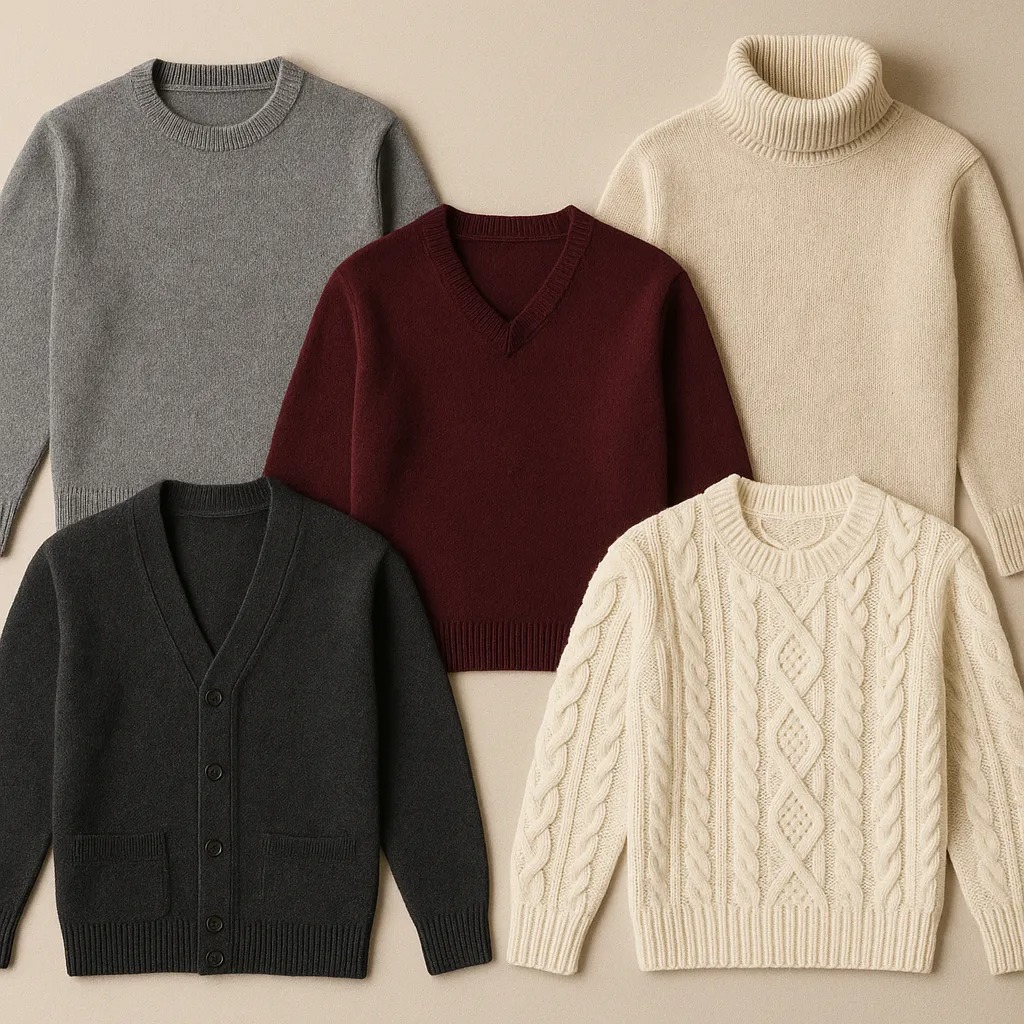
There are many types of sweaters for men, but the main categories usually include crew neck sweaters, V-neck sweaters, turtlenecks, mock neck sweaters, cardigans, quarter-zip sweaters, cable-knit sweaters, chunky sweaters, fine-gauge sweaters, and sweater vests. In manufacturing terms, these types are separated by neckline, closure, knit structure, weight, and intended use.
At Fusionknits, sweater classification is not only a styling issue. It is also a product development issue. Each sweater type requires different yarn planning, knitting programs, fit control, and finishing standards. When buyers understand the major sweater types clearly, they can build stronger collections and avoid weak category overlap.
Why are there so many different types of men’s sweaters?
A sweater is a broad knitwear category, not a single garment form. Once knitwear moves beyond the basic idea of a warm top, the category expands quickly through neckline, closure, yarn, silhouette, and seasonal function.
There are many types of men’s sweaters because sweaters can be developed in different neck shapes, weights, textures, fits, and closures. These variations allow the same knitwear family to cover casualwear, business casual, seasonal layering, fashion-forward styles, and cold-weather essentials.
This product diversity is commercially useful because it gives brands more ways to serve different markets. A fine-gauge merino crew neck, a shawl-collar cardigan, and a chunky cable sweater all belong to men’s knitwear, but they do not share the same product logic. Their yarn behavior, stitch density, trim needs, and customer use cases are very different.
At Fusionknits, sweater development usually begins by defining the role of the garment first. Is it a core basic, a refined office style, a seasonal statement knit, or a practical layering piece? That decision shapes nearly every technical choice after it.
Why the men’s sweater category expands so easily
- Neckline changes the product identity
- Knit weight changes seasonality
- Texture changes visual value
- Fit changes styling direction
- Closures create new subcategories
- Different yarns create different market levels
Why this matters in manufacturing
Not every sweater should be developed the same way
A winter chunky knit and a fine spring sweater need different machines, yarns, and finishing.
The customer uses sweaters for many different reasons
Some need polish. Some need warmth. Some need relaxed layering.
Better classification improves collection planning
Clear sweater categories reduce duplication and improve range structure.
A simple product view
| Sweater factor | Product effect |
|---|---|
| Neckline | Changes style and layering use |
| Gauge | Changes weight and drape |
| Stitch | Changes texture and value perception |
| Fit | Changes silhouette and market position |
| Closure | Creates new sweater subcategories |
That is why men’s sweaters should be understood as a category system rather than a single garment type.
What are the main neckline types of sweaters for men?
Neckline is one of the strongest ways to divide men’s sweaters because it affects both styling and product purpose. Some necklines are more classic, while others are more layered, more formal, or more winter-driven.
The main neckline types of men’s sweaters are crew neck, V-neck, turtleneck, mock neck, funnel neck, and shawl-collar or cardigan-based neckline variations. These neckline categories strongly influence how the sweater is worn and how it is positioned in the market.
Crew neck sweaters are among the broadest commercial basics because they are easy to wear and easy to layer. V-neck sweaters often work well over shirts and support business casual dressing. Turtlenecks and mock necks usually feel more refined or more winter-focused because they build more coverage at the neck.
At Fusionknits, neckline direction is often chosen before stitch texture because it immediately defines how the customer is likely to use the garment.
Main neckline sweater categories
- Crew neck sweater
- V-neck sweater
- Turtleneck sweater
- Mock neck sweater
- Funnel neck sweater
- Shawl-collar knitwear styles
Why neckline matters so much
It changes layering behavior
A V-neck works differently over a shirt than a crew neck.
It changes market use
Mock necks and turtlenecks often feel more polished or seasonal.
It changes visual balance
The neckline shapes the entire upper body impression.
Neckline overview
| Neckline type | Typical use |
|---|---|
| Crew neck | Everyday versatile basic |
| V-neck | Smart casual and layered wear |
| Turtleneck | Warm, refined, winter-focused |
| Mock neck | Modern and cleaner alternative |
| Funnel neck | More structured cold-weather use |
That is why neckline is one of the first and most important ways to classify men’s sweaters.
What are the most common core sweater styles for men?
Some sweater types form the commercial core of most men’s knitwear assortments. These are the shapes that return season after season because they work across different ages, climates, and retail levels.
The most common core sweater styles for men are crew neck sweaters, V-neck sweaters, cardigans, quarter-zip sweaters, and turtlenecks. These styles form the foundation of many men’s knitwear collections because they are practical, wearable, and easy to adapt across different yarns and fits.
Crew necks are usually the safest broad-market choice. V-necks perform strongly in smarter categories. Cardigans add front-opening flexibility. Quarter-zips create a more sporty or modern layer. Turtlenecks bring a more elevated or winter-specific product identity.
At Fusionknits, core sweater development usually focuses on these shapes first because they support the broadest commercial demand.
Core sweater types in many men’s collections
- Crew neck sweater
- V-neck sweater
- Button-front cardigan
- Zip or quarter-zip sweater
- Turtleneck sweater
Why these styles remain commercially important
They are easy to wear
Customers already understand how these garments fit into the wardrobe.
They adapt well to different markets
The same core shape can shift from premium to commercial depending on yarn and construction.
They support repeat business
Core sweater shapes often become reorder styles when executed well.
Core-style overview
| Core style | Commercial strength |
|---|---|
| Crew neck | Broadest and safest category |
| V-neck | Strong for layered smart casualwear |
| Cardigan | Flexible and seasonally useful |
| Quarter-zip | Modern and versatile |
| Turtleneck | Strong in cooler seasons |
That is why these sweater types often form the backbone of men’s knitwear programs.
Are cardigans and sweater vests counted as sweater types?
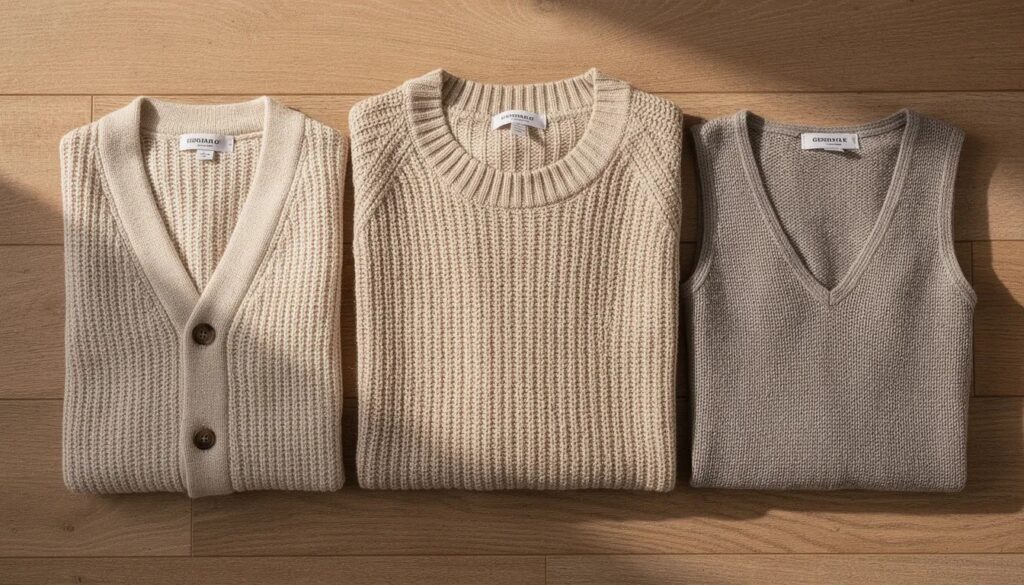
Yes. In professional knitwear language, cardigans and sweater vests both belong to the wider sweater family, even though they have different structures from pullovers.
Yes, cardigans and sweater vests are counted as sweater types because they are both knitwear garments built within the sweater category. Cardigans are front-opening sweaters, while sweater vests are sleeveless sweaters designed for layering over shirts or lightweight tops.
This matters because many people think of sweaters only as pullovers. In real product development, that is too narrow. Cardigans bring closure and front-structure variation. Sweater vests bring sleeveless layering function and often support schoolwear, officewear, and fashion-led styling.
At Fusionknits, both categories are treated as essential knitwear subgroups because they solve different wardrobe needs than standard pullovers.
Why these garments belong in the sweater family
- They use knitwear construction
- They rely on yarn and gauge planning
- They serve layering functions
- They are developed through sweater-specific technical logic
What makes them different
Cardigans open in the front
This adds plackets, buttons, zippers, or open-front construction.
Sweater vests remove the sleeves
This shifts the garment toward shirt layering and lighter structure.
Pullovers remain closed-front garments
They sit differently in both styling and construction.
Sweater-family overview
| Sweater family type | Main difference |
|---|---|
| Pullover | Closed-front sweater |
| Cardigan | Front-opening sweater |
| Sweater vest | Sleeveless sweater |
| Quarter-zip | Partial front-opening sweater |
That is why the full men’s sweater category is wider than just standard pullovers.
What is the difference between fine-gauge, mid-gauge, and chunky sweaters?
Knit weight is another major way to separate men’s sweater types. The same neckline can feel completely different depending on whether the sweater is fine, medium, or chunky in gauge.
Fine-gauge sweaters use lighter, smoother yarn structures and usually feel more polished, mid-gauge sweaters offer the broadest everyday versatility, and chunky sweaters use heavier yarns or denser knit structures to create warmer, more textured garments.
Fine-gauge sweaters often support business casualwear, cleaner layering, and premium minimal styling. Mid-gauge sweaters are the most flexible in many markets because they balance comfort and wearability. Chunky sweaters usually lean more strongly into cold weather, casual styling, and visible texture.
At Fusionknits, gauge direction is one of the first technical decisions in sweater development because it changes machine setup, yarn count, drape, and finishing requirements.
Main knit-weight categories
- Fine-gauge sweater
- Mid-gauge sweater
- Chunky sweater
- Heavy textured winter sweater
Why gauge changes the product so much
It changes warmth
Heavier knits usually trap more heat.
It changes silhouette
Fine knits drape more cleanly, while chunky knits create more volume.
It changes market role
A fine merino V-neck and a chunky cable crew neck do not serve the same customer need.
Gauge overview
| Gauge type | Typical effect |
|---|---|
| Fine gauge | Smooth, light, refined |
| Mid gauge | Balanced, broadly wearable |
| Chunky gauge | Warm, textured, casual, seasonal |
That is why men’s sweaters should always be classified by knit weight as well as by neckline or closure.
What textured sweater types are common for men?
Texture is one of the clearest ways to create value and visual depth in men’s sweaters. Even when the silhouette stays simple, the stitch can change the product identity completely.

Common textured sweater types for men include cable-knit sweaters, rib-knit sweaters, waffle-knit sweaters, fisherman-style sweaters, and other patterned knitwear styles. These sweaters usually carry stronger tactile appeal and often perform well in autumn and winter assortments.
Cable-knit sweaters are often associated with heritage or winter styling. Rib-knit sweaters can feel either classic or modern depending on scale. Fisherman-style sweaters usually carry a rugged, dense, and colder-weather identity. Waffle or structured textures may sit between casual basics and statement knitwear.
At Fusionknits, textured sweaters often require more careful programming, slower knitting, and more finishing control because the stitch itself becomes part of the product value.
Common textured sweater types
- Cable-knit sweater
- Rib-knit sweater
- Waffle-knit sweater
- Fisherman sweater
- Pattern-knit winter sweater
Why texture matters in men’s knitwear
It adds visible craftsmanship
Texture can make the garment look richer without relying on prints or heavy decoration.
It changes seasonal value
Textured sweaters often feel more winter-ready and substantial.
It supports brand identity
Texture can help define whether a sweater feels classic, rugged, premium, or fashion-led.
Texture overview
| Texture type | Typical product identity |
|---|---|
| Cable knit | Heritage and winter-driven |
| Rib knit | Flexible, from refined to casual |
| Fisherman knit | Dense, rugged, colder-season use |
| Waffle knit | Casual and textured everyday use |
That is why textured sweaters form an important part of men’s knitwear category planning.
What sweater types work best for different occasions?
Not every sweater type fits every environment. One reason men’s sweater categories are so important is that each one supports a different type of use, from officewear to weekend layering.
Different sweater types work best for different occasions: crew necks and fine-gauge V-necks often work well for daily and officewear, cardigans and quarter-zips support business casual and travel use, while chunky knits and textured sweaters perform strongly in relaxed, cold-weather, or lifestyle-focused settings.
From a product development angle, occasion use should influence both styling and technical choices. A refined office sweater usually needs smoother yarn and cleaner finish. A rugged winter sweater can carry heavier yarn and more visible texture.
At Fusionknits, occasion-based product logic is one of the best ways to organize sweater collections clearly.
Typical sweater use by occasion
- Office or business casual: V-neck, fine-gauge crew neck, cardigan
- Travel or smart casual: quarter-zip, classic cardigan, mock neck
- Weekend casual: crew neck, chunky knit, textured sweater
- Winter layering: turtleneck, chunky sweater, fisherman knit
Why occasion matters in sweater selection
It affects construction choices
A polished environment usually needs cleaner knit surfaces.
It affects yarn direction
Heavier, rustic yarns may not fit officewear as well.
It improves collection balance
When sweater types are organized by use, assortments become easier to understand and sell.
Occasion overview
| Occasion | Best sweater direction |
|---|---|
| Officewear | Fine-gauge V-neck or cardigan |
| Smart casual | Crew neck, quarter-zip, mock neck |
| Weekend casual | Chunky or textured pullover |
| Winter layering | Turtleneck or fisherman knit |
That is why occasion is one of the clearest practical ways to divide men’s sweater types.
How should buyers plan sweater categories for a men’s collection?
A strong men’s sweater assortment should not repeat one shape too many times. It should separate roles clearly so the customer can understand the range and find a suitable product for different uses.
Buyers should plan men’s sweater categories by balancing neckline types, knit weights, textures, closures, and use occasions. A strong assortment usually includes a mix of core basics, polished layering styles, casual textured pieces, and at least one more seasonal or statement knit.
At Fusionknits, the most balanced men’s knitwear ranges often begin with a core crew neck or V-neck, then add a cardigan or quarter-zip, followed by a textured or chunky style for colder seasons. This creates both commercial stability and visual variety.
Useful questions for planning sweater categories
- Is there enough core basic knitwear?
- Is there a polished option for smart casualwear?
- Is there enough winter texture or warmth?
- Does the range rely too heavily on one neckline?
- Are the yarn and gauge directions varied enough?
Why this approach strengthens a collection
It reduces duplication
Customers do not need several sweaters that all serve the same role.
It improves commercial clarity
Each sweater type has a clearer reason to exist in the assortment.
It supports wider customer needs
Different sweater categories serve different dress codes and climates.
Assortment-planning guide
| Product role | Suggested sweater type |
|---|---|
| Core basic | Crew neck or V-neck |
| Smart casual layer | Cardigan or quarter-zip |
| Winter statement knit | Cable or chunky sweater |
| Modern refined option | Mock neck or fine merino sweater |
That is how buyers can turn sweater variety into a stronger and more saleable men’s knitwear collection.
Conclusion
There are many types of sweaters for men, but the main categories usually include crew neck sweaters, V-neck sweaters, turtlenecks, mock necks, cardigans, quarter-zips, sweater vests, cable knits, chunky sweaters, and fine-gauge sweaters. These types differ through neckline, closure, knit weight, texture, fit, and intended use. In real apparel development, the category is much broader than a simple pullover. Each sweater type serves a different role in styling, seasonality, and commercial planning.
At Fusionknits, men’s sweaters are developed as a structured knitwear system rather than as isolated styles. The strongest collections balance core basics, refined layering pieces, and more textured or seasonal knitwear so that the full range feels useful, clear, and commercially complete.
When buyers understand how many sweater types exist and what each one is designed to do, they make better sourcing decisions, build better assortments, and create men’s knitwear ranges with stronger depth and stronger long-term value.