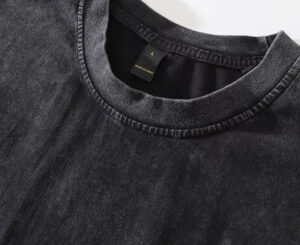
Stone washed T-shirts attract buyers because they feel softer, look older, and carry a broken-in vintage mood from the first wear. But many people misunderstand what “stone washed” really means in production. It is not just one random wash. It is a controlled garment-finishing process built around abrasion, color reduction, softness, and consistency.
At Fusionknits, we make a stone washed T-shirt by starting with the right garment-dyed or pigment-ready cotton tee, then applying controlled abrasion in a washing machine—traditionally with pumice stones, often supported or partly replaced by enzymes—followed by rinsing, softening, drying, and strict quality checks for shade, hand feel, shrinkage, and surface damage.
As a professional manufacturer, we do not treat stone wash as a decorative afterthought. We treat it as a finishing system. The result depends on the base fabric, garment construction, dye behavior, machine load, wash time, stone ratio, and softening stage. If one of those parts is wrong, the T-shirt may look uneven, lose strength, or feel rough instead of premium.
What does “stone washed” mean on a T-shirt?
Stone washing means the garment is washed with abrasive media—traditionally pumice stones—inside an industrial washing machine so the surface rubs, the color breaks down, and the fabric starts to look used rather than new.
At Fusionknits, a stone washed T-shirt is not just a faded T-shirt. It is a garment that has been intentionally abraded to create a softer hand feel, visual depth, and a more natural broken-in character.
That matters because some buyers confuse stone wash with acid wash, bleach wash, or pigment wash. Those finishes can overlap visually, but the process logic is different. Stone wash is primarily based on controlled surface abrasion, even when enzymes are added to support the effect.
What stone wash usually changes
- Surface color depth
- Softness
- Vintage appearance
- Hand feel
- Casual character
What it should not do
It should not destroy the garment
If the abrasion is too aggressive, the tee can become weak, patchy, or unstable.
It should not look random without control
A premium stone wash still needs consistency from piece to piece.
| Stone wash effect | Visible result |
|---|---|
| Surface abrasion | Faded, worn appearance |
| Fiber softening | More broken-in feel |
| Controlled washdown | Vintage casual character |
Which fabrics work best for a stone washed T-shirt?
Stone washing works best on garments that can respond well to abrasion and still hold together after repeated tumbling. Cotton-rich T-shirts are usually the strongest choice because they soften well and show surface wash effects clearly.

At Fusionknits, we prefer 100% cotton jersey or high-cotton blends for stone washed T-shirts because they respond well to abrasion, develop a more natural faded surface, and retain the casual softness customers expect from this finish.
A medium-weight combed cotton jersey often performs better than a very loose or fragile knit, because the garment must survive tumbling, rinsing, and finishing without twisting excessively or tearing at stress points.
Pigment-dyed and garment-dyed T-shirts also work especially well because they produce richer visual highs and lows during washing. But even when the color story looks attractive, the knit quality must be stable. If the jersey is too weak or too open, the wash can exaggerate problems instead of improving the garment.
Strong fabric choices for stone wash
- 100% cotton jersey
- Ring-spun cotton jersey
- Combed cotton jersey
- Cotton-rich slub jersey
- Select pigment-dyed cotton knits
Fabrics that need extra caution
Very lightweight jersey
It may become too fragile after abrasion.
Highly elastic performance knits
They usually do not produce the same authentic stone-washed look.
| Fabric type | Stone wash suitability |
|---|---|
| Medium-weight cotton jersey | High |
| Lightweight unstable jersey | Medium to low |
| Technical synthetic jersey | Low |
What is the basic process for making a stone washed T-shirt?
The core process is straightforward in theory but sensitive in execution. A standard workflow usually begins with garment preparation, then stone abrasion, rinsing, softening, drying, and final inspection.
At Fusionknits, the basic production flow for a stone washed T-shirt usually includes garment preparation, pre-wash or desize if needed, controlled stone wash in a rotary machine, multiple rinses, softening, extraction, drying, and final quality inspection.
The exact sequence changes with the dye type, target vintage level, and whether enzymes are being used.
The “stone” stage is where the visual identity is built. Pumice stones tumble with the garments and abrade the surface. Drum type, stone size, time, and stone ratio all affect the final result. Stronger abrasion increases washdown but also increases damage risk.
Typical process flow
- Prepare and sort garments
- Load garments into washing machine
- Pre-wash or desize if required
- Add stones and begin abrasion cycle
- Rinse to remove loosened dye and debris
- Add softener or finishing agent
- Extract water
- Dry and stabilize
- Inspect and pack
Why each stage matters
Pre-treatment supports consistency
A garment cannot wash evenly if the starting condition is unstable.
Rinsing and softening finish the story
Without proper rinsing and softening, the tee may feel dirty, rough, or unfinished.
| Process stage | Main purpose |
|---|---|
| Pre-wash | Stabilize garment before abrasion |
| Stone wash | Create fade and texture |
| Rinse | Remove residue and loose color |
| Softener | Improve hand feel |
| Drying | Set final body and appearance |
Why are pumice stones used, and what do they actually do?
Pumice stones are used because their rough surface physically abrades the garment during tumbling. The stones tumble with the garments, loosening surface dye and roughening the outer layer of the fabric.
At Fusionknits, pumice stones are used as the traditional mechanical tool that creates authentic irregularity. They help remove color unevenly, soften the surface, and produce the broken-in vintage look that many stone washed T-shirt buyers want.
But traditional pumice stone use comes with disadvantages. It can create sludge, increase machine wear, and raise the risk of garment damage or unwanted roughness. That is why many factories reduce stone intensity, combine stones with enzymes, or use newer no-stone or low-stone alternatives.

What pumice stones influence
- Abrasion level
- Fade character
- Surface irregularity
- Softness development
- Vintage authenticity
Why stones are not used carelessly
Too much abrasion can weaken the tee
The same action that creates character can also shorten garment life.
Cleanup is a real cost
Traditional stone washing creates waste and equipment stress.
| Stone factor | Impact |
|---|---|
| Larger stone load | Stronger abrasion |
| Longer wash time | More fading and softness |
| Poor control | Higher damage risk |
Why are enzymes often used together with stone washing?
Enzymes are used because they help remove surface fibers and improve softness while reducing some of the harshness of a purely mechanical process.
At Fusionknits, enzymes help us make the finish more refined. They support smoother washdown, cleaner softness, and better surface quality, especially when we want a vintage look without over-damaging the T-shirt.
This is one reason modern stone washed tees often feel softer than older versions of heavily abraded garments. Enzyme support can reduce the need for extreme stone pressure while still helping the shirt look washed and worn.
Why manufacturers use enzymes
- Improve softness
- Reduce surface fuzz
- Support cleaner wash effects
- Lower dependence on aggressive abrasion
- Improve finish control
Why this matters commercially
Better softness improves retail perception
A vintage tee must still feel premium in hand.
Less damage means fewer quality issues
Controlled finishing protects the garment during production.
| Enzyme role | Benefit |
|---|---|
| Surface fiber removal | Cleaner finish |
| Softness support | Better hand feel |
| Controlled washdown | More refined vintage look |
How do you control the final vintage effect?
The final look depends on several variables working together: stone size, stone ratio, machine load, wash time, temperature, garment dye type, and whether enzymes are used.

At Fusionknits, we control the vintage effect by adjusting abrasion intensity rather than relying on one fixed formula. A lighter wash needs less tumbling, fewer stones, and tighter control. A stronger vintage wash needs more abrasion, but we still limit the process carefully to protect fabric strength and seam stability.
This is why sample development matters so much. A stone washed T-shirt cannot be judged only by the idea in the design meeting. It must be sampled, washed, reviewed, and corrected. Small process changes can make a large visual difference.
Main variables that shape the look
- Stone size
- Stone-to-garment ratio
- Wash duration
- Temperature
- Enzyme support
- Dye depth of the original tee
Why sampling is essential
The same formula does not work on every fabric
Different jerseys respond differently to abrasion and dye loss.
Vintage effect is a visual target, not a generic wash
The result must match the brand’s identity.
| Process variable | Typical effect |
|---|---|
| More stones | Stronger fade |
| Longer time | More abrasion |
| Softer setting | Cleaner, lighter wash |
| Enzyme support | Better softness and polish |
What quality problems can happen in stone washed T-shirts?
Stone washing can create quality problems if the process is not controlled. For T-shirts specifically, manufacturers have to watch for seam damage, body twisting, uneven shade, excessive shrinkage, pilling, and weak areas at necklines or hems.
At Fusionknits, the biggest risks in stone washed T-shirts are uneven color, fabric weakness, excessive abrasion, and poor dimensional stability. A stone wash should make the garment look older, not make it perform like a damaged reject.
This is why post-wash inspection is essential. A tee may look visually attractive but fail in real wear if shrinkage or seam distortion is too severe. Vintage appeal should never come at the cost of basic garment integrity.
Common quality risks
- Uneven shade
- Abrasion holes
- Neck rib distortion
- Side seam twisting
- Excessive shrinkage
- Surface weakness
Why inspection must be strict
The wash can hide technical problems
A distressed look can sometimes mask damage if the QC team is not disciplined.
Vintage is not the same as defective
The customer still expects durability and comfort.
| Risk area | What to check |
|---|---|
| Shade | Consistency across the batch |
| Fabric strength | No over-washed weak spots |
| Measurements | Controlled shrinkage |
| Seams and rib | Stability after wash |
How do you finish and package a stone washed T-shirt properly?
After washing, the garment needs proper softening, drying, and final stabilization.
At Fusionknits, finishing is what turns a washed garment into a sellable premium product. After the wash effect is achieved, we focus on hand feel, dimensional recovery, clean drying, trimming, pressing if needed, and final inspection before packing.
A stone washed T-shirt should feel soft and look natural, not stiff or overprocessed. Packaging also matters. Because stone-washed tees often have a premium casual story, folding, shade grouping, and wash-description labeling should support that value in retail presentation.
Conclusion
A stone washed T-shirt is made by taking a cotton-based garment and applying controlled abrasion—traditionally with pumice stones, often with enzyme support—inside industrial washing equipment to create a softer hand feel and a worn, vintage appearance. The process usually includes preparation, abrasion, rinsing, softening, drying, and strict quality control. While traditional pumice stone washing remains the classic method, modern factories often combine it with enzymes or lower-impact alternatives to reduce damage, sludge, and machine wear.
At Fusionknits, we approach stone washed T-shirts as a manufacturing system, not just a fashion effect. The right cotton fabric, the right dye base, the right abrasion level, and the right finishing sequence are all necessary to create a garment that looks vintage but still feels premium and wears well.
A successful stone washed T-shirt should feel softer, look naturally aged, and remain stable enough for real consumer use. That balance is what separates a strong washed product from a damaged one.