A sweatshirt can feel soft in the hand and still turn disappointing after only a few washes. Many buyers judge quality too early. They focus on first touch, logo, or weight, but real quality shows up later in shape retention, surface stability, neckline control, and overall wear performance.
A high-quality sweatshirt is made from the right fabric, balanced construction, stable fit, durable rib, clean finishing, and reliable wash performance. It should feel comfortable on day one, but more importantly, it should keep its shape, color, surface quality, and overall structure after repeated wear and laundering.
At Fusionknits, we define sweatshirt quality as a full product system. A sweatshirt is not truly high-quality because it is heavy, expensive, or branded. It becomes high-quality when fabric, fit, rib, stitching, finishing, and durability all work together in a consistent way. That is what turns a basic garment into a dependable long-term product.
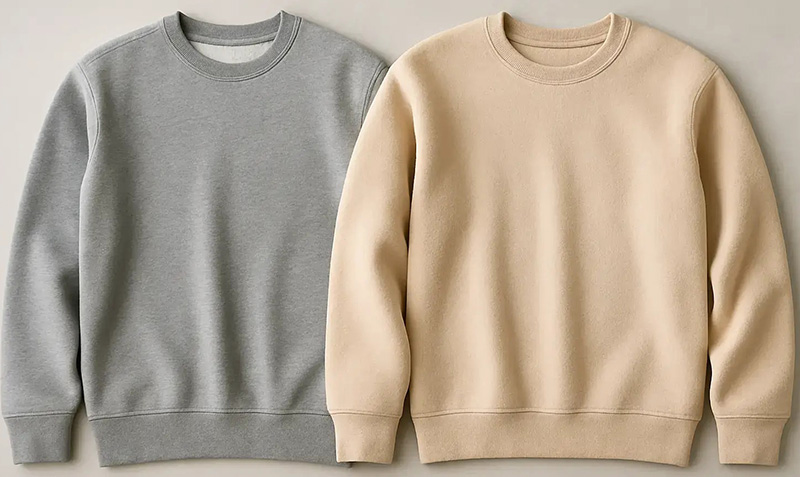
Why Is Sweatshirt Quality More Than Just Fabric Weight?
Many customers assume a heavier sweatshirt must be a better sweatshirt. Weight can help, but it is not a complete answer. A heavy garment can still feel rough, shrink badly, pill quickly, or lose balance after washing.
Sweatshirt quality is more than fabric weight because true quality depends on fabric composition, yarn quality, knit structure, construction accuracy, rib recovery, fit consistency, and wash durability. A heavyweight sweatshirt can still be low-quality if the material and build are weak.
Sweatshirt quality is cumulative. One strong feature cannot fully hide three weak ones. A dense fleece may feel impressive in hand, but if the neckline stretches out or the cuffs lose recovery, the product still fails. This is why professional product review always goes deeper than GSM alone.
At Fusionknits, sweatshirt quality starts with material selection, but it only becomes complete when the full garment performs correctly over time.
Why quality cannot be judged by weight alone
- Heavy fabric can still pill
- Thick material can still shrink
- Dense fleece can still have poor recovery
- A strong hand feel can still hide weak sewing
- Premium appearance can still fail in repeated wear
Why this matters for real product evaluation
First impression is not the same as long-term value
A sweatshirt must still look good after actual use.
Structural balance matters
The whole garment should stay stable, not only the body fabric.
Comfort should survive washing
Softness is useful only when it lasts.
| Quality factor | Why it matters |
|---|---|
| Fabric weight | Only one part of quality |
| Surface stability | Affects long-term appearance |
| Construction | Affects durability and shape |
| Wash performance | Proves real value |
Does Fabric Quality Decide Most of a Sweatshirt’s Value?
Yes, fabric quality is one of the biggest drivers of sweatshirt quality. It influences softness, drape, pilling, warmth, and how the garment behaves after washing. But fabric must still match the intended product role.

Yes, fabric quality decides a major part of a sweatshirt’s value because it controls comfort, warmth, breathability, pilling resistance, recovery, and wash behavior. A high-quality sweatshirt usually begins with a better fabric system, not only a better design.
At Fusionknits, a strong sweatshirt fabric should match the category. A premium basic may need loopback cotton or dense fleece. A broad commercial sweatshirt may work well in a strong cotton-poly blend. A trans-seasonal style may perform best in French terry. The best fabric is not the one with the best marketing story. It is the one that performs best in the intended use.
Strong fabric qualities in better sweatshirts
- Cleaner yarn quality
- Better knit density
- Better recovery
- More stable surface
- More reliable shrink control
- Better softness retention
Common strong sweatshirt fabric directions
Cotton-rich fleece
Strong for premium comfort and classic sweatshirt feel.
French terry
Strong for all-season wear and cleaner breathability.
Cotton-poly fleece
Strong for durability, stability, and repeated washing.
Loopback cotton
Strong for premium basics and refined casualwear.
| Fabric type | Main strength |
|---|---|
| Cotton-rich fleece | Soft warmth and premium feel |
| French terry | All-season versatility |
| Cotton-poly blend | Better recovery and durability |
| Loopback cotton | Cleaner breathable premium quality |
What Kind of Surface Quality Shows a Sweatshirt Is Better?
Surface quality is one of the quickest ways to tell if a sweatshirt is likely to wear well. A good surface should feel clean, stable, and well-finished. It should not immediately suggest pilling or fuzz breakdown after light friction.
A better sweatshirt usually shows stronger surface quality through smoother yarn appearance, lower loose-fiber release, cleaner brushing control, and a face that does not look weak or hairy too quickly. The surface should feel soft, but still controlled and durable.
At Fusionknits, we look closely at the face fabric because it often predicts long-term customer satisfaction. If the surface already looks unstable before wash testing, the sweatshirt is more likely to disappoint later. A better face usually supports better visual value, better branding results, and better long-term appearance.
Signs of stronger surface quality
- Cleaner face finish
- More compact knit appearance
- Less loose fiber shedding
- Better brushing control
- More even color take
Why surface quality matters so much
It affects pilling risk
Weak surfaces often pill faster.
It affects visual value
A cleaner face usually looks more premium.
It affects print and embroidery results
The decoration sits better on a stronger fabric surface.
| Surface issue | Likely problem |
|---|---|
| Excess fuzz | Faster pilling |
| Uneven face | Lower premium perception |
| Weak brushing | Faster aging |
| Stable smooth face | Better long-term quality |
How Important Are Construction and Stitching in a High-Quality Sweatshirt?
They are extremely important. A sweatshirt is a repeat-use garment, so seam quality and assembly consistency have a direct effect on product life. Strong fabric can still underperform in weak construction.
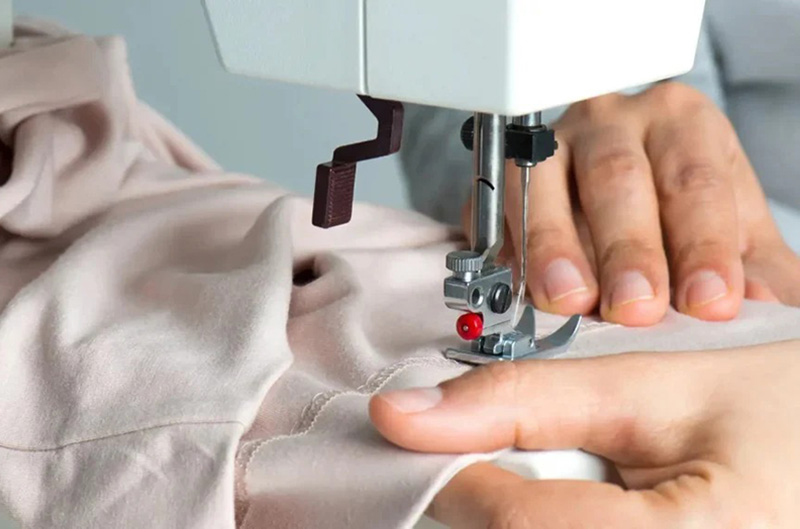
Construction and stitching are essential in a high-quality sweatshirt because they determine seam durability, neckline stability, shoulder balance, hem shape, and overall garment consistency. Clean and reliable sewing helps the sweatshirt keep its structure through repeated wear and washing.
Weak construction is one of the fastest ways a sweatshirt loses value. Side seams may twist. Necklines may ripple. Shoulder seams may lose balance. Rib attachment may feel uneven. These problems are often caused by poor sewing control, not only poor fabric.
Construction details that show stronger quality
- Clean seam consistency
- Stable shoulder assembly
- Straight side seam alignment
- Smooth neckline finishing
- Strong rib attachment
- Better topstitch balance
Why stitching matters beyond durability
It changes the silhouette
A sweatshirt should hang correctly on the body.
It affects comfort
Poorly finished seams can reduce wear comfort.
It affects wash stability
Good sewing helps the garment hold its intended shape.
| Construction area | Strong quality signal |
|---|---|
| Shoulder seam | Stable and balanced |
| Neck seam | Smooth and controlled |
| Side seam | Straight and clean |
| Rib join | Secure and even |
Does the Neckline Tell You If a Sweatshirt Is High-Quality?
Yes. The neckline is one of the clearest quality signals in the whole product. A weak neckline often stretches, waves, or loses shape early. A good neckline stays balanced and supports the garment visually.
Yes, the neckline is a strong sign of sweatshirt quality because it affects structure, comfort, and long-term appearance. A high-quality sweatshirt usually has a neckline that feels stable, sits cleanly on the body, and maintains shape after repeated wear and washing.
At Fusionknits, neckline performance is one of the first things we review in sample approval. Even a beautiful fleece can feel weak if the neck rib is too soft, too thin, or attached with poor tension. A strong neckline makes the whole sweatshirt look more intentional.
Signs of a better neckline
- Good rib recovery
- Clean opening shape
- Strong attachment to body fabric
- Balanced depth and width
- Better resistance to stretching out
Why neckline control matters so much
It frames the whole garment
The eye notices neckline balance immediately.
It affects layering
A weak neckline looks worse under jackets and coats.
It predicts long-term stability
Poor neck recovery often shows up early in use.
| Neckline behavior | Quality meaning |
|---|---|
| Stays clean after wear | Strong quality |
| Ripples or stretches fast | Weak quality |
| Balanced opening | Better fit and finish |
| Thin unstable rib | Lower long-term value |
Do Rib Cuffs and Hem Matter as Much as the Body Fabric?
Yes, absolutely. Rib components carry a lot of performance pressure. If the cuffs and hem fail, the sweatshirt often looks old much sooner, even when the body fabric is acceptable.
Yes, rib cuffs and hem matter just as much as the body fabric because they affect recovery, silhouette, comfort, and long-term product appearance. A high-quality sweatshirt should use rib that feels stable, elastic, and well matched to the main fabric.
At Fusionknits, better rib helps the garment keep its identity. The cuff should not become loose too quickly. The hem should not sag or wave after washing. These are common weaknesses in average sweatshirts and strong differentiators in better ones.
What stronger rib usually does better
- Holds cuff shape
- Maintains hem line
- Supports better body proportion
- Recovers after stretch
- Adds finish and visual discipline
What weak rib often causes
Loose cuffs
The sleeves stop looking clean.
Sagging hem
The body loses structure and premium appearance.
Reduced garment life
Even a decent fabric feels weaker when rib components fail.
| Rib behavior | Product result |
|---|---|
| Strong recovery | Better long-term quality |
| Early stretching | Lower value |
| Balanced tension | Better comfort and appearance |
| Twisting or waving | Weak trim control |
How Does Fit Affect Whether a Sweatshirt Feels High-Quality?
Fit is not only a style choice. It is also a product quality signal. A good sweatshirt should look intentional on the body. If proportions are off, even expensive fabric may not feel premium.
Fit affects sweatshirt quality because a high-quality sweatshirt should have balanced shoulders, chest ease, sleeve volume, body length, and neckline proportion. The better the fit balance, the more refined, comfortable, and dependable the sweatshirt feels.
At Fusionknits, fit should match the category. Oversized should still feel deliberate. Regular fit should still feel clean and current. A poor fit often makes the garment feel generic or unfinished, even when the fabric is otherwise good.
Fit signs of a better sweatshirt
- Balanced shoulder line
- Correct body length for category
- Comfortable chest ease
- Better sleeve proportion
- Clean neckline placement
- Proper hem and cuff relationship
Why fit changes perceived quality
Better fit looks more deliberate
The garment feels more expensive.
Better proportion improves wear comfort
The sweatshirt layers and moves more naturally.
Wrong fit weakens strong materials
A premium fabric cannot fully rescue weak pattern balance.
| Fit area | Strong quality signal |
|---|---|
| Shoulder | Natural and stable |
| Body length | Proportionate and intentional |
| Sleeve shape | Comfortable and controlled |
| Overall silhouette | Clear product identity |
Does Wash Performance Prove Real Sweatshirt Quality?
Yes. In many ways, wash performance is the most honest quality test. A sweatshirt that looks good once but fails after laundering is not a high-quality product.
Yes, wash performance proves real sweatshirt quality because a high-quality sweatshirt should resist major shrinkage, surface breakdown, twisting, color loss, and shape collapse after repeated laundering. Real quality must survive normal care, not only initial presentation.
At Fusionknits, wash testing is one of the most important quality checkpoints. A sweatshirt should still feel balanced after laundering. The body should not twist heavily. The neckline should not wave. The cuffs and hem should still recover. This is where many average products fail.
Signs of stronger wash performance
- Controlled shrinkage
- Stable color retention
- Better pilling resistance
- Stronger shape recovery
- Less twisting after wash
- Better softness retention
Why wash testing matters so much
Sweatshirts are washed often
Customers expect them to survive regular care.
Repeat wear is the real product test
Long-term consistency creates trust.
Better wash behavior protects brand credibility
A sweatshirt that holds up well supports reorder potential.
| Wash factor | Why it matters |
|---|---|
| Shrinkage control | Protects fit |
| Surface stability | Protects appearance |
| Recovery after wash | Protects structure |
| Color consistency | Protects value perception |
Do Finishing and Trims Make a Sweatshirt Feel More Premium?
Yes. Small details often separate an average sweatshirt from a strong one. These details may not define the product alone, but they strongly affect the final perception.
Yes, finishing and trims make a sweatshirt feel more premium because they improve the final experience of the garment. Better labels, cleaner inside finishing, smoother seam edges, stronger rib finish, and more controlled washing or brushing all help the sweatshirt feel more complete and more reliable.
At Fusionknits, finishing is where product discipline becomes visible. A sweatshirt may have decent fabric and fit, but weak finishing often lowers the full result. Better finishing helps the garment feel intentional, not rushed.
Better finishing signals
- Clean inside seam handling
- Better label application
- Controlled garment washing or brushing
- More even color finishing
- Cleaner rib edges
- Stronger consistency across units
Why details still matter
Customers notice them during wear
Touch points affect quality perception quickly.
Finishing affects first and repeated impressions
A cleaner product feels better every time it is worn.
The garment feels more credible and more complete.
| Detail | Quality effect |
|---|---|
| Clean inside finish | Better comfort and polish |
| Better label application | Stronger brand perception |
| Controlled wash finish | Better texture and consistency |
| Strong trim discipline | Better overall product value |
How Should Brands Judge Sweatshirt Quality Professionally?
Brands should never judge quality by one feature only. The strongest review method looks at the sweatshirt as a full system and checks whether that system still works after real use.
Brands should judge sweatshirt quality by reviewing fabric, surface stability, construction, neckline, rib recovery, fit balance, finishing, and wash results together. A high-quality sweatshirt should feel strong in hand, perform well in wear, and remain stable after repeated laundering.
At Fusionknits, we usually recommend reviewing the sweatshirt in stages. First touch matters, but testing matters more. The goal is not only to approve a good-looking sample. The goal is to confirm that the garment can repeat consistently in bulk and still satisfy the customer after actual use.
Better professional review questions
- Is the fabric dense and stable enough?
- Does the sweatshirt pill too quickly?
- Does the neckline hold shape?
- Do the cuffs and hem recover correctly?
- Is the fit consistent with the brand category?
- Does the garment shrink or twist too much?
- Does the sweatshirt still feel premium after wash testing?
Why this method works
Not all quality problems show up in the first fitting.
It protects brand trust
A better product creates stronger long-term value.
It improves production discipline
The whole line becomes more reliable.
| Review area | What to check |
|---|---|
| Fabric | Surface, density, recovery |
| Construction | Seams, neckline, rib joins |
| Fit | Balance and consistency |
| Wash performance | Shrinkage, twist, pilling |
Conclusion
A high-quality sweatshirt is made through the full balance of fabric, construction, fit, neckline control, rib recovery, finishing, and wash durability. It is not defined only by heavyweight fleece, a premium label, or a soft first-touch impression.
Strong fabric matters because it affects softness, surface stability, and long-term wear. Strong construction matters because it protects the sweatshirt’s structure. Strong fit matters because it makes the garment feel intentional and more valuable. Strong wash performance matters because it proves whether the product can survive real use.
At Fusionknits, we believe a sweatshirt becomes truly high-quality only when all these parts work together over time. A great sweatshirt should still feel comfortable, look clean, and hold shape after repeated wear and laundering. That is what gives the product real commercial value and real customer trust. In the end, quality is not one feature. It is the repeated performance of the whole garment.