In international apparel trade, CIF (Cost, Insurance, and Freight) is a widely used Incoterm in garment sourcing from China. It refers to a trade structure where the supplier is responsible for manufacturing the goods, handling export procedures, and arranging shipping and basic insurance to the destination port. In the apparel industry, CIF is commonly used for bulk shipments such as T-shirts, hoodies, and other ready-to-wear products, where logistics are partially managed by the factory. This article focuses on helping you clearly understand the CIF trade term and how it works in real garment sourcing.
What Is CIF in Apparel Trade?
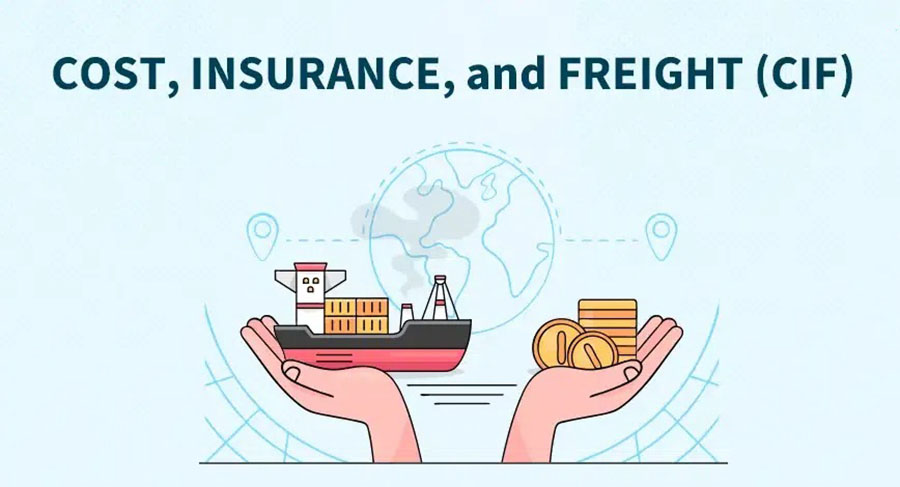
CIF stands for Cost, Insurance, and Freight, and it is widely used in international apparel sourcing between Chinese garment factories and global buyers. In simple terms, CIF means the seller is responsible for producing the garments and arranging transportation to the destination port, including ocean freight and basic insurance.
In apparel trade, CIF is commonly used when buyers prefer the supplier to handle most of the export and shipping process, reducing the need to coordinate international logistics directly.
Under CIF terms, the factory manages the full process up to the destination port, while the buyer mainly focuses on import clearance and receiving goods after arrival.
However, CIF does not mean door-to-door delivery. It only covers transportation up to the destination port, after which the buyer takes over full responsibility for import procedures and inland delivery.
CIF Shipping in Apparel Trade
To better understand how CIF works in real apparel sourcing, let’s take a practical example from the garment industry.
Assume you purchase 10,000 pieces of clothing from a factory in Guangzhou, China, and the shipment is arranged from Guangzhou Port to Los Angeles Port, USA under CIF terms.
This example clearly shows how responsibilities, costs, and risks are divided between the seller and the buyer.
Seller’s Responsibilities
Under CIF terms, the seller is responsible for all processes from production to delivery at the destination port.
The seller will:
- First complete garment production, quality inspection, and professional packaging, then arrange inland trucking from the factory to Guangzhou Port. At this stage, the goods are fully under the seller’s responsibility.
- Arrange export customs clearance and handle all related documentation and port procedures. The seller also bears all costs related to loading, handling, and export declaration at the port.
- Book ocean freight and arrange shipment to Los Angeles Port. In addition, the seller is responsible for purchasing basic cargo insurance before the goods depart from the origin port.
Once the goods are loaded onto the vessel at Guangzhou Port, the seller’s responsibility for risk ends, even though freight and insurance have been arranged and paid.
Buyer’s Responsibilities
Under CIF terms, the buyer is responsible for the destination-side process after shipment is in transit.
The buyer will:
- Pay for the CIF shipment based on the seller’s quotation before or during shipment arrangement, as agreed in the contract.
- Bear the transportation risk once the goods are loaded onto the vessel, meaning any damage or loss during ocean shipping is technically the buyer’s risk, although insurance may cover part of the loss.
- Handle import customs clearance upon arrival at Los Angeles Port, including obtaining necessary import licenses and paying duties, taxes, and port-related charges.
- Arrange inland transportation from the port to the final warehouse or distribution center in the destination country.
In a CIF transaction, choosing an experienced and trustworthy freight forwarder can save a significant amount of time and effort. It is often not easy for buyers to identify a reliable logistics partner among many forwarding companies, and the selection process may require considerable communication and coordination. If you does not already have a preferred freight forwarder, you can ask the seller for recommendations, as most suppliers usually have long-term cooperating freight forwarding partners who are familiar with handling CIF shipments efficiently.
When to Use CIF in Apparel Trade
CIF is commonly used in apparel sourcing when buyers prefer a more simplified import process and want the supplier to handle shipping arrangements up to the destination port. It is especially suitable for situations where the buyer does not have an established freight forwarder or limited experience in international logistics.
In garment trade practice, CIF is often chosen by small to medium-sized brands, first-time importers, or companies that want to reduce coordination work with shipping and insurance providers. By using CIF, buyers can focus more on product development and sales, while the factory manages production and international freight arrangements.
CIF is also used when buyers prefer a “port-to-port” delivery structure, meaning they are responsible only after goods arrive at the destination port, including customs clearance and inland transportation. This makes CIF a practical option for buyers who want a more predictable and less operationally complex sourcing process.
Risk Transfer in CIF
In CIF (Cost, Insurance, and Freight), the key principle is that risk transfer does not follow cost payment or shipping control. Instead, it is linked to a specific shipping milestone.
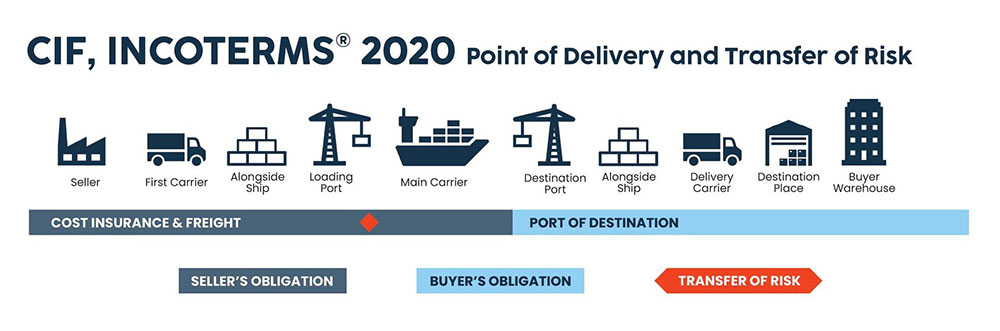
Under CIF terms, the risk transfers from the seller to the buyer once the goods are loaded onto the vessel at the port of shipment in the exporting country.
This means that even though the seller is responsible for paying ocean freight and arranging basic insurance to the destination port, the seller does not bear the transportation risk during sea freight.
Before loading onto the ship, the seller is fully responsible for any loss or damage, including production issues, inland transportation accidents, or export handling problems. After the cargo is loaded on board, the buyer assumes the risk of loss or damage during international transportation, even though insurance is usually arranged to cover potential claims.
In short, CIF risk transfer happens at the port of shipment loading stage, not at the destination port arrival.
What Is CIF Price in Apparel Trade?
In apparel international trade, CIF price refers to the total cost of goods delivered to the destination port, which includes product manufacturing cost, export handling, inland logistics, ocean freight, and insurance.
In simple terms, CIF price can be understood as:
CIF price = FOB price + ocean freight + insurance
To better understand how CIF pricing works in real garment sourcing, let’s take a practical example from China’s apparel export industry.
Assume a buyer from the United Kingdom places an order of 50,000 pieces of clothing from a factory in Dongguan, China, and the goods are shipped to Liverpool Port, UK. In most cases, goods from Dongguan are transported to a major export port in China, such as Shenzhen or Guangzhou, before being shipped internationally.
In this case, the cost structure is calculated as follows:
- FOB price includes product cost, factory-to-port transportation, export customs clearance, documentation, and handling fees
- Ocean freight is calculated from China export port to Liverpool Port
- Insurance is added based on shipment value and coverage level
Therefore, CIF price = FOB price + ocean freight to Liverpool Port + insurance
It is important to understand that ocean freight rates are not fixed. In global apparel logistics, shipping costs fluctuate due to market demand, fuel prices, and seasonal changes. For example, during peak shipping seasons (usually June to September), freight rates are significantly higher compared to off-peak periods. External events such as global supply chain disruptions can also cause extreme price fluctuations in ocean freight costs.
In addition, CIF shipments are often affected by container loading methods:
For larger shipments, FCL (Full Container Load) is usually more cost-efficient and stable, as one buyer uses a full container and freight cost is relatively predictable. For smaller shipments, LCL (Less than Container Load) is used, where goods are consolidated with other shipments, which may result in higher per-unit logistics costs due to additional handling and consolidation fees.
In general, when cargo volume exceeds approximately 20 CBM, FCL is usually recommended, while smaller or mid-sized shipments may require consultation with freight forwarders to determine the most cost-effective shipping method.
Advantages of CIF
One of the main advantages of CIF is that it simplifies the shipping process for buyers. The supplier is responsible for arranging ocean freight and insurance, which reduces the need for the buyer to coordinate with multiple logistics providers.
Another advantage is that CIF allows buyers, especially new importers, to focus more on product development and sales rather than international shipping management. This makes it easier for brands without logistics experience to start sourcing from China.
CIF also provides a clearer “delivered-to-port” cost structure, which helps buyers estimate landed costs before goods arrive at the destination port.
Limitations of CIF
One key limitation of CIF is that buyers have less control over the shipping process. Since the seller arranges freight and insurance, buyers may have limited visibility into carrier selection, shipping routes, and transit timing.
Another limitation is cost transparency. Freight rates and insurance costs are controlled by the seller’s logistics arrangement, which can vary depending on market conditions and forwarder selection.
In addition, although CIF includes insurance, it is usually based on basic coverage. If buyers require higher protection, additional insurance may be needed separately.
Finally, buyers still need to handle import clearance and inland transportation, which means CIF is not a fully simplified door-to-door solution.
CIF vs FOB vs DDP vs EXW in Apparel Trade
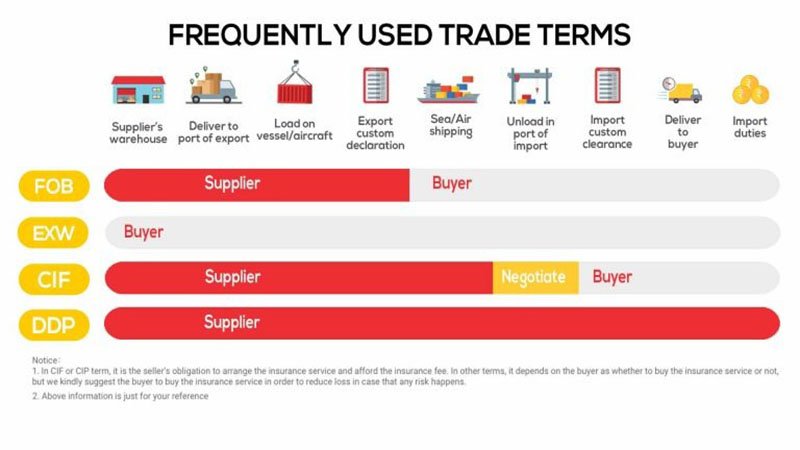
In apparel international trade, CIF is often compared with other Incoterms such as FOB, DDP, and EXW, because each term represents a different level of responsibility between buyers and suppliers.
CIF vs FOB
The main difference between CIF and FOB is who controls international shipping.
Under FOB, the buyer is responsible for arranging ocean freight and insurance after the goods are loaded onto the vessel. Under CIF, the seller handles freight and insurance up to the destination port.
In simple terms:
- FOB = Buyer controls shipping and logistics cost
- CIF = Seller controls shipping and includes freight + insurance in the price
FOB provides more transparency and cost control, while CIF offers more convenience for buyers.
CIF vs DDP
DDP (Delivered Duty Paid) is a door-to-door shipping model where the seller handles everything from factory to the buyer’s final destination.
Compared with CIF:
- CIF stops at destination port
- DDP continues to buyer’s warehouse or address
Under DDP, the seller also pays import duties, taxes, and handles full customs clearance in the destination country.
In simple terms:
- CIF = Port-to-port delivery
- DDP = Door-to-door delivery
DDP is more comprehensive, while CIF only covers shipping to port.
CIF vs EXW
EXW (Ex Works) represents the opposite end of the responsibility spectrum compared to CIF.
Under EXW:
- The seller only provides goods at the factory
- The buyer handles everything from pickup, export, shipping, insurance, and import
Under CIF:
- The seller handles production, export, freight, and insurance to destination port
- The buyer only handles import clearance and inland logistics
In simple terms:
- EXW = Buyer handles everything
- CIF = Seller handles most logistics up to destination port
EXW gives buyers maximum control but also maximum responsibility, while CIF reduces buyer workload but limits control over logistics decisions.
Conclusion
CIF is a widely used Incoterm in global apparel trade that allows garment suppliers to manage production, export procedures, ocean freight, and insurance up to the destination port. It is particularly suitable for buyers who prefer a simplified sourcing process without managing international logistics directly.
For apparel brands, understanding CIF clearly helps avoid misunderstandings in cost structure, risk transfer, and logistics responsibilities.
We support global fashion brands with flexible CIF and FOB solutions, providing end-to-end garment manufacturing and export coordination to ensure smooth and reliable delivery from China to global markets.Our goal is to help clients achieve stable, efficient, and scalable apparel sourcing from China to global markets.