
In international apparel trade, DAT (Delivered At Terminal) is one of the Incoterms used to define how responsibilities, costs, and logistics are allocated between garment manufacturers and global buyers. It is commonly applied in global clothing shipments such as T-shirts, hoodies, sweatpants, jackets, and other ready-to-wear apparel exported from China to international markets.
DAT is defined by the International Chamber of Commerce (ICC) as a trade term that specifies delivery when goods are unloaded at a named terminal in the destination country. It clearly outlines the point at which responsibility transfers from the seller to the buyer during the shipping process.
DAT has evolved from earlier Incoterms such as DES (Delivered Ex Ship) and DEQ (Delivered Ex Quay), and was later updated in Incoterms 2010 and renamed as DPU (Delivered at Place Unloaded) in Incoterms 2020 to better reflect its actual meaning and delivery conditions.
This article explains what DAT means in apparel trade and how it works in real garment sourcing.
What Is DAT in Apparel Trade ?
DAT (Delivered At Terminal) is an Incoterm in international trade where the seller is responsible for delivering the goods to a named terminal in the destination country and unloading them there. In apparel sourcing, this terminal can be a port container yard, airport cargo terminal, or inland logistics hub, depending on the agreed delivery location.
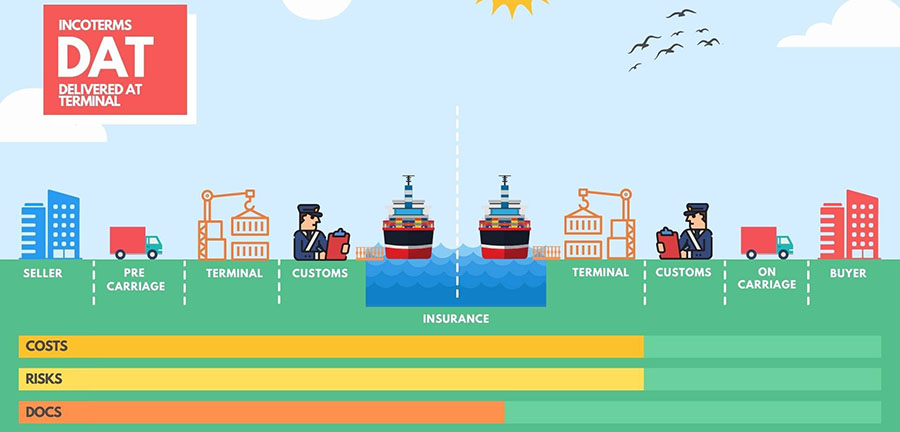
Under DAT terms, the seller takes responsibility for almost the entire logistics process from production to destination terminal delivery. This includes garment manufacturing, quality control, export customs clearance in the origin country, inland transportation to port, international freight, and arranging unloading at the destination terminal.
For example, if you are purchasing apparel from China under DAT terms, the supplier will manage the full shipment process and ensure that your goods arrive and are unloaded at the agreed terminal in your country. You do not need to arrange international freight or coordinate shipping logistics, as these are handled by the seller.
In terms of risk, under DAT, the seller bears all risks until the goods are fully unloaded at the destination terminal. This means that any loss or damage during production, export handling, or international transportation remains the responsibility of the seller until the delivery point is completed.
Once the goods are unloaded at the named terminal, the risk transfers to you as the buyer, and you become responsible for import customs clearance, duties, taxes, and inland transportation to your final destination.
How DAT Works in Apparel Trade ?
In real apparel manufacturing and export operations, DAT is used as a structured delivery model where the seller manages almost the entire logistics chain until the goods are physically delivered and unloaded at a named terminal in the buyer’s country.
The process usually begins with production. If you place an order such as 12,000 pieces of T-shirts from a garment factory in China, the supplier first handles fabric sourcing, cutting, sewing, printing, finishing, and final quality inspection based on your approved specifications. Once production is completed, goods are packed and prepared for export.
Next, the seller manages all export logistics in the origin country. This includes carton labeling, export customs declaration, booking shipping space, and arranging inland transportation from the factory to the designated export port. After that, the goods are shipped internationally under the seller’s responsibility.
During the international transportation stage, the seller also coordinates freight and ensures that the shipment reaches the destination country. Unlike FOB, you do not need to select a freight forwarder or manage shipping schedules, as the logistics flow is fully controlled by the supplier.
Finally, under DAT terms, the seller is responsible for delivering and unloading the goods at the agreed destination terminal, such as a port container yard or logistics hub. Once unloading is completed at that terminal, the delivery obligation under DAT is considered fulfilled.
Key Features of DAT
DAT (Delivered At Terminal) has several clear characteristics in apparel sourcing that distinguish it from other Incoterms such as FOB, CIF, and EXW.
- DAT places maximum logistics responsibility on the seller before the goods arrive at the destination terminal. The seller is responsible for production, export clearance, international freight, and even unloading at the named terminal, which significantly reduces the buyer’s involvement in shipping coordination.
- DAT has a clearly defined delivery point, which is the destination terminal. This means the risk transfer is not based on shipment departure, but only occurs after the goods are physically unloaded at the agreed terminal in the buyer’s country.
- DAT simplifies the procurement process for buyers. Since the seller manages most of the logistics chain, buyers do not need to deal with freight forwarders, shipping bookings, or carrier selection, making it easier for less experienced importers to handle international apparel sourcing.
- DAT still requires the buyer to handle import-related procedures, including customs clearance, duties, taxes, and inland transportation after the goods arrive at the terminal. This makes DAT a “controlled delivery-to-terminal” model rather than a full door-to-door service.
Advantages and Limitations of DAT for Buyers
In apparel sourcing, DAT offers a mix of convenience and limitations for buyers, depending on their experience and logistics capability.
Advantages for Buyers
1. Reduced logistics complexity
Under DAT terms, the seller handles almost the entire shipping process, including export procedures, international freight, and unloading at the destination terminal. This significantly reduces the operational workload for buyers, especially those who do not have established freight forwarding networks.
2. Easier entry for new importers
DAT is particularly suitable for first-time or less experienced apparel buyers, as it removes the need to coordinate international shipping. Buyers can focus more on product selection, pricing, and market development instead of managing logistics details.
Limitations for Buyers
1. Limited control over logistics decisions
Since the seller manages freight and shipping arrangements, buyers have less visibility and control over carrier selection, transit routes, and shipping costs. This may reduce flexibility in optimizing total landed cost.
2. Responsibility starts at terminal only, not final delivery
Although DAT covers delivery to and unloading at the destination terminal, buyers still need to handle customs clearance and inland transportation. This means additional coordination is still required before goods reach the final warehouse.
Advantages and Limitations of DAT for Sellers
In apparel export operations, DAT (Delivered At Terminal) also brings both operational advantages and certain limitations for the seller, especially in terms of responsibility scope and logistics management.
Advantages for Sellers
1. Stronger control over the logistics chain
Under DAT terms, the seller manages the entire process from production to delivery at the destination terminal. This allows better coordination of production schedules, shipping arrangements, and delivery timing, reducing the risk of delays caused by external logistics providers.
2. Higher value-added service capability
By offering DAT, sellers can provide a more complete shipping solution to buyers, including freight and unloading at destination terminal. This can increase competitiveness in international markets and make it easier to attract buyers who prefer simplified sourcing solutions.
Limitations for Sellers
1. Higher cost and operational responsibility
DAT requires the seller to bear nearly all logistics costs and risks until unloading at the destination terminal. This increases financial exposure and operational burden, especially when freight rates fluctuate.
2. Greater dependency on international logistics performance
Since the seller is responsible for shipping and unloading at the destination, any delays, port congestion, or carrier issues directly impact the seller’s responsibility. This requires stronger coordination with freight forwarders and increases operational complexity.
DAT vs DDP vs DAP in Apparel Trade
In international apparel sourcing, DAT is often compared with DDP and DAP because all three terms define delivery responsibilities beyond the factory level. However, the key difference lies in how far the seller’s responsibility extends and who handles import clearance and taxes.
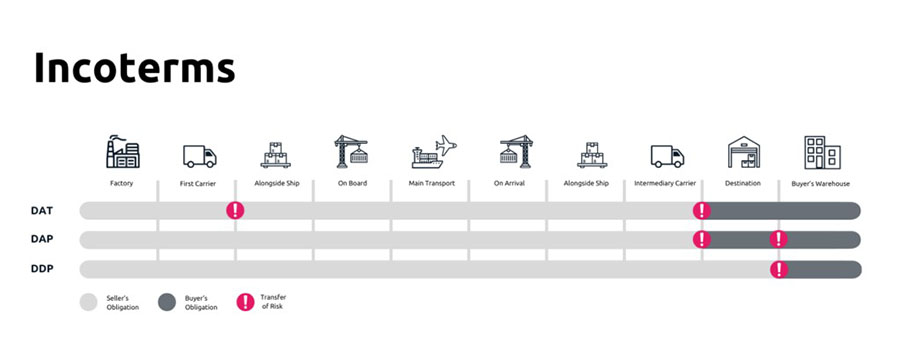
DAT vs DDP
The main difference between DAT and DDP is the handling of import duties and final delivery responsibility.
Under DAT (Delivered At Terminal):
- The seller delivers goods and unloads them at a named terminal in the destination country
- The buyer is responsible for import customs clearance
- The buyer also pays import duties and taxes
- Delivery ends at the terminal, not the final address
Under DDP (Delivered Duty Paid):
- The seller is responsible for everything, including import duties and taxes
- The seller handles customs clearance in the destination country
- The seller delivers goods directly to the buyer’s final location (door-to-door)
Key difference:
- DAT ends at the terminal
- DDP ends at the buyer’s final address with all costs included
DDP is a fully “all-inclusive” model, while DAT still leaves import obligations to the buyer.
DAT vs DAP
The difference between DAT and DAP is mainly about unloading responsibility and delivery point definition.
Under DAT (Delivered At Terminal):
- The seller is responsible for transportation AND unloading at the destination terminal
- Risk transfers only after goods are unloaded at the terminal
Under DAP (Delivered At Place):
- The seller delivers goods to a named place (such as warehouse or distribution center)
- However, the seller is NOT responsible for unloading
- Unloading is handled by the buyer
Key difference:
- DAT includes unloading at terminal
- DAP does not include unloading responsibility
Conclusion
DAT is an important Incoterm in international apparel trade that clearly defines delivery at a destination terminal with unloading included. It helps simplify logistics for buyers while ensuring that sellers manage most of the transportation process up to the final terminal point.
Understanding how DAT works, including its responsibilities, risk transfer point, and operational structure, can help apparel brands make more informed sourcing decisions and avoid misunderstandings in global trade.
As a professional garment manufacturing company, we have extensive experience in apparel production and international export, and we are able to provide comprehensive solutions to support your business across product development, manufacturing, and global shipping coordination. If you need any assistance or have any questions regarding DAT or apparel sourcing from China, please feel free to contact us at any time.