T-shirt printing looks simple from the outside, but the process depends on much more than one printer and one design file. If the equipment setup is incomplete, the print quality becomes unstable, production speed drops, and the final garment may fail in wash performance or visual consistency.
The equipment needed for T-shirt printing depends on the printing method, but the main setup usually includes artwork preparation tools, printing equipment, curing or heat-setting equipment, pre-treatment equipment where required, drying or finishing equipment, and quality control tools. A complete printing line must support both print appearance and production stability.
At Fusionknits, T-shirt printing is treated as a controlled production process, not only as a decoration step. The right equipment depends on whether the project uses screen printing, heat transfer, DTG, DTF, sublimation, or another print method. Each route requires its own technical setup, workflow, and quality controls.
Why does the printing method decide what equipment is needed?
Not all T-shirt printing uses the same production route. A machine that works well for one method may be completely unsuitable for another.
The printing method decides what equipment is needed because each process applies ink, film, transfer, or dye in a different way. Screen printing, DTG, DTF, and heat transfer all require different machines, curing systems, preparation steps, and quality controls.
From a manufacturing perspective, equipment planning should always begin with the print method. A supplier cannot build the right printing setup until the decoration route is clear. A cotton fashion tee with water-based screen printing needs a very different setup from a polyester performance tee using sublimation or a small-run custom order using DTG.
At Fusionknits, print equipment decisions are usually linked to four practical questions: what fabric is being used, what artwork is required, what order quantity is planned, and what durability level is expected.
Main T-shirt printing methods that affect equipment choice
- Screen printing
- DTG printing
- DTF printing
- Heat transfer printing
- Sublimation printing
- Vinyl heat transfer in small applications
Why method choice matters so much
It changes the production flow
Some print methods need more manual preparation, while others depend more on digital equipment.
It changes the curing system
A print must be fixed properly to the garment, and different methods require different temperatures and timing.
It changes cost and speed
The equipment investment and production efficiency can vary greatly between methods.
A simple method-to-equipment view
| Printing method | Main equipment direction |
|---|---|
| Screen printing | Screens, press, dryer, exposure unit |
| DTG | DTG printer, pretreatment machine, heat press or dryer |
| DTF | DTF printer, powder shaker, curing unit, heat press |
| Heat transfer | Printer or transfer source, cutter in some cases, heat press |
| Sublimation | Sublimation printer, transfer paper, heat press |
This is why printing equipment should never be selected in isolation. It has to match the actual print route.
What basic artwork and pre-production equipment is needed before printing starts?
Printing quality does not begin at the machine. It begins before production, during artwork preparation and print planning.

Before T-shirt printing starts, the basic pre-production equipment usually includes a computer, graphic design software, color-separated artwork tools where needed, RIP software for digital printing, and file preparation systems that match the chosen print method.
Artwork quality affects print sharpness, placement, color separation, and production efficiency. If the artwork file is weak, even a good printing machine may produce poor results. This is especially important in B2B production, where print consistency and approval accuracy matter.
At Fusionknits, artwork preparation is treated as part of print production because the file quality directly affects the machine output and the print approval process.
Basic pre-production tools often needed
- Computer workstation
- Graphic design software
- Color separation setup for screen printing
- RIP software for digital methods
- Artwork approval and layout tools
- Print placement templates
Why pre-production equipment matters
It controls print accuracy
Artwork must match the intended size, resolution, and location on the garment.
It supports production efficiency
A strong file setup reduces correction time and prevents avoidable errors.
It improves approval control
Buyers often need mockups, strike-offs, or layout confirmations before bulk printing starts.
Pre-production equipment and its role
| Equipment | Main purpose |
|---|---|
| Computer workstation | Artwork preparation and production planning |
| Design software | Graphic editing and print setup |
| RIP software | Color and output control in digital printing |
| Layout templates | Placement consistency |
| Approval tools | Sample and strike-off confirmation |
A printing line becomes more reliable when pre-production is treated as part of the equipment system, not as an afterthought.
What equipment is needed for screen printing on T-shirts?
Screen printing remains one of the most common decoration methods in large-volume T-shirt production. It is especially useful for bold graphics, spot colors, and commercially stable runs.
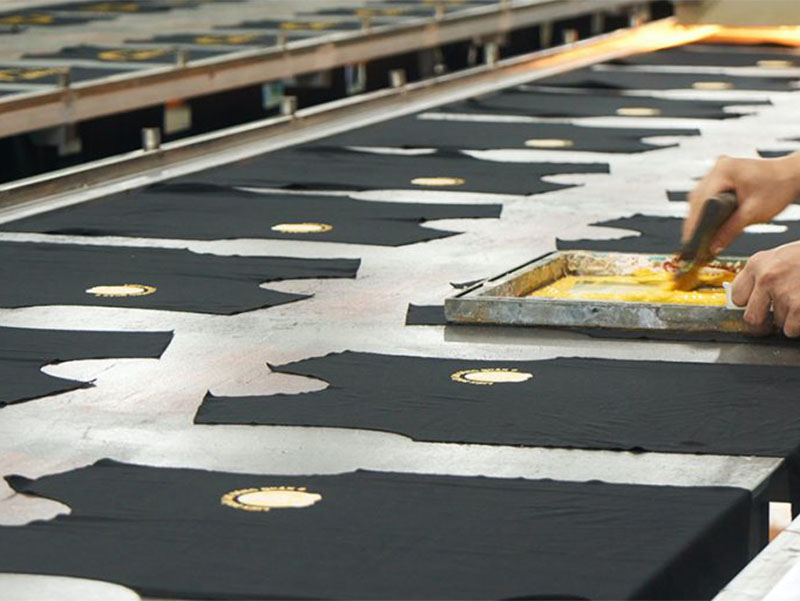
The equipment needed for screen printing on T-shirts usually includes screens, an exposure unit, screen coating tools, a screen printing press, squeegees, pallets, inks, flash cure units, and a conveyor dryer. This setup supports both manual and automatic printing lines depending on production scale.
Screen printing is not one machine. It is a complete system. The artwork must be separated, the screens must be prepared, the press must register colors correctly, and the print must be cured properly after application.
At Fusionknits, screen printing is often preferred for larger orders because it offers good efficiency, solid wash durability, and strong color consistency when the setup is managed correctly.
Core screen printing equipment
- Screen frames
- Mesh screens
- Emulsion coating tools
- Exposure unit
- Washout booth
- Printing press
- Squeegees
- Pallets and platen adhesive
- Flash cure unit
- Conveyor dryer
Supporting equipment that also matters
Registration tools
These help align colors accurately in multi-color prints.
Ink mixing equipment
This supports color accuracy and repeatability.
Drying and curing systems
Without proper curing, even a visually strong print can fail in wash testing.
Screen printing equipment overview
| Equipment | Function |
|---|---|
| Screen frame and mesh | Holds stencil for ink transfer |
| Exposure unit | Creates the image on screen |
| Printing press | Applies the print to the shirt |
| Flash cure unit | Gels layers during multi-color printing |
| Conveyor dryer | Fully cures the finished print |
A screen printing setup becomes commercially strong when the whole line works together, not just the press itself.
What equipment is needed for DTG printing?
DTG printing is often used when the order quantity is small, the artwork is complex, or the customer needs photo-like detail. It is popular in custom and on-demand production.
The equipment needed for DTG printing usually includes a DTG printer, pretreatment machine or spray unit, heat press or curing equipment, RIP software, platen system, and maintenance tools for printhead care and ink management.
DTG works differently from screen printing because the ink is applied directly onto the garment through a digital print process. This allows more flexibility in artwork detail, but it also means the fabric, pretreatment, and curing process must be controlled carefully.
At Fusionknits, DTG is usually more suitable for smaller runs, short lead-time development, or artwork that would be inefficient to separate for screens.
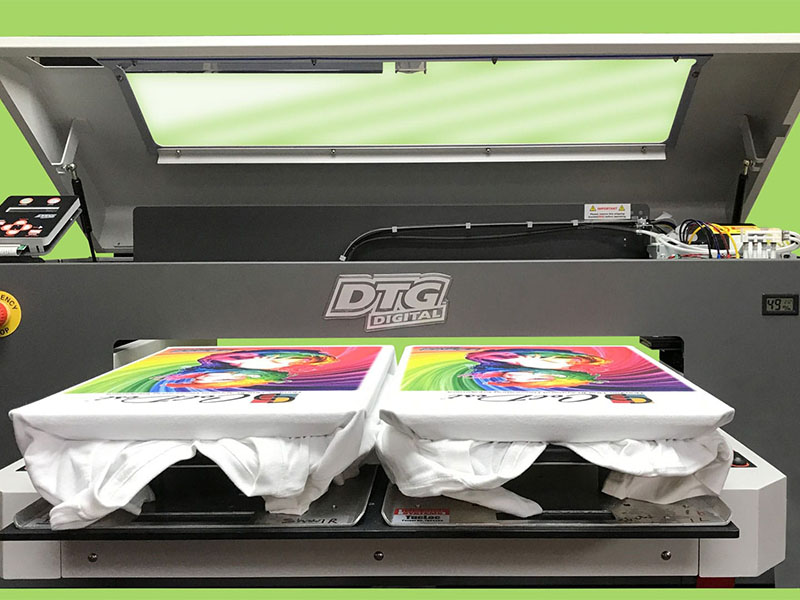
Main DTG equipment
- DTG printer
- Garment platen system
- Pretreatment machine or manual sprayer
- Heat press or conveyor dryer
- RIP software
- Computer workstation
Supporting DTG equipment
Humidity and maintenance control
DTG equipment often needs stable maintenance conditions for better output consistency.
Cleaning and printhead care tools
Without proper upkeep, print quality can drop quickly.
Test print and color management tools
These help confirm output quality before production runs.
DTG setup overview
| Equipment | Function |
|---|---|
| DTG printer | Prints ink directly onto garment |
| Pretreatment machine | Prepares fabric surface, especially for dark garments |
| Heat press or dryer | Sets and cures the print |
| RIP software | Controls print output and color management |
| Maintenance tools | Protects print quality and machine condition |
A DTG line is only as stable as its preparation and maintenance routine.
What equipment is needed for DTF printing?
DTF has become more widely used because it allows flexible print application onto garments through film transfer. It is especially useful when a business needs detailed graphics with broad material compatibility.
The equipment needed for DTF printing usually includes a DTF printer, PET transfer film, powder adhesive system, powder shaker and curing unit, heat press, RIP software, and post-print handling tools.
DTF printing does not print directly onto the shirt. Instead, the design is printed onto a film, coated with adhesive powder, cured, and then transferred to the garment with heat and pressure.
At Fusionknits, DTF can be useful for flexible production planning, especially when print detail is important and the order quantity does not justify full screen setup.
Core DTF equipment
- DTF printer
- PET transfer film
- Adhesive powder system
- Powder shaker
- Curing unit
- Heat press
- RIP software
Supporting DTF equipment
Film handling tools
These help protect transfer quality before application.
Heat transfer alignment tools
Placement accuracy still matters in DTF, especially in branded garments.
Press pressure and temperature controls
Poor transfer settings can lead to peeling or poor hand feel.
DTF equipment summary
| Equipment | Function |
|---|---|
| DTF printer | Prints image onto transfer film |
| Adhesive powder system | Prepares design for garment bonding |
| Curing unit | Sets powder on the film |
| Heat press | Transfers the design onto the shirt |
| RIP software | Controls file output and print quality |
DTF works best when the film preparation and transfer stages are both controlled carefully.
What equipment is needed for heat transfer and vinyl printing?
Heat transfer methods are commonly used for small runs, personalization, sports numbering, and simple logo applications. The equipment can be more compact than other print setups, but the process still needs control.
The equipment needed for heat transfer and vinyl printing usually includes a heat press, transfer paper or transfer film, printer in some workflows, cutting plotter for vinyl applications, weeding tools, and alignment tools for garment placement.
Heat transfer is not always the same thing. Some processes use printed transfers. Others use cut vinyl. Both require pressure and temperature control to apply the design properly to the garment.
At Fusionknits, heat transfer methods are usually selected for specific product types rather than for all-purpose T-shirt decoration.
Main heat transfer equipment
- Heat press machine
- Transfer paper or transfer film
- Printer for transfer output in some systems
- Cutting plotter for heat transfer vinyl
- Weeding tools
- Alignment guides
Why heat press quality matters
It controls application accuracy
Pressure, time, and temperature all affect the final result.
It affects durability
If transfer conditions are weak, the print may crack, peel, or lift.
It affects production repeatability
A stable heat press helps keep output more consistent.
Heat transfer setup overview
| Equipment | Function |
|---|---|
| Heat press | Applies the design to the garment |
| Transfer media | Carries the print or cut shape |
| Plotter cutter | Cuts vinyl shapes or text |
| Weeding tools | Removes excess film |
| Placement guides | Supports consistency in positioning |
For transfer-based decoration, a simple setup can still be professional if the control points are strong.
What equipment is needed for sublimation printing?
Sublimation is mostly used on polyester garments or garments with polyester-coated surfaces. It is common in sportswear and all-over print applications.
The equipment needed for sublimation printing usually includes a sublimation printer, sublimation inks, transfer paper, heat press or calendar press, artwork preparation software, and garment alignment tools.
Sublimation does not work like screen or direct garment printing. The image is first printed onto transfer paper, then transferred with heat so the dye bonds with the polyester material. This is why fabric compatibility matters strongly.
At Fusionknits, sublimation is often considered in sportswear, teamwear, and polyester-based product programs rather than in standard cotton T-shirt lines.
Main sublimation equipment
- Sublimation printer
- Sublimation inks
- Transfer paper
- Heat press or roll-to-roll calendar press
- Artwork software
- Alignment and positioning tools
Why sublimation needs the right garment base
Fabric compatibility is critical
The method is most suitable for polyester or polyester-rich garments.
Print planning affects final quality
Registration, scaling, and transfer alignment must be correct before pressing.
Press consistency matters
Uneven pressure or heat can affect color uniformity.
Sublimation equipment summary
| Equipment | Function |
|---|---|
| Sublimation printer | Prints image onto transfer paper |
| Sublimation ink system | Creates the transferable dye image |
| Heat press or calendar press | Transfers image to fabric |
| Transfer paper | Holds the artwork before transfer |
| Alignment tools | Helps keep placement accurate |
Sublimation can deliver strong visual results, but only when the material and equipment route are suitable.
What curing, drying, and finishing equipment is needed after printing?
Printing is not finished when the design appears on the shirt. The print must still be set, cured, or bonded correctly to achieve usable production quality.
After printing, the needed equipment usually includes conveyor dryers, heat presses, flash cure units, curing ovens, cooling areas, or other finishing systems depending on the print method. Proper curing is essential for wash durability, hand feel, and production stability.
At Fusionknits, curing is treated as one of the most important parts of print quality. A design can look good when it leaves the press and still fail in washing if curing is incomplete.
Common post-print equipment
- Conveyor dryer
- Heat press
- Flash cure unit
- Cooling racks or handling tables
- Wash-test preparation tools
Why curing and finishing equipment matters
It affects wash durability
A print that is not cured correctly may crack, peel, or fade too quickly.
It affects hand feel
Overcuring or undercuring can both damage print quality.
It affects consistency
The same artwork can perform very differently if curing is unstable.
Post-print equipment overview
| Equipment | Main role |
|---|---|
| Conveyor dryer | Full print curing in screen printing |
| Heat press | Transfer application and final setting |
| Flash cure unit | Intermediate curing between print layers |
| Cooling area | Stabilizes garments after heat exposure |
A printing line is only complete when the fixing and curing stage is controlled as carefully as the printing stage itself.
What quality control equipment is needed for T-shirt printing?
Even with the right printer, poor quality control can still damage the final product. Print production needs verification, not only output.
The quality control equipment needed for T-shirt printing usually includes measurement tools, wash test tools, curing test methods, color approval standards, alignment guides, and inspection stations for checking print position, surface quality, and consistency.
At Fusionknits, print quality is evaluated as part of the garment, not as a separate visual effect. The design must be sharp, well placed, durable, and consistent across the order.
Common quality control tools
- Print placement templates
- Wash test setup
- Color approval reference
- Surface inspection lighting
- Peel or adhesion check methods where needed
- Temperature and pressure monitoring tools
Why inspection equipment matters
It prevents repeat errors
A defect found early is easier to stop before bulk output increases.
It supports consistency
The first garment and the thousandth garment should still match within standard.
It protects customer confidence
B2B buyers expect repeatability, not just one good sample.
Print inspection checkpoints
| Check area | What should be controlled |
|---|---|
| Placement | Alignment and location |
| Color | Match to approved standard |
| Surface | Sharpness, coverage, cleanliness |
| Durability | Wash and adhesion performance |
| Curing | Stability after pressing or drying |
Good print businesses do not rely on machine output alone. They rely on process control and inspection.
How should a T-shirt printing business choose the right equipment setup?
The right setup depends on the business model. A startup custom shop, a print-on-demand service, and a wholesale factory do not need the same system.
A T-shirt printing business should choose equipment based on print method, order quantity, fabric type, artwork complexity, target market, and investment level. The strongest setup is the one that matches the actual production model instead of overbuying or underbuilding the equipment line.
At Fusionknits, equipment planning is usually linked to production purpose first. If the goal is high-volume bulk printing, the setup should support speed and repeatability. If the goal is custom small-run printing, the setup should support flexibility.
Questions that help define the right setup
- What print method will be used most often?
- What fabrics will be printed?
- What order quantities are expected?
- How many colors are needed?
- Is the business focused on custom orders or bulk production?
- What durability level does the market expect?
A practical setup logic
For bulk spot-color production
Screen printing equipment usually offers stronger efficiency.
For small custom full-color orders
DTG or DTF may be more practical.
For sports and polyester printing
Sublimation may be the better route.
For names, numbers, and simple branding
Heat transfer systems can be effective.
Equipment planning guide
| Business model | Most suitable equipment direction |
|---|---|
| Bulk commercial printing | Screen printing line |
| Small-run custom printing | DTG or DTF setup |
| Sportswear polyester printing | Sublimation setup |
| Personalization and numbering | Heat press and vinyl or transfer setup |
The strongest printing operation is usually not the one with the most machines. It is the one with the right machines for the real order flow.
Conclusion
The equipment needed for T-shirt printing depends on the print method, production scale, fabric type, and product requirements. A complete setup may include artwork preparation tools, printing machines, pretreatment systems, transfer or screen preparation equipment, curing equipment, and quality control tools. Screen printing, DTG, DTF, heat transfer, and sublimation all require different workflows and different machine combinations.
From a professional manufacturing perspective, successful T-shirt printing depends on more than one machine. It depends on building a complete production system that supports print quality, durability, consistency, and commercial efficiency.
At Fusionknits, the most effective equipment setup is always the one that matches the actual product direction, order volume, and quality standard. When the method, machine, and workflow are aligned correctly, T-shirt printing becomes much more stable, scalable, and reliable in real production.