A cardigan is not a confusing garment in the U.S., but the naming around it does change by context. In everyday speech, retail merchandising, and knitwear product development, Americans may use slightly different terms for the same garment or for closely related variations. U.S. dictionary references define a cardigan as a sweater or sweater-like knit that opens down the front, and American retailers very often merchandise the category specifically as “cardigan sweaters.”
In America, they usually call a cardigan a “cardigan” or a “cardigan sweater.” In everyday use, “cardigan” is the most direct term. In retail and product language, Americans often say “cardigan sweater,” and then add more specific labels such as button-front cardigan, open-front cardigan, cropped cardigan, or ribbed cardigan depending on the style.
At Fusionknits, this question matters because knitwear naming affects sourcing, product briefs, and sampling accuracy. A buyer may say “cardigan,” “cardigan sweater,” or “button-front cardigan,” and the general garment family is still the same. But in manufacturing, small naming differences can also suggest different gauge, silhouette, closure, or yarn expectations.
Is “cardigan” the normal American word for this garment?
Yes. In American English, “cardigan” is a normal and widely accepted standard word for this front-opening knitwear category. Cambridge’s Essential American English entry defines cardigan as a clothing item like a jacket, often made of wool, that fastens at the front, and Merriam-Webster defines it as a usually collarless sweater or jacket that opens the full length of the center front.
Yes, “cardigan” is the normal American word for this garment. In the U.S., people commonly understand “cardigan” on its own without needing extra explanation, especially when the garment is a knit layer that opens at the front.
From a knitwear product point of view, this matters because the base category name is already strong and stable. Unlike some apparel terms that change more noticeably between the U.S. and the U.K., “cardigan” remains standard in American English. Cambridge also shows the same core word in American usage rather than replacing it with a completely different garment term.
At Fusionknits, “cardigan” is usually the clearest starting term when a buyer is discussing knitwear with an American market focus.
Why “cardigan” works clearly in American English
- It is a standard dictionary term
- It is used directly in U.S. retail
- It already implies a front-opening knit garment
- It works across women’s, men’s, and unisex categories
Why this matters in sourcing
It reduces category confusion
If a buyer says “cardigan,” a supplier should already understand the general garment family clearly.
It supports cleaner technical communication
The manufacturer can move more quickly into closure, fit, yarn, and stitch questions instead of first clarifying the category itself.
Basic naming overview
| American term | Typical meaning |
|---|---|
| Cardigan | Standard front-opening knitwear term |
| Cardigan sweater | Same garment with extra retail clarity |
So in America, the basic word people use is still simply cardigan.
Do Americans also say “cardigan sweater”?
Yes, very often. In U.S. retail language, “cardigan sweater” is extremely common because it makes the category sound more specific and easier to merchandise. Macy’s uses “cardigan sweaters” in both guides and product pages, which reflects standard American retail naming.
Yes, Americans also say “cardigan sweater,” especially in retail, e-commerce, and product listing language. The word “cardigan” is already correct by itself, but “cardigan sweater” is often used to make the product category even clearer for shoppers.
From a commercial point of view, this extra word matters because “sweater” gives the shopper an instant category anchor. Retailers often use longer garment labels when they want product pages and category navigation to be more intuitive.
At Fusionknits, “cardigan sweater” is very useful in product communication with buyers who want a more retail-facing or consumer-facing description.
Why “cardigan sweater” is common in the U.S.
- It sounds retail-friendly
- It helps shoppers classify the garment quickly
- It fits online product titles
- It reduces ambiguity in broader sweater categories
Why retailers use the longer term
It improves category clarity
A cardigan sits inside the sweater family, so “cardigan sweater” tells the shopper both the subcategory and the broader category.
It supports merchandising
Retail websites often need searchable, descriptive product titles.
Naming comparison
| Term | Typical American use |
|---|---|
| Cardigan | Everyday and standard garment term |
| Cardigan sweater | Retail, e-commerce, and product merchandising term |
So Americans absolutely do say cardigan sweater, especially when the context is selling or shopping rather than casual conversation.
Do Americans call a cardigan just a “sweater”?
Sometimes yes, but only in a broad category sense. “Sweater” is a wider American category term that includes many knit tops, while “cardigan” is more specific. Cambridge’s American Dictionary entry defines sweater broadly as a warm knitted upper-body garment, while Merriam-Webster defines cardigan as one front-opening type within that broader knitwear family.
Yes, Americans may call a cardigan a type of sweater, but “sweater” is broader and less precise. A cardigan is usually understood as a specific sweater style that opens down the front, while “sweater” can also refer to pullovers, turtlenecks, crewnecks, and many other knitwear types.
This distinction matters in manufacturing because a vague category word can still create technical confusion. If a buyer asks for a “sweater,” the supplier still needs to know whether that means a pullover, a cardigan, a zip knit, or another knitwear structure.
At Fusionknits, “sweater” is useful as a broad family word, but “cardigan” is the more accurate term when the garment opens in front.
Why “sweater” is not the best exact substitute
- It covers many knitwear styles
- It does not confirm front opening
- It does not define closure type
- It does not define silhouette clearly
Why this matters in development
A cardigan is a subcategory
Not every sweater is a cardigan, even though every cardigan belongs to the sweater family.
Technical planning changes by category
A cardigan usually needs closure planning, placket structure, and front-opening balance.
Category hierarchy
| Term | What it describes |
|---|---|
| Sweater | Broad knitwear category |
| Cardigan | Front-opening sweater type |
| Cardigan sweater | Specific cardigan within the sweater category |
So in America, a cardigan can be discussed as a sweater, but cardigan is the better direct word when accuracy matters.
Do Americans use different names for different kinds of cardigans?
Yes. Once the base category is clear, Americans often describe cardigan variations by closure, length, neckline, texture, or silhouette. U.S. retail pages show common product labels such as open-front cardigan, crewneck cardigan, ribbed cardigan, button-front cardigan, and cropped cardigan.
Yes, Americans often use more specific names for different cardigan styles, such as open-front cardigan, button-front cardigan, cropped cardigan, ribbed cardigan, crewneck cardigan, zip cardigan, or belted cardigan. These are not different garment families in the broad sense. They are style-specific cardigan labels.
From a product development point of view, these naming differences matter because they guide the supplier toward a more specific construction direction. An open-front cardigan and a crewneck button-front cardigan do not carry the same front structure, neckline balance, or styling logic.
At Fusionknits, these retail subcategory names are very useful because they help narrow the product route before yarn, gauge, and measurement decisions are finalized.
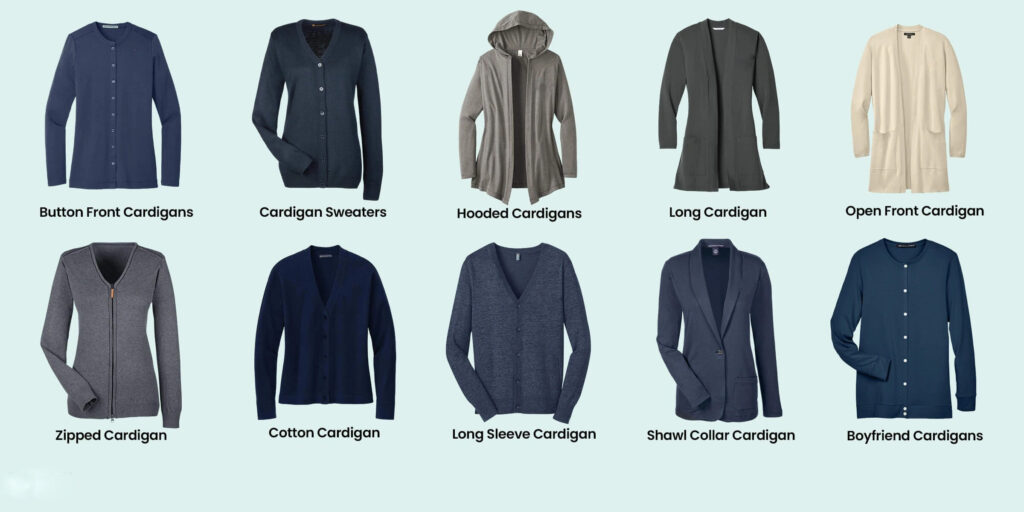
Common American cardigan style names
- Open-front cardigan
- Button-front cardigan
- Cardigan sweater
- Crewneck cardigan
- Ribbed cardigan
- Cropped cardigan
- Zip cardigan
- Belted cardigan
Why these labels are useful
They clarify style details
The supplier can understand more than the broad garment category.
They improve retail presentation
The customer can understand the product faster in product listings.
They support cleaner sampling
The more specific the naming, the fewer early assumptions the factory needs to make.
Style-name overview
| American style label | What it usually emphasizes |
|---|---|
| Open-front cardigan | No front fastening |
| Button-front cardigan | Front closure and more structure |
| Crewneck cardigan | Neckline type |
| Cropped cardigan | Shorter body proportion |
| Ribbed cardigan | Surface texture or knit structure |
That is why Americans do not usually rename the garment completely. They usually keep cardigan as the base word and then add style detail around it.
Do Americans say “cardy” or “cardie” the way some British speakers do?
Not commonly. Cambridge notes cardy or cardie as informal variants, but in American retail and standard usage, the dominant forms are still cardigan and cardigan sweater. U.S. dictionary and retail references in the search results overwhelmingly use the standard full term rather than the shortened slang form.
No, Americans do not commonly use “cardy” or “cardie” in mainstream product or retail language. Those shortened forms may be understood in informal fashion conversation, but they are not the standard American term. In the U.S., “cardigan” remains much more normal and much more commercially useful.
From a manufacturing and B2B point of view, this is useful because slang is usually weaker than standard category language. A supplier serving the U.S. market should prioritize the words buyers and retailers actually use in specs, product pages, and commercial communication.
At Fusionknits, American-facing knitwear communication is usually strongest when it stays with clear standard wording rather than slang.
Why standard terms work better than slang
- They reduce confusion
- They fit retail and factory language better
- They improve tech-pack clarity
- They support cleaner international communication
Slang vs standard usage
| Term | American usefulness |
|---|---|
| Cardigan | Strong standard usage |
| Cardigan sweater | Strong retail usage |
| Cardy / cardie | Much less standard in U.S. commercial language |
So while Americans may understand the slang form, it is not the normal term they rely on in mainstream apparel communication.
Why does the American name for a cardigan matter in manufacturing and sourcing?
This may look like a language issue only, but in real knitwear production, naming affects development speed, category understanding, and sample accuracy.
The American name for a cardigan matters because product naming influences how suppliers interpret the garment. “Cardigan” gives the clearest category signal, while more specific terms like button-front cardigan or cardigan sweater help guide closure, silhouette, and merchandising expectations.
From a factory perspective, weak naming can create early confusion. If a buyer says only “sweater,” the manufacturer still has to ask whether the garment opens in the front, what kind of closure it uses, and whether the customer wants a retail cardigan, a cardigan jacket, or a finer-gauge layering knit.
At Fusionknits, cardigan naming is treated as the first layer of technical communication, but it still must be supported by actual product details such as yarn composition, gauge, fit block, and length.
Why naming affects knitwear sourcing
- It influences product interpretation
- It affects closure planning
- It shapes neckline assumptions
- It supports clearer costing
- It improves sample development
Why professional clarification helps
It reduces assumptions
A factory should not guess whether a “sweater” is actually a cardigan.
It improves quote quality
A clearer category usually creates more accurate costing and better MOQ discussion.
It improves development accuracy
The sample team can start from the right product family immediately.
Naming and production logic
| Product term | Manufacturing effect |
|---|---|
| Sweater | Broad knitwear family only |
| Cardigan | Clearer front-opening knitwear direction |
| Cardigan sweater | Clear category plus retail emphasis |
| Button-front cardigan | More specific construction expectation |
That is why naming matters even in something as familiar as a cardigan. Clearer language creates cleaner product development.
So what is the best American term to use?
The best answer depends on context. In everyday American English, cardigan is usually enough. In retail and merchandising, cardigan sweater is often even more useful because it is more explicit and search-friendly.
The best American term to use is usually “cardigan” for everyday or standard product communication and “cardigan sweater” for retail, e-commerce, or consumer-facing product language. If more detail is needed, Americans usually add style words such as open-front, button-front, cropped, ribbed, or crewneck.
At Fusionknits, “cardigan” is usually the clearest technical starting point, while “cardigan sweater” is often the strongest retail-friendly term for American-facing collections and listings.
Best use by context
- Use cardigan for clear standard naming
- Use cardigan sweater for retail and e-commerce
- Add style detail when the garment needs more precision
Practical naming guide
| Context | Best American term |
|---|---|
| Factory communication | Cardigan |
| Product page title | Cardigan sweater |
| Everyday conversation | Cardigan |
| Style-specific retail labeling | Button-front cardigan, cropped cardigan, ribbed cardigan |
The best term is the one that gives the clearest product meaning with the least confusion.
Conclusion
In America, they usually call cardigans cardigans or cardigan sweaters. The word cardigan is the standard and most direct term in American English, while cardigan sweater is especially common in retail and e-commerce because it makes the category even clearer. Americans also use more specific style labels such as open-front cardigan, button-front cardigan, crewneck cardigan, ribbed cardigan, and cropped cardigan depending on the product.
From a professional knitwear manufacturing perspective, the most useful term is the one that communicates the product clearly.
At Fusionknits, cardigan is usually the strongest technical word, while cardigan sweater is often the best retail-facing word for the U.S. market. Both are correct, but stronger sourcing and development still depend on adding the right fit, closure, yarn, and style details beyond the basic name itself.