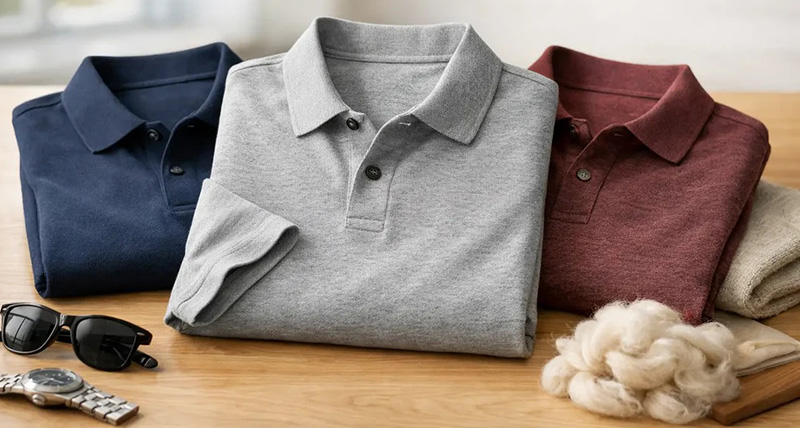
A polo shirt can look polished on the hanger and still disappoint after real wear. The collar may lose shape, the surface may pill, the body may twist, or the fabric may feel too hot, too stiff, or too thin for daily use. That is why the best fabric for polo shirts is not the one with the strongest marketing story. It is the one that fits the product’s real purpose.
The best fabric for polo shirts depends on the category, but in most cases the strongest options are cotton piqué, cotton jersey, mercerized cotton, cotton blends with elastane or polyester, and fine-gauge knit fabrics such as cotton, merino, or cotton-silk blends for premium polos. For classic everyday polos, cotton piqué is usually the best overall choice because it balances breathability, texture, structure, and long-term wearability.
At Fusionknits, we see polo fabric as the foundation of the whole garment. A strong collar, clean placket, and balanced fit all become weaker if the fabric is wrong. That is why the best polo fabric should always be chosen through product logic, not only through trend, price, or fiber name.
Why Does Fabric Matter So Much in a Polo Shirt?
A polo shirt sits between a T-shirt and a shirt, which makes fabric choice much more important than many buyers expect. The fabric has to feel comfortable like casualwear, but also hold enough structure to support the collar, placket, and overall silhouette.
Fabric matters so much in a polo shirt because it controls breathability, drape, collar support, surface texture, durability, wash behavior, and whether the shirt feels sporty, casual, refined, or premium. A weak fabric can make even a good polo pattern feel unstable or cheap.
Polo fabric affects nearly every part of the garment. It influences how the collar sits, how the chest line falls, how the placket behaves after washing, and how the shirt performs in repeated wear. Even the same pattern can feel completely different in different knit structures.
At Fusionknits, we usually evaluate polo fabric as a full system. The best fabric should not only feel good in a swatch. It should also hold shape, stay presentable, and work naturally with the collar and fit.
Why fabric changes the full polo result
- It affects comfort and breathability
- It changes how sporty or refined the shirt feels
- It influences collar and placket stability
- It affects pilling and surface aging
- It controls shrinkage and wash performance
- It shapes the overall silhouette
Why this matters in development
A polo has more structure than a T-shirt
The fabric has to support more construction points.
The category covers many markets
A golf polo, a uniform polo, and a luxury knit polo should not use the same fabric logic.
Customers notice fabric quickly
Polo quality is often judged by hand feel and collar behavior almost immediately.
| Fabric role | Why it matters |
|---|---|
| Surface quality | Changes premium perception |
| Knit structure | Changes product identity |
| Recovery | Supports long-term shape |
| Breathability | Supports daily wear comfort |
Is Cotton Piqué the Best Classic Fabric for Polo Shirts?
Yes, in most traditional polo categories, cotton piqué remains the strongest overall answer. It is the fabric most closely associated with the polo shirt because it supports the category’s original sport-casual identity.

Yes, cotton piqué is usually the best classic fabric for polo shirts because it offers breathable texture, better body than flat jersey, strong sport heritage, and enough structure to support the collar and placket. It remains the most reliable fabric for traditional everyday polos.
At Fusionknits, we still treat piqué as the benchmark fabric in classic polo development. It has enough texture to feel authentic, enough structure to sit cleanly on the body, and enough familiarity to give customers confidence. A good cotton piqué polo usually feels honest, stable, and easy to wear.
Why cotton piqué works so well
- Breathable knit structure
- Recognizable polo texture
- Better body than many flat knits
- Strong sport-to-casual identity
- Good all-around daily wearability
Why piqué remains the standard
It supports the polo silhouette
The collar, placket, and body all benefit from the extra structure.
It feels traditional
Customers immediately understand it as a “real polo.”
It works across many price levels
Basic, mid-range, and premium polo programs can all use piqué successfully.
| Fabric type | Best polo role |
|---|---|
| Cotton piqué | Classic everyday polo |
| Better compact piqué | Premium classic polo |
| Lower-density piqué | Softer, but less stable polo |
Is Cotton Jersey Better Than Piqué for Some Polo Shirts?
In some categories, yes. Cotton jersey creates a softer, smoother, and often more T-shirt-like polo. It is not usually the best answer for a traditional sport polo, but it can be excellent in softer casualwear and cleaner premium basics.
Yes, cotton jersey can be better than piqué when the goal is a softer, smoother, more relaxed polo shirt. Jersey polos usually feel lighter, more fluid, and more comfortable against the skin, but they often offer less structure than piqué.
At Fusionknits, we often recommend jersey polos when the brand wants a refined casual basic or a softer premium summer polo. Jersey works especially well when the polo is meant to feel easy and understated rather than heavily sporty.
Why jersey works in some polo categories
- Smoother hand feel
- Softer against the skin
- Cleaner minimal appearance
- Good in lightweight warm-weather polos
- Strong in T-shirt-inspired casual polos
Why jersey is not always the best answer
Less structure
The collar and placket may need more support.
Less traditional polo texture
The shirt may feel more casual than classic.
Surface quality matters more
A weak jersey can look flat or age quickly.
| Fabric type | Best polo role |
|---|---|
| Cotton jersey | Soft casual polo |
| Compact jersey | Cleaner refined polo |
| Weak thin jersey | Lower long-term value |
What Makes Mercerized Cotton a Premium Polo Fabric?
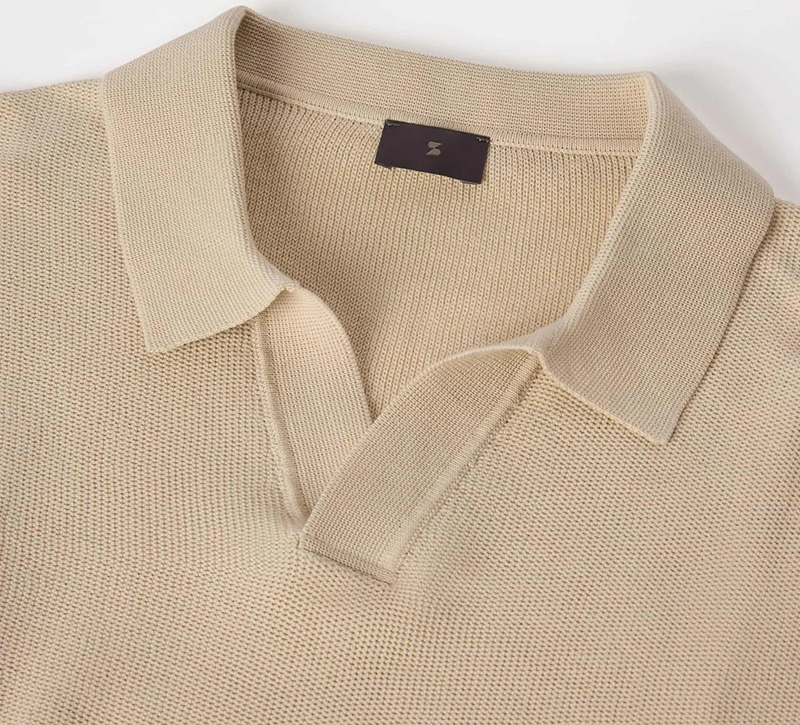
Mercerized cotton is one of the strongest options when a brand wants a polo that feels cleaner, smoother, and more elevated than a standard casual basic. It often adds refinement without changing the category too dramatically.
Mercerized cotton is a premium polo fabric because the mercerization process improves smoothness, luster, color depth, and surface stability. A mercerized cotton polo usually looks cleaner, feels more refined, and sits more easily in smart-casual and premium markets.
At Fusionknits, mercerized cotton is especially useful when the buyer wants a polo that feels polished without becoming too formal. It works well in elevated basics, minimal luxury collections, and polos that need a more mature appearance.
- Smoother surface
- Richer color appearance
- Cleaner visual finish
- Stronger refined-casual identity
- Better compatibility with premium branding
Why it works well in polos
The fabric looks sharper
This helps the polo feel more versatile in smart-casual styling.
The surface holds color well
The shirt often looks richer and more polished.
It upgrades a familiar product
The polo remains wearable but feels more elevated.
| Fabric type | Best polo role |
|---|---|
| Mercerized cotton | Premium clean polo |
| Mercerized jersey | Refined casual polo |
| Mercerized piqué | Elevated classic polo |
Are Cotton Blends Better Than Pure Cotton for Polo Shirts?
In many commercial programs, yes. Cotton blends are popular because they often solve practical problems in durability, recovery, and easier care. But the best blend depends on what the shirt is designed to do.
Yes, cotton blends are often better than pure cotton for some polo shirts because they can improve recovery, reduce shrinkage, add stretch, and support easier care. Cotton-polyester blends are often strong in uniform and commercial polos, while cotton-elastane blends are useful when comfort stretch and shape retention matter more.
At Fusionknits, we often use blends when the product needs more technical performance or broader durability. A pure cotton polo can be beautiful, but a strong blend may outperform it in repeated wash cycles, uniform programs, travel use, or close-fitting styles.
Common useful cotton blends
- Cotton-polyester
- Cotton-elastane
- Cotton-poly-elastane
- Cotton-modal in selected softer polos
Why blends are so common
Better recovery
The shirt often returns to shape more easily.
Better commercial stability
Shrinkage and distortion risk may be reduced.
Better end-use flexibility
The polo can move more easily into uniform, performance, or travel categories.
| Blend type | Main benefit |
|---|---|
| Cotton-poly | Better durability and easier care |
| Cotton-elastane | Better comfort stretch |
| Cotton-poly-elastane | Better all-around commercial balance |
Is Performance Fabric the Best Choice for Sports and Golf Polos?
For those categories, often yes. Sports and golf polos need more than classic casual comfort. They often need stretch, moisture handling, and easy maintenance, which changes the best fabric answer completely.

Yes, performance fabric is usually the best choice for sports and golf polos because these shirts need moisture management, easier drying, movement support, and stable shape retention. Polyester-based or poly-stretch performance knits are usually stronger in these categories than traditional all-cotton fabrics.
At Fusionknits, we never recommend classic cotton piqué as the first answer for serious sports or golf use. In these categories, technical function becomes more important than heritage fabric identity. The best performance polos usually depend on engineered synthetic or blended knits.
Why performance polos need different fabrics
- Faster drying
- Better movement support
- Better shape retention in activity
- Lower moisture absorption
- Easier repeated care
Why this changes the best-fabric answer
End use is different
Athletic performance places more pressure on the garment.
Cotton comfort is not enough
Movement and sweat handling become more important.
The product identity changes
A golf polo should not always be built like a classic piqué lifestyle polo.
| Fabric type | Best polo role |
|---|---|
| Polyester performance knit | Golf and sport polo |
| Poly-stretch blend | Active and travel polo |
| Cotton piqué | Better for classic non-sport polo |
Are Knit Polos Better in Merino, Cotton-Silk, or Other Luxury Fibers?
In premium knitwear categories, yes. But these are different from classic piqué polos. The best luxury knit polo fabrics are chosen not for sporty texture, but for refined drape, softness, and elegance.
Yes, luxury knit polos are often better in fabrics such as merino wool, cotton-silk blends, Sea Island cotton, or other fine-gauge natural fibers because these materials create smoother drape, greater softness, and a more elevated smart-casual appearance.
At Fusionknits, we treat knit polos as a separate lane inside the polo category. A fine-gauge merino polo and a classic cotton piqué polo should not be judged by exactly the same rules. One is rooted in sport heritage. The other is rooted in refined knitwear.
Strong luxury knit polo fabrics
- Fine merino
- Cotton-silk blends
- Sea Island cotton
- Fine-gauge premium cotton
- Silk-cotton or cashmere-touch blends in niche luxury categories
Why these fabrics feel different
Better drape
The shirt feels smoother and more elegant.
Softer hand feel
The polo becomes less sporty and more refined.
Better smart-casual crossover
These fabrics often work well with tailored casualwear.
| Fabric type | Best polo role |
|---|---|
| Merino knit | Refined luxury polo |
| Cotton-silk blend | Elevated soft-drape polo |
| Fine-gauge cotton knit | Premium minimalist polo |
Which Polo Fabric Breathes Best in Daily Wear?
Breathability depends on both fiber and knit structure. A breathable shirt needs more than just natural fiber language. The structure has to let air move through the garment effectively.
For daily wear, cotton piqué and quality cotton jersey are usually among the best-breathing polo fabrics because they combine natural fiber comfort with knit structures that allow air movement. In hotter climates, lighter cotton piqué and softer premium jersey can perform especially well.
At Fusionknits, breathable comfort is one of the biggest reasons classic cotton polos remain strong. Piqué especially works well because the textured knit helps keep the shirt from feeling too flat against the skin.
Strong breathable polo fabrics
- Lightweight cotton piqué
- Midweight cotton piqué
- Quality cotton jersey
- Fine-gauge cotton knit
- Light cotton-modal blends in softer categories
Why breathability matters so much
Polos are often warm-weather garments
The fabric must stay wearable for long hours.
The collar makes the shirt feel more closed than a tee
This makes breathable fabric even more important.
Daily wear depends on comfort
A polo should feel easy, not heavy.
| Fabric type | Breathability level |
|---|---|
| Cotton piqué | Strong |
| Cotton jersey | Strong |
| Dense synthetic knit | Depends on engineering |
| Luxury fine-gauge cotton | Strong in lighter constructions |
Which Polo Fabric Holds Its Shape Best?
Shape retention matters because polo shirts rely on collar and placket structure more than many casual tops. A fabric that collapses too quickly weakens the whole garment.
The polo fabrics that hold shape best are usually stronger piqué knits, cotton-poly blends, cotton-elastane blends, mercerized cotton knits, and selected performance fabrics. These materials usually offer better recovery and more stable support for the collar, placket, and body.
At Fusionknits, structure and recovery often matter more than softness alone in polos. A shirt that feels luxurious on day one but loses shape after a few washes is not the best long-term answer.
Better shape-holding fabric directions
- Dense cotton piqué
- Cotton-poly piqué
- Cotton-elastane knit
- Mercerized cotton
- Performance polo knits
Why shape retention matters in polos
The collar depends on it
Weak fabric makes collar behavior weaker.
The placket depends on it
The front opening should sit cleanly.
The body should stay presentable
A polo should not twist or collapse too fast.
| Fabric direction | Shape-retention strength |
|---|---|
| Dense piqué | Strong |
| Cotton-poly blend | Strong |
| Performance knit | Strong |
| Weak thin jersey | Lower |
So Which Fabric Is Best for Most Polo Shirts?
For most classic and everyday polo shirts, the answer still returns to cotton piqué. It remains the strongest overall balance of structure, breathability, identity, and commercial reliability. But the final answer still depends on product category.
For most everyday polo shirts, cotton piqué is still the best overall fabric because it offers the most balanced combination of breathability, texture, structure, durability, and classic polo identity. However, jersey is often better for softer casual polos, performance knit is better for sport polos, and fine-gauge luxury fibers are better for elevated knit polos.
At Fusionknits, this category-based view is the strongest one. Buyers make better decisions when they stop asking for one universal “best” and instead ask which fabric best matches the intended role of the polo.
Best-fabric summary by category
- Classic polo: cotton piqué
- Soft casual polo: cotton jersey
- Premium clean polo: mercerized cotton
- Commercial durable polo: cotton blend
- Golf or sport polo: performance knit
- Luxury knit polo: merino or fine-gauge premium fibers
Why this answer works best
It respects product purpose
Each polo type gets the fabric it actually needs.
It improves sourcing accuracy
Fabric choice becomes more practical and less emotional.
It supports stronger collections
Brands can build polos that serve different customers clearly.
| Polo category | Best fabric direction |
|---|---|
| Classic everyday polo | Cotton piqué |
| Soft casual polo | Cotton jersey |
| Premium refined polo | Mercerized cotton |
| Performance polo | Poly-stretch knit |
| Luxury knit polo | Merino or fine-gauge premium knit |
Conclusion
The best fabric for polo shirts depends on the type of polo being made, but for most classic everyday polos, cotton piqué remains the strongest overall choice. It offers the best balance of breathability, texture, structure, and authentic polo identity.
Cotton jersey is often better for softer casual polos. Mercerized cotton works especially well in premium refined polos. Cotton blends improve durability, recovery, and commercial practicality. Performance fabrics are best for golf and sports polos. Luxury knit polos usually perform best in merino, fine-gauge cotton, or cotton-silk blends. That means the best fabric is not one answer for every product. It is the fabric that best supports the polo’s intended use.
At Fusionknits, we believe the strongest polo fabric decisions begin with category clarity. A classic piqué polo, a sport polo, and a luxury knit polo should not be built from the same logic. When fabric is chosen through product purpose, the polo becomes more comfortable, more stable, and much more commercially effective in real wear.