Many polo shirts look polished at first, but that does not mean they are truly high quality. Some lose collar shape after washing. Some pill too quickly. Some feel stiff, hot, or weak after repeated wear. That is why the real question is not only what a polo looks like on the hanger. The better question is what a high-quality polo is actually made of.
High quality polos are usually made of strong cotton piqué, mercerized cotton, fine cotton jersey, premium cotton blends, or refined knit fibers such as merino wool, Sea Island cotton, or cotton-silk blends, depending on the product category. The best high-quality polo materials balance breathability, shape retention, comfort, surface quality, collar support, and long-term wash performance.
At Fusionknits, we see polo quality as a full product system. A high-quality polo is not made from one magic fiber alone. It is made from the right fiber, the right knit structure, the right finishing, and the right construction working together. That is what creates a polo that feels better, wears better, and holds its value longer.
Why Does Material Matter So Much in a Polo Shirt?
A polo shirt sits between a T-shirt and a shirt, so the fabric has to do more than just feel soft. It must support the collar, keep the placket stable, breathe well, and still look presentable after repeated wear.
Material matters so much in a polo shirt because it controls the shirt’s comfort, drape, texture, structure, and durability. A weak fabric can make the collar collapse, the body twist, the surface pill, or the shirt lose its shape after washing.
The fabric affects every major part of the garment. It influences how the polo feels on the skin, how the chest line falls, how the neckline behaves, and how premium the product appears. Even the same pattern can feel completely different when made in a stronger or weaker fabric.
At Fusionknits, this is why material selection is one of the first and most important decisions in polo development. If the fabric is wrong, the rest of the product becomes harder to save.
Why fabric changes the whole polo result
- It affects breathability
- It changes collar support
- It influences drape and structure
- It affects pilling resistance
- It controls long-term wash behavior
- It changes whether the polo feels sporty, classic, or premium
Why this matters in development
A polo has more structure than a basic knit top
The shirt needs a material that can support more construction points.
Customers expect repeated wear
A polo should still look clean after multiple uses and washes.
Fabric defines category identity
A sporty golf polo and a refined knit polo should not feel the same.
| Fabric role | Product effect |
|---|---|
| Surface quality | Changes premium perception |
| Knit structure | Changes category identity |
| Recovery | Supports long-term shape |
| Breathability | Supports daily comfort |
Is Cotton the Main Fiber in High Quality Polos?
Yes, in many of the best polo categories, cotton remains the main fiber. It is trusted, comfortable, breathable, and highly adaptable across different polo structures.

Yes, cotton is one of the main fibers in high quality polos because it offers breathability, softness, familiarity, and strong comfort in daily wear. Most premium classic polos still rely on cotton in one form or another, especially in piqué, jersey, or fine-gauge knit constructions.
At Fusionknits, cotton remains a leading choice because it aligns very naturally with what customers want from a polo: comfort, polish, and broad wearability. But the type of cotton and the way it is knitted still matter greatly. Better cotton in a better structure creates a much stronger shirt than weak cotton in a weak construction.
Why cotton remains so important
- Comfortable against the skin
- Good breathability
- Strong consumer trust
- Broad styling flexibility
- Works well in both classic and premium polos
Why “cotton” alone is not enough
Fiber quality still varies
Not all cotton produces the same softness or durability.
Knit structure matters
Cotton piqué and cotton jersey do not behave the same way.
Finishing matters
Better processing improves color, hand feel, and shape retention.
| Cotton role | Why it helps |
|---|---|
| Breathability | Better daily comfort |
| Familiarity | Easier customer trust |
| Versatility | Works across many polo categories |
| Softness | Better wear experience |
Are High Quality Polos Usually Made of Cotton Piqué?
In classic polo categories, very often yes. Cotton piqué remains one of the strongest and most respected polo fabrics because it supports both structure and comfort.
Yes, many high quality classic polos are made of cotton piqué because this knit structure offers breathable texture, enough body to support the collar and placket, and the most recognizable traditional polo identity. It remains one of the best materials for everyday premium polos.
At Fusionknits, cotton piqué is still the benchmark in classic polo development. It gives the shirt enough texture to feel authentic and enough structure to sit cleanly on the body. It is one of the clearest answers when the product goal is a traditional polo with broad styling value.
Why cotton piqué works so well
- Breathable knit texture
- Strong classic polo identity
- Better body than flat jersey
- Good support for collar and placket
- Strong all-around commercial value
Why piqué is often the first answer
It defines the classic polo look
Customers usually recognize it immediately.
It balances structure and comfort
The shirt feels more stable than a basic tee.
It works across many price levels
Entry, mid-tier, and premium brands all use piqué successfully.
| Fabric type | Best polo role |
|---|---|
| Cotton piqué | Classic everyday polo |
| Dense premium piqué | Higher-end classic polo |
| Lightweight piqué | Soft warm-weather polo |
Are Mercerized Cotton Polos Better Than Regular Cotton Polos?
In many premium categories, yes. Mercerized cotton adds a cleaner, more refined appearance and often gives the fabric a richer finish than ordinary cotton.
Mercerized cotton polos are often better than regular cotton polos when the goal is a more refined, polished, and premium product. Mercerization improves smoothness, surface clarity, luster, and color richness, which helps the polo feel more elevated in smart-casual and luxury basics categories.
At Fusionknits, mercerized cotton is especially useful for buyers who want a polo that feels more mature than a sporty piqué basic. It creates a cleaner visual line and often helps the shirt move more easily into elevated casualwear.
- Smoother surface
- Richer dye appearance
- Cleaner visual finish
- Better refined-casual identity
- More polished hand feel
The shirt looks sharper
This helps it work better beyond weekend casualwear.
The surface feels more controlled
That supports a more expensive-looking result.
It upgrades a simple silhouette
Even a plain polo can feel more luxurious.
| Fabric type | Main effect |
|---|---|
| Regular cotton piqué | Classic casual polo |
| Mercerized cotton | Elevated refined polo |
| Mercerized jersey | Smoother premium polo |
Are High Quality Polos Sometimes Made of Jersey Instead of Piqué?
Yes. Not every high-quality polo needs to use piqué. Some of the best polos in softer casualwear and premium basics are made from quality cotton jersey or compact jersey knits.
Yes, high quality polos can also be made of jersey, especially when the goal is a softer, smoother, and more relaxed shirt. Jersey polos often feel cleaner against the skin and less sporty than piqué polos, which makes them strong in minimal casualwear and premium summer categories.
At Fusionknits, jersey polos work best when the shirt is meant to feel more like a refined T-shirt with a collar than a traditional sports polo. This fabric direction is especially strong when softness and understated style matter more than textured heritage.
Why jersey can be a high-quality polo fabric
- Smooth and soft hand feel
- Cleaner minimalist appearance
- Good warm-weather comfort
- Less overtly sporty look
- Strong in premium casualwear
Why jersey is not the universal answer
It offers less structure than piqué
The collar and placket may need more support.
It changes category identity
The shirt often feels more modern and less traditional.
Surface quality becomes more important
A weak jersey can feel flat or unstable.
| Fabric type | Best polo role |
|---|---|
| Cotton jersey | Soft casual polo |
| Compact jersey | Premium smooth polo |
| Weak jersey | Lower long-term performance |
Do High Quality Polos Use Luxury Fibers Like Merino or Silk Blends?
Yes, especially in premium knit polos. These are usually different from classic sports polos and belong more to elevated knitwear categories.

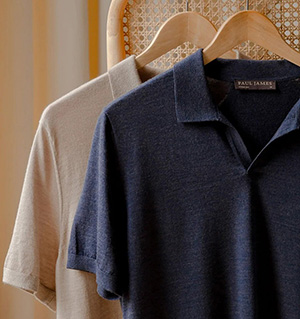
Yes, high quality polos are sometimes made of luxury fibers such as merino wool, Sea Island cotton, cotton-silk blends, or other fine-gauge knit yarns. These materials are especially common in luxury knit polos, where softness, drape, refinement, and smart-casual elegance matter more than classic sport texture.
At Fusionknits, we treat knit polos as a distinct lane. A fine-gauge merino polo is not trying to compete directly with a cotton piqué tennis-style polo. Each one has its own product logic. Luxury fibers are strongest when the polo is meant to feel more sophisticated and dress-oriented.
Common luxury polo materials
- Fine merino wool
- Sea Island cotton
- Cotton-silk blends
- Fine-gauge premium cotton
- Selected cotton-linen blends in warm-weather luxury categories
Why these fibers feel different
Better drape
The shirt falls more smoothly on the body.
Better softness
The garment often feels more refined than sporty.
Better smart-casual crossover
These polos work more easily with tailored casual styling.
| Fiber type | Best polo role |
|---|---|
| Merino | Refined luxury knit polo |
| Cotton-silk | Soft elevated polo |
| Sea Island cotton | Premium minimalist knit polo |
Are Cotton Blends Used in High Quality Polos Too?
Yes, especially when the product needs more recovery, stretch, durability, or easier care. A blend does not automatically mean lower quality. In many cases, a strong blend is the more practical and more effective choice.
Yes, high quality polos can also be made of cotton blends, especially cotton-polyester, cotton-elastane, or cotton-poly-elastane combinations. These blends are often used to improve shape retention, reduce shrinkage, add comfort stretch, and support more durable repeated wear.
At Fusionknits, we often use blends in uniform polos, travel polos, close-fitting polos, and broader commercial programs. A pure cotton polo can be beautiful, but a strong blend may perform better when the shirt needs more technical support or more wash stability.
Why blends appear in good polos
- Better recovery
- Better repeated wash stability
- More stretch comfort
- Lower shrink risk
- Stronger broad-market practicality
When blends are especially useful
Uniform and workwear polos
These need reliable shape and easier care.
Travel and everyday repeat-wear polos
The shirt benefits from greater stability.
Fitted polos
A little stretch can improve movement and comfort.
| Blend type | Main benefit |
|---|---|
| Cotton-poly | Durability and easy care |
| Cotton-elastane | Better movement and fit |
| Cotton-poly-elastane | Strong all-around performance |
What Knit Structure Makes a Polo Feel More Expensive?
Fiber matters, but knit structure matters too. The same fiber can feel basic or premium depending on how it is knitted and finished.
A polo usually feels more expensive when it uses a denser, cleaner, and more controlled knit structure such as quality piqué, compact jersey, mercerized jersey, or fine-gauge knit constructions. The knit should support the collar, hold its shape, and keep a stable surface through wear.
At Fusionknits, expensive-looking polos usually share a few fabric signs. The surface is cleaner. The texture is more controlled. The shirt hangs better. The collar sits more confidently. These results come from knit quality just as much as from fiber name.
- Dense cotton piqué
- Compact cotton jersey
- Mercerized cotton knits
- Fine-gauge knitted cotton
- Fine merino knit structures
Why knit quality changes the result so much
It supports cleaner drape
The shirt looks more intentional.
It improves surface stability
The polo feels better after repeated wear.
It helps the collar and placket work better
These are key quality points in the category.
| Knit structure | Premium effect |
|---|---|
| Dense piqué | Strong classic polish |
| Compact jersey | Smooth minimal refinement |
| Fine-gauge knit | Luxury smart-casual appearance |
What Else Besides Fiber Makes a Polo High Quality?
Material is essential, but a high-quality polo is not created by fiber alone. Collar construction, placket quality, stitching discipline, and finishing all matter too.
Besides fiber, a high-quality polo depends on collar stability, placket construction, stitch accuracy, surface finish, shrink control, and fit balance. The best materials still need strong garment engineering to perform well.
At Fusionknits, we always remind buyers that material should be judged in the context of the whole product. A premium cotton piqué can still underperform if the collar is weak. A luxury knit polo can still fail if the fit collapses after washing. High quality is always the result of multiple parts working together.
Other factors that shape polo quality
- Collar construction
- Placket stability
- Stitching accuracy
- Wash performance
- Shrinkage control
- Fit consistency
Why material alone is not enough
The polo is a structured knit shirt
The fabric must support other construction parts.
Repeated wear reveals weaknesses
The customer notices collar and placket problems quickly.
Product value is cumulative
One strong feature cannot fully hide several weak ones.
| Product area | Why it matters |
|---|---|
| Collar | Defines structure and polish |
| Placket | Controls front balance |
| Stitching | Supports durability |
| Finishing | Supports premium feel |
So What Are High Quality Polos Usually Made Of?
The most accurate answer is that high quality polos are made from different strong materials depending on category. But certain fabrics appear again and again because they consistently perform well.
High quality polos are usually made of cotton piqué, mercerized cotton, premium cotton jersey, cotton blends with performance support, or fine-gauge knit fibers such as merino, Sea Island cotton, and cotton-silk blends. In classic polos, quality cotton piqué remains the most common answer. In premium refined polos, mercerized cotton and knit luxury fibers are especially important.
At Fusionknits, we usually guide buyers by product lane instead of by one universal fabric claim. That is the most useful and most professional way to understand polo quality.
Best material choices by polo category
- Classic polo: cotton piqué
- Soft casual polo: quality cotton jersey
- Premium refined polo: mercerized cotton
- Commercial durable polo: strong cotton blend
- Luxury knit polo: merino or fine-gauge premium fibers
Why this category-based answer works
It matches the product to the material
The fabric supports the polo’s actual purpose.
It avoids oversimplification
Not every high-quality polo should feel the same.
It improves sourcing decisions
Buyers can build more accurate product ranges.
| Polo type | Best material direction |
|---|---|
| Classic everyday polo | Cotton piqué |
| Premium smooth polo | Mercerized cotton or compact jersey |
| Uniform or travel polo | Cotton blend |
| Luxury knit polo | Merino or cotton-silk blend |
Conclusion
High quality polos are usually made of strong cotton-based fabrics such as cotton piqué, mercerized cotton, premium jersey, and selected cotton blends, while more elevated knit polos often use luxury fibers such as merino, Sea Island cotton, or cotton-silk blends.
The best material depends on the product category. Cotton piqué remains the classic benchmark because it balances breathability, texture, structure, and authentic polo identity. Mercerized cotton works especially well in premium refined polos. Jersey works well in softer casual styles. Blends improve durability and stability. Fine-gauge luxury fibers create more elegant knit polos.
At Fusionknits, we believe the best answer is always product-led. A high-quality polo is not made from one famous material alone. It is made from the right material, the right knit structure, and the right garment construction working together. When brands understand polo quality this way, they make better fabric choices, build stronger products, and create shirts that truly feel premium in real-life wear.