A cardigan is one of the easiest knitwear pieces to wear, but it is also one of the easiest to get wrong. When the fit, length, yarn weight, or styling balance is off, the cardigan can look heavy, shapeless, or old-fashioned. When those same elements are controlled well, the cardigan becomes one of the most flattering layers in a collection.
At Fusionknits, a flattering cardigan is not created by trend alone. It is created by proportion, structure, knit gauge, length balance, neckline shape, and the way the garment sits on the body. A cardigan looks flattering when it supports the body line instead of hiding it carelessly or pulling against it.
From a professional apparel manufacturing perspective, “flattering” is not only a styling word. It is also a development word. A cardigan that flatters well usually has better pattern balance, better drape, better front opening behavior, and a more intentional relationship between body, sleeve, and hem. That is why flattering knitwear begins in product development, not only in styling advice.
Why do some cardigans look flattering and others do not?
A cardigan looks flattering when it creates shape, balance, and visual clarity. It looks unflattering when it adds unnecessary bulk, breaks the body line in the wrong place, or collapses without enough structure. This is why two cardigans made from similar yarn can perform very differently on the body.
At Fusionknits, the difference usually comes down to five technical points: fit, gauge, length, neckline, and front opening behavior. If those five areas are developed correctly, the cardigan will usually look cleaner and more balanced. If one of them is wrong, the whole garment can lose its effect.
For example, a cardigan may be soft and expensive, but still look poor if the shoulder drops too low, the front hangs too far from the body, or the hem stops at the widest part of the hip without control. A flattering cardigan needs visual direction. It must guide the eye instead of creating confusion.
What usually makes a cardigan look unflattering?
- Too much bulk through the body
- Weak shoulder balance
- A poor hem position
- Excess tension at the button line
- Too much visual volume without shape
Why these details matter
The cardigan changes the body outline
Unlike a fitted knit top, a cardigan adds another layer, so its shape becomes part of the silhouette.
The front opening draws attention
If the front pulls, twists, or hangs badly, the customer notices immediately.
| Cardigan problem | Visual result |
|---|---|
| Too much width | Boxy appearance |
| Too much tightness | Pulling and strain |
| Wrong length | Broken body proportion |
How does fit make a cardigan more flattering?
Fit is the first major factor. A cardigan does not need to be tight to be flattering, but it usually needs more shape than many basic commercial styles offer. The best fit depends on the cardigan type, but in most cases a balanced fit works better than an extreme one.

At Fusionknits, a cardigan becomes more flattering when the fit follows the body with control instead of squeezing it or floating too far away from it. This usually means moderate ease at the chest, enough room for movement, and a body width that supports clean drape without looking oversized by accident.
A fitted fine-gauge cardigan can be flattering because it defines the body cleanly. A relaxed cardigan can also be flattering if the shoulder, body width, and sleeve volume are properly controlled. The key point is that fit should look intentional. Unplanned looseness is rarely flattering.
Fit choices that usually help
- A clean shoulder line
- Controlled ease through the body
- Sleeves that are not too wide
- Enough room for light layering
- A front opening that lies flat
Why balance is more flattering than extremes
Over-tight fit creates tension
The cardigan stops looking elegant when buttons pull or ribs stretch too hard.
Over-loose fit hides proportion
Too much extra width can make the garment look heavy and dated.
| Fit direction | Best use |
|---|---|
| Lightly fitted | Fine-gauge or top-like cardigan |
| Balanced relaxed | Most everyday cardigans |
| Oversized | Only when shape is carefully controlled |
How does cardigan length affect flattery?
Length changes everything. A cardigan can make the body look longer, shorter, broader, or cleaner depending on where the hem finishes. This is one of the most important fit decisions in cardigan development.
At Fusionknits, cardigan length becomes more flattering when it works with body proportion instead of cutting across the wrong visual point. Cropped cardigans often flatter by lifting the waistline visually. Hip-length cardigans often flatter by staying balanced and easy to wear. Longline cardigans can flatter if the drape is clean and the body underneath is visually controlled.
The problem usually appears when the cardigan ends at a wide point without enough shape. A bulky hem at the fullest hip area can make the whole silhouette feel wider. A long cardigan that lacks drape can make the body look heavier. Length must always be judged together with fit and yarn weight.
Length directions that often flatter well
- Cropped lengths with high-rise bottoms
- Standard hip lengths for easy versatility
- Longline lengths with cleaner inner layers
- Waist-defining short cardigans for top-like styling
Why length should never be chosen alone
Length changes proportion
The same cardigan can feel modern or awkward depending on where it ends.
Yarn weight interacts with length
A long heavy cardigan needs more drape control than a short fine-gauge one.
| Length type | Flattering effect |
|---|---|
| Cropped | Raises visual waist |
| Hip length | Balanced and versatile |
| Longline | Elongates when drape is clean |
How can the neckline make a cardigan more flattering?
Neckline shape is one of the most effective ways to improve a cardigan’s appearance. A cardigan neckline frames the face, changes how the chest area looks, and affects how open or closed the upper body feels.
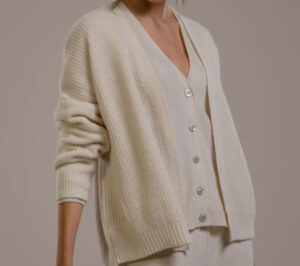
At Fusionknits, V-necks are often among the most flattering cardigan necklines because they create vertical direction and visually open the upper body. Crew neck cardigans can also be flattering, especially in fine gauges and cropped proportions, but they usually need stronger fit balance because they create a more closed shape.
A deep or moderate V-neck often works well because it reduces visual heaviness and allows layering with tops, shirts, or dresses more easily. A neckline that is too high and too thick can sometimes make the upper body feel blocked. A neckline that is too weak can lose structure. The cardigan neckline should frame the garment, not fight the body line.
Neckline choices that usually flatter well
- Moderate V-neck
- Refined deep V-neck
- Clean crew neck in fitted styles
- Open-front necklines with controlled drape
Why neckline matters so much
It shapes the top half of the outfit
The eye reads neckline early, especially in knitwear.
It affects visual length
A more open neckline often creates a longer and lighter effect.
| Neckline type | Typical visual effect |
|---|---|
| V-neck | Lengthening and opening |
| Crew neck | Cleaner, more compact |
| Open front | Relaxed vertical flow |
Why does knit gauge and yarn weight matter for flattery?
Gauge and yarn weight are often overlooked, but they strongly affect whether a cardigan flatters well. A thick cardigan naturally adds more visual volume than a fine one. That is not a problem by itself, but it has to be handled carefully in pattern development.
At Fusionknits, a cardigan becomes more flattering when the knit gauge and the silhouette support each other. Fine-gauge cardigans can hold a neater shape and sit closer to the body. Chunkier gauges need more thoughtful volume control, cleaner length decisions, and stronger shoulder balance to avoid looking bulky.
This is why flattering chunky cardigans usually need simpler shapes and cleaner styling. If a cardigan already has heavy yarn, oversized cables, and a long body, then adding too much width can make the garment visually overloaded. A cardigan should not compete with itself.
Gauge effects that matter most
- Fine gauge supports cleaner fit
- Mid gauge supports balanced everyday shapes
- Chunky gauge adds visual volume fast
- Open-knit gauge changes body transparency and drape
Why yarn bulk changes the silhouette
More bulk creates more width
The body reads the cardigan differently even before fit is considered.
Heavy knits need simpler proportions
The design should leave space for the yarn to speak clearly.
| Gauge type | Best flattering strategy |
|---|---|
| Fine gauge | Cleaner fit and shape |
| Mid gauge | Balanced relaxed fit |
| Chunky gauge | Controlled volume and simpler lines |
How can styling make a cardigan more flattering?
A cardigan does not work alone. Styling changes how flattering it looks. The inner layer, trouser rise, sleeve treatment, and open-or-closed styling all affect the result. A cardigan that looks average on a hanger can become very flattering when paired correctly.

At Fusionknits, styling makes a cardigan more flattering when it restores shape and visual direction. This usually means creating a clear waist point, using contrast between the cardigan and the layer underneath, and making sure the volume of the cardigan is balanced by cleaner lines elsewhere.
For example, a relaxed cardigan often looks more flattering over a cleaner base layer. A cropped cardigan often looks better with high-rise trousers or skirts because the proportions feel more deliberate. A long cardigan often works best when the garment underneath is less bulky, so the outer layer can hang cleanly.
Styling choices that improve cardigan flattery
- Pair cropped cardigans with high-rise bottoms
- Wear relaxed cardigans over a cleaner inner layer
- Keep sleeve bulk under control
- Use open-front styling to create vertical lines
- Button selectively to define shape
Why styling can correct proportion
The cardigan is part of a full silhouette
Its success depends on what sits under and around it.
Visual contrast creates structure
A cardigan often looks better when the rest of the outfit gives it direction.
| Styling choice | Flattering benefit |
|---|---|
| High-rise bottom | Better waist definition |
| Slimmer inner layer | Cleaner outer drape |
| Open-front wear | Longer visual line |
Small construction details can make a big visual difference. Buttons, rib height, placket width, and hem finish all affect how polished and flattering the cardigan appears. These are not only trim decisions. They are proportion decisions.
At Fusionknits, a cardigan usually becomes more flattering when the front placket lies flat, the rib is proportionate to the gauge, and the buttons support the garment scale rather than overpower it. Heavy buttons on a delicate cardigan can feel clumsy. Weak plackets on a fitted cardigan can pull. Thick rib on a fine-gauge cardigan can disrupt balance.
This is why flattering knitwear often looks simple but is technically precise. The details are not louder. They are better matched to the garment.
Construction details that improve flattery
- Stable front placket
- Buttons scaled to the knit
- Ribs with correct depth
- Hems that sit flat
- Fronts that close smoothly
Why these details matter visually
Small imbalance becomes visible fast
Cardigans are front-facing garments, so proportion problems are easy to see.
Precision makes the garment look more expensive
Well-controlled front details improve overall polish.
| Detail | Flattering result |
|---|---|
| Flat placket | Cleaner body line |
| Correct rib scale | Better proportion |
| Balanced buttons | More refined appearance |
How should manufacturers develop a cardigan to make it more flattering?
Flattering cardigans do not happen by accident. They come from fit development, yarn testing, wash testing, and wear review. The pattern must account for gauge, the neckline must hold shape, the shoulder must sit correctly, and the front opening must behave well in motion.
At Fusionknits, a cardigan is developed to be more flattering through pattern balance, gauge-specific fitting, and repeated review of drape, closure, and body proportion. The goal is not only to make the cardigan fit. The goal is to make it look balanced from the front, side, and open position.
This is especially important because knitwear changes in production. Wash behavior, relaxation, and finishing can all alter how the cardigan sits. A flattering first sample is not enough. The production version must keep that same visual quality.
Key development areas
- Shoulder balance
- Neckline recovery
- Placket stability
- Correct body ease
- Length control
- Gauge-specific fit testing
Why development quality matters
Flattery is technical
It depends on measurements, recovery, and drape, not only styling ideas.
Knitwear moves during production
The approved fit must survive finishing, packing, and real wear.
| Development point | Why it matters |
|---|---|
| Fit testing | Confirms body balance |
| Yarn behavior review | Protects drape |
| Placket control | Prevents front distortion |
Conclusion
A cardigan becomes more flattering when fit, length, neckline, knit gauge, and styling all work together. The most flattering cardigan is usually not the tightest or the loosest. It is the one that supports the body line with enough structure, enough ease, and the right visual balance for its yarn and purpose. Cropped styles can flatter by lifting the waistline, V-necks can flatter by creating vertical direction, and balanced relaxed fits often flatter better than extremes.
At Fusionknits, flattering cardigan design begins with technical development rather than trend language alone. We focus on proportion, drape, placket behavior, rib balance, and gauge-specific fit because those are the elements that make a cardigan look cleaner and feel more wearable.
A flattering cardigan should do one clear job: support the silhouette instead of fighting it. When that happens, the garment looks more refined, more modern, and more commercially successful.