
In international apparel trade, CIP (Carriage and Insurance Paid To) is an Incoterm that defines how costs, logistics responsibilities, and risk are allocated between garment suppliers and global buyers. Compared with FOB and CIF, CIP offers more flexibility in transportation modes, including air, sea, rail, and multimodal shipping, making it suitable for faster and more diversified supply chains.
Understanding CIP is important for fashion brands because it directly affects who pays for transportation, who arranges insurance, and when risk transfers during the shipment process.This article explains CIP from a practical apparel manufacturing perspective,focusing on how brands should understand its cost, responsibility, and risk structure.

What Is CIP in Apparel Trade?
CIP stands for Carriage and Insurance Paid To, an Incoterm defined by the International Chamber of Commerce (ICC) that describes how goods are delivered and how transportation and insurance costs are shared between the seller and the buyer.
In apparel trade, CIP means the seller is responsible for preparing your garments, arranging transportation, and paying for insurance up to a named destination point. This destination can be an airport, seaport, or logistics hub depending on your agreement.
For example, if you are buying clothing from China under CIP terms, the supplier will handle production, arrange shipping through air or sea freight, and purchase cargo insurance on your behalf. The goods are then transported to your agreed destination, such as CIP Los Angeles airport or CIP London warehouse.
Under CIP, the seller not only pays for transportation but also provides insurance coverage during transit. This means if damage or loss occurs during shipping, the insurance policy can cover part or all of the loss depending on the coverage level.
However, it is important to understand that while insurance reduces risk, it does not change the fact that risk transfers once the goods are handed over to the carrier at the origin point, and compensation depends on the insurance terms rather than full seller liability in all cases.
In summary, CIP is a trade term that combines transportation and insurance services arranged by the seller, giving buyers a more secure and simplified shipping arrangement compared to terms where insurance is not included.
How CIP Works in Apparel Trade?
To understand CIP more clearly, let’s look at a real apparel sourcing scenario.
Assume you are a fashion brand in the UK, and you place an order with a garment factory in China for 10,000 jackets. The shipment is arranged under CIP London Airport.
In this case, the Chinese supplier will take full responsibility for preparing and shipping your goods. First, the factory completes production, packaging, and quality inspection. Then the supplier selects a suitable transportation method—such as air freight or sea freight—and books the shipment on your behalf. At the same time, the supplier also purchases cargo insurance based on the agreed coverage level and pays for it.
Next, the seller handles export procedures in China, including customs declaration and clearance, before the goods leave the country. After that, the shipment is handed over to the carrier and transported toward the destination country.
During this process, you as the buyer do not need to arrange freight or insurance, as these are already managed by the supplier under CIP terms. However, you are responsible for appointing a customs broker or logistics agent in your country to handle import clearance when the goods arrive.
Once the goods reach the destination airport or terminal and are released by customs, you will pay import duties and taxes and arrange transportation to your warehouse or distribution center.
It is important to understand that although the supplier arranges insurance, risk does not remain with the seller throughout the journey. Instead, risk transfers once the goods are handed over to the carrier in the country of origin. This means that any damage or loss during transit is covered by the insurance policy rather than the seller directly.
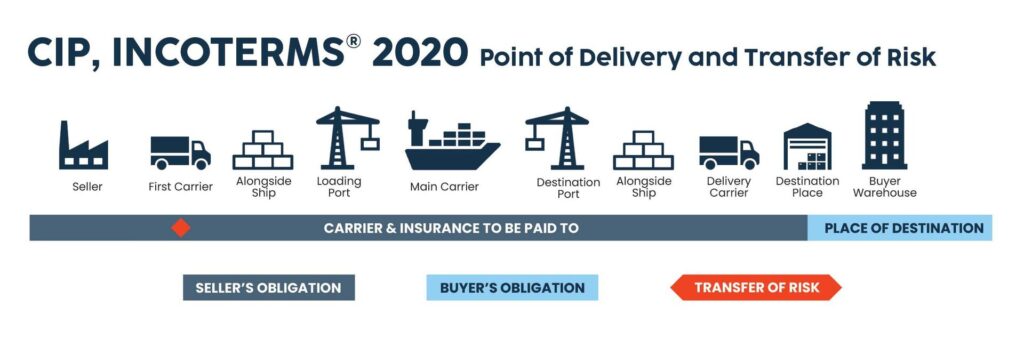
After you receive the goods, any remaining issues related to storage, handling, or distribution become your responsibility as the buyer.
Responsibilities of Buyer and Seller Under CIP Terms
Under CIP terms, the responsibilities between you and the supplier are clearly divided, with the seller handling most of the logistics process and the buyer taking responsibility mainly after arrival in the destination country.
Seller’s responsibilities
If you are sourcing apparel from China under CIP, the supplier is responsible for the full preparation and shipment process. This includes production of your garments, quality control, packaging, export customs clearance in China, arranging transportation (air, sea, rail, or multimodal), and paying for freight and insurance to the agreed destination. The seller ensures that your goods are delivered to the nominated place such as an airport terminal or logistics hub in your country.
Buyer’s responsibilities
Your role begins once the goods arrive at the destination and are ready for import processing. This means you need to handle import customs clearance, pay applicable duties and taxes according to your country’s regulations, and arrange inland transportation from the terminal to your warehouse or final delivery point.
For example, if you are importing apparel under CIP terms from China to Germany, the supplier will take care of production, export procedures, shipping, and insurance. Once the shipment arrives at Frankfurt airport or designated terminal, you will be responsible for clearing customs and completing final delivery arrangements.
CIP significantly reduces your involvement in international shipping management, while still requiring you to manage import procedures and final distribution after the goods arrive in your country.
Who Pays for What Under CIP Terms in Apparel Trade?
Under CIP (Carriage and Insurance Paid To) terms, the payment responsibilities are clearly structured, with the seller covering most of the transportation-related costs, while the buyer is responsible for import-related expenses after arrival.
As a buyer, if you are sourcing apparel under CIP, you do not need to pay for international freight or insurance separately. The seller is responsible for paying the cost of production, export handling, transportation from factory to destination, and cargo insurance up to the agreed location. This means that when you receive a CIP quotation, these logistics costs are already included in the total price provided by the supplier.
For example, if you are purchasing 5,000 hoodies from China under CIP terms, the price you are quoted already includes manufacturing costs, inland trucking, export clearance, shipping charges, and insurance coverage to your destination airport or terminal. You only make one payment to the supplier for the agreed CIP price.
However, once the goods arrive in your country, you are responsible for additional costs such as import customs clearance fees, import duties, taxes, and inland transportation from the terminal to your warehouse or distribution center.
In summary, under CIP terms, the seller pays for production, logistics, and insurance up to the destination point, while you as the buyer handle import and local delivery costs after arrival.

Insurance Under CIP Terms: Optional or Mandatory?
In CIP (Carriage and Insurance Paid To) terms, insurance is not optional for the seller—it is a mandatory obligation. This is one of the key differences between CIP and many other Incoterms used in apparel trade.
When you purchase garments under CIP, the seller is required to arrange and pay for cargo insurance during international transportation. This means that if you are buying apparel from China, your supplier must purchase insurance coverage that protects the goods while they are in transit from the origin country to the agreed destination point, such as an airport or logistics hub in your country.
However, it is important for you to understand that the insurance level under CIP is not fully customizable by default. According to international trade practice, sellers typically purchase a standard level of insurance coverage unless you specifically request a higher coverage or additional protection. This means the protection exists, but the depth of coverage may vary depending on the agreement with your supplier.
For example, if you are importing 10,000 jackets under CIP terms, the supplier will automatically include insurance in the shipping arrangement. If any damage or loss occurs during transportation, you can claim compensation through the insurance policy rather than directly from the supplier.
That said, if your goods are high-value or highly sensitive in quality—such as premium fashion apparel or seasonal collections—you may need to communicate with your supplier in advance to ensure stronger insurance coverage.
In summary, under CIP, insurance is a required part of the seller’s responsibility, not an optional service. However, the level of coverage can still be adjusted depending on your agreement and product requirements.
Advantages and Limitations of CIP for Buyers and Sellers
CIP (Carriage and Insurance Paid To) has different impacts on both buyers and sellers in apparel trade, as it shifts most logistics responsibilities to the seller while still leaving import control to the buyer. Understanding these advantages and limitations can help you decide whether CIP is suitable for your sourcing strategy.
Advantages for Buyers
One of the main advantages is convenience. If you are sourcing apparel from China, CIP allows you to avoid dealing with international freight arrangements and insurance coordination. The supplier handles production, shipping, and insurance, so you only need to focus on receiving goods and completing import procedures. This significantly reduces operational complexity, especially if you do not have an established freight forwarder or logistics team.
Another advantage is risk protection during transit. Since insurance is included under CIP terms, you have financial protection if goods are damaged or lost during transportation. This is especially useful when shipping high-volume apparel orders or time-sensitive seasonal products.
Limitations for Buyers
The first is limited control over logistics decisions. Since the supplier manages freight and insurance, you cannot directly choose carriers or optimize shipping routes and costs. The second limitation is that you still need to handle import customs clearance and local delivery, which means CIP is not a fully door-to-door solution.
Advantages for Sellers
The ability to offer a more complete service package, which can increase competitiveness when dealing with international apparel buyers. It also allows the seller to control the logistics process from factory to destination, ensuring better coordination of production and shipping schedules.
Limitations for Sellers
Sellers also face higher responsibility and cost exposure. They must arrange and pay for international freight and insurance, which increases financial burden. In addition, any delays or issues in logistics may directly affect the seller’s performance obligation, making operational management more complex.
In summary, CIP offers buyers more convenience and risk protection, while giving sellers more control over logistics but also increasing their operational responsibility and cost exposure.
How are CIP Incoterms Different from CPT, DAP, and CIF?
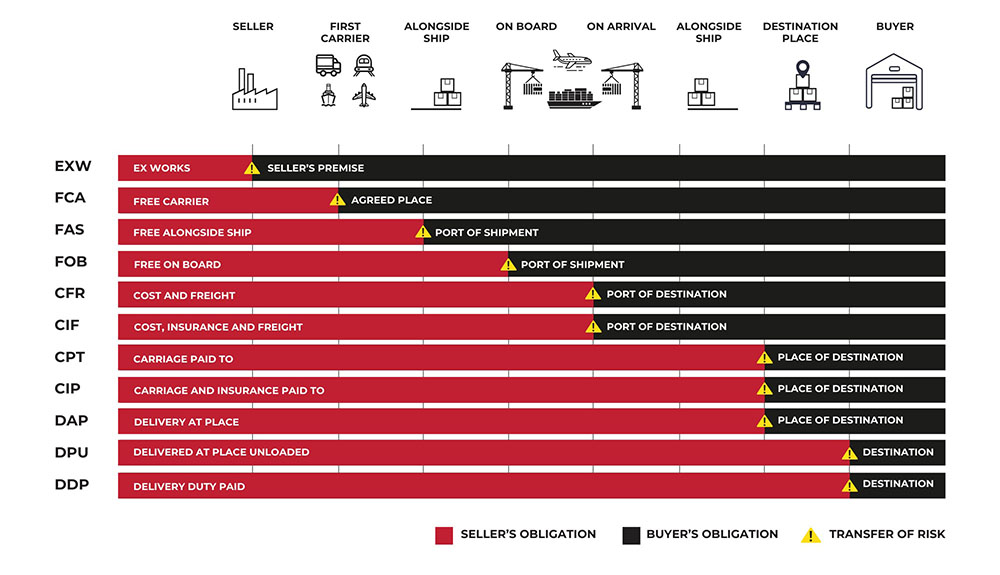
In apparel sourcing, CIP is often compared with CPT, DAP, and CIF because these Incoterms look similar on the surface but differ significantly in insurance responsibility, delivery point, and cost allocation. Understanding these differences helps you choose the right shipping structure based on control, risk protection, and logistics requirements.
CIP vs CPT
The main difference between CIP and CPT (Carriage Paid To) is insurance responsibility.
Under CPT:
- The seller pays for transportation to the destination
- However, the seller is NOT required to provide insurance
- Risk transfers to the buyer once goods are handed to the first carrier
Under CIP:
- The seller pays for both transportation AND insurance
- Insurance is mandatory under CIP and usually has higher coverage
- Risk still transfers early (when goods are handed to carrier), but insurance protection continues during transit
Key insight:
CIP = CPT + insurance obligation
So CIP provides stronger risk protection compared to CPT in apparel shipments.
CIP vs DAP
The difference between CIP and DAP (Delivered At Place) is mainly about who handles import clearance and when delivery is considered complete.
Under DAP:
- Seller delivers goods to a named place (e.g., warehouse or store)
- Seller is responsible for transportation up to destination
- Buyer handles import customs clearance and duties
- Insurance is not mandatory
Under CIP:
- Seller delivers goods to a carrier or destination point, not final warehouse
- Seller pays for transportation and insurance
- Buyer handles import clearance and final delivery after arrival
Key insight:
DAP = delivery closer to final destination
CIP = delivery to destination point + insurance, but not final delivery
So DAP offers more delivery convenience, while CIP focuses more on insured transportation rather than door-to-door service.
CIP vs CIF
The difference between CIP and CIF (Cost, Insurance, and Freight) is mainly about transport flexibility and insurance standard.
Under CIF:
- Only used for sea or inland waterway transport
- Seller pays freight and insurance to destination port
- Insurance level is typically minimum coverage
Under CIP:
- Can be used for air, sea, rail, and multimodal transport
- Seller pays freight and mandatory insurance
- Insurance coverage under CIP is generally higher than CIF
Key insight:
CIF = sea freight only + basic insurance
CIP = all transport modes + stronger insurance requirement
In apparel logistics, CIP is more suitable for fast-moving supply chains, especially air freight shipments, while CIF is more traditional and mainly used for ocean shipping.
Conclusion
CIP is an important Incoterm in international apparel trade that combines transportation and insurance arranged by the seller up to the destination point, while still requiring the buyer to handle import clearance and final delivery. It offers a practical balance between logistics convenience and risk protection, making it widely used in modern global garment sourcing.
As a professional garment manufacturing company, we have extensive experience in apparel production and international export, and we are able to provide comprehensive solutions to support your business across product development, manufacturing, and global shipping coordination. If you need any assistance or have any questions regarding CIP or apparel sourcing from China, please feel free to contact us at any time.