In international import and export trade, trade terms (Incoterms) are professional rules that clearly define the obligations of both buyers and sellers during the transportation of goods, including who is responsible for paying costs and who bears the risks at each stage of shipment. In global apparel sourcing, these terms are extremely important because they directly determine how your goods are priced, shipped, and delivered across borders.
Among these international trade terms, EXW (Ex Works) is one of the most commonly used basic shipping terms in garment manufacturing and sourcing. It represents the minimum responsibility of the seller and the maximum responsibility of you as the buyer, making it essential to fully understand before using it in real transactions.
If you are considering using the EXW shipping term in your apparel sourcing or manufacturing orders, this article will help you understand it clearly from the following key perspectives.
What Is EXW in Apparel Trade?
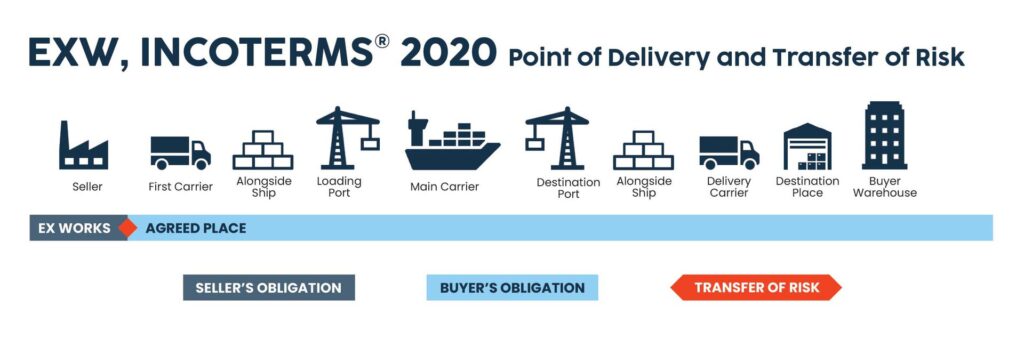
EXW (Ex Works) is an international trade term where the seller’s responsibility is limited to making the goods available at their factory or warehouse, while the buyer takes full control of the entire logistics process from that point onward. In apparel sourcing, EXW is commonly used when you want maximum control over shipping arrangements and cost optimization.
Under EXW terms, the seller only completes production, packaging, and places the goods ready for pickup at the factory gate. From that moment, you as the buyer are responsible for every step of the supply chain, including inland transport in China, export customs clearance, international freight, insurance, and import procedures in your destination country.
EXW Example in Real Apparel Trade
For example, if you are buying 20,000 hoodies from a garment factory in Dongguan under EXW terms,
Once production is completed, the factory notifies you that the goods are ready for pickup. At this stage, the seller’s responsibility ends completely.
You will then need to:
- Arrange a freight forwarder in China
- Pick up the goods directly from the factory warehouse
- Transport the goods to Shenzhen or Guangzhou port
- Handle export customs declaration and documentation
- Arrange international shipping to your destination country
- Manage import customs clearance and local delivery
This means every logistics step after factory readiness becomes your responsibility, not the supplier’s.
The most important feature of EXW is the maximum separation of responsibility between seller and buyer:
- Seller responsibility ends at factory gate
- Buyer assumes full control of logistics and risk immediately
- Export and import processes are handled entirely by the buyer
Advantages and Disadvantages of EXW
In EXW (Ex Works) trade terms, the distribution of responsibilities creates very different advantages and challenges for both buyers and sellers because the seller’s role is minimal while the buyer takes full control of the entire logistics chain.
Advantages for Buyers (You as the Importer):
- You get the lowest possible factory price, since EXW excludes all logistics and export costs
- You have full control over freight forwarders, shipping routes, and cost optimization
- Suitable for buyers who want to consolidate shipments from multiple suppliers in China
In practice, EXW gives you maximum flexibility in managing international logistics and negotiating freight rates.
Disadvantages for Buyers (You as the Importer):
- You must handle everything from factory pickup to final delivery
- Export customs clearance in China can be complex if you lack local experience
- Higher operational risk due to multiple coordination steps across logistics stages
This means EXW is only efficient when you already have a strong logistics network in China.
Advantages for Sellers (Your Supplier in China):
- Minimal responsibility after production is completed
- No need to manage export logistics or international freight
- Lower operational risk and reduced documentation workload
For the seller, EXW is the simplest trade structure.
Disadvantages for Sellers (Your Supplier in China):
- Limited control over shipment after goods leave the factory
- Cannot optimize logistics or ensure delivery performance
- May require coordination support if buyers lack export experience
This is why many suppliers prefer FOB instead of EXW for smoother export operations.
What Is EXW Price in Apparel Trade?
In international apparel sourcing, EXW price (Ex Works price) refers to the pure factory price of the garments, meaning it only covers the cost of producing the goods at the supplier’s factory without any additional logistics or export-related services.
Under EXW terms, the price you receive from the supplier reflects the cost of:
- Fabric and garment production
- Cutting, sewing, printing, and finishing
- Basic packaging and quality control
- Factory profit margin
In simple terms, EXW price = product manufacturing cost only, without any shipping or export handling included.
For example, if you are purchasing 20,000 hoodies from a factory in Dongguan under EXW terms, the EXW price only includes the cost of making the garments inside the factory.
Let’s break it down:
- Fabric and production cost: $42,000
- Printing, stitching, finishing, packaging: $3,000
- Factory operation and QC cost: $2,000
EXW total factory price = $47,000
At this stage, the factory has only completed production and placed the goods ready for pickup. Everything beyond the factory gate is not included in this price.
You will still need to handle:
- Factory pickup in China
- Inland trucking to port or airport
- Export customs clearance
- International freight and insurance
- Import duties and local delivery
The most important feature of EXW pricing is that it shows the true manufacturing cost of the product, without any logistics influence.
In apparel sourcing, EXW pricing is mainly used for factory comparison and cost benchmarking, because it allows you to see the real production cost without hidden shipping components.

When Should You Use EXW ?
EXW (Ex Works) is most suitable when you have strong logistics capability and full control over international shipping, because under this term you are responsible for the entire supply chain from the factory gate to your final destination.
In apparel sourcing, EXW is typically used in situations where you already understand the exporting country’s logistics system, or you have your own freight forwarder or local office in China. This allows you to directly manage pickup, export customs clearance, and international shipping, helping you optimize freight cost and delivery efficiency.
In simple terms, EXW is suitable when you want full control over logistics and already have the ability to manage shipping independently.
For example, if you are buying 15,000 hoodies from a factory in Yiwu, China under EXW terms and shipping them to Los Angeles.
The factory completes production and informs you that the goods are ready at their warehouse. At this stage, the seller’s responsibility ends completely.
You will then need to:
- Arrange a freight forwarder in China to pick up the goods
- Transport the goods from Yiwu to Ningbo or Shanghai port
- Handle export customs declaration
- Arrange international sea or air freight to Los Angeles
- Complete import customs clearance and final delivery in the US
In this case, you control the entire logistics chain, but you also承担 all operational responsibility and risk during transportation.
When EXW Is Not a Good Choice
In practice, EXW is not suitable for most first-time importers because:
- Export customs clearance in China can be complex
- Factory pickup coordination requires local experience
- Freight cost negotiation may be difficult without a local agent
This is why many buyers prefer FOB or CIF, where the supplier helps handle export and shipping arrangements.
EXW vs FOB vs CIF Key Differences Explained
In international apparel sourcing, EXW, FOB, and CIF are three of the most commonly used trade terms, but they represent very different levels of responsibility, cost structure, and logistics control between you and your supplier. Understanding the differences helps you evaluate quotations more accurately and choose the right sourcing strategy.
EXW vs FOB
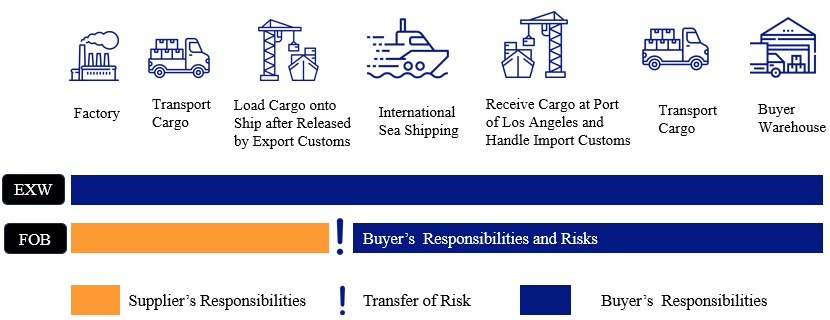
The main difference between EXW and FOB is who is responsible for export handling and transportation to the port in China.
- EXW (Ex Works): You are responsible for everything from factory pickup, inland transport, and export customs clearance
- FOB (Free On Board): The seller is responsible for export clearance and delivering goods to the designated port in China
In simple terms, EXW = buyer handles everything, FOB = seller handles export process and port delivery.
From a cost perspective:
- EXW price = factory production cost only
- FOB price = EXW price + inland logistics + export clearance + port handling
This means FOB reduces your operational burden in China and is often more practical for apparel importers.
EXW vs CIF
The difference between EXW and CIF is how far the seller is responsible in the international shipping process.
- EXW: You handle the entire logistics chain from factory to destination
- CIF (Cost, Insurance and Freight): The seller handles production, export clearance, ocean freight, and insurance to your destination port
In simple terms, EXW gives you full control, while CIF gives you full shipping service up to your port.
From a pricing perspective:
- EXW price = production only
- CIF price = EXW + inland transport + export clearance + ocean freight + insurance
However, even under CIF, you still handle import customs clearance and local delivery in your country.
In apparel trade, EXW is typically used for cost comparison, FOB is most commonly used for container shipments, and CIF is often chosen when buyers want a simpler shipping arrangement without managing freight directly.
As an apparel importer, the choice between EXW, FOB, and CIF is not only about price, but also about how much control and responsibility you want in the logistics chain. A lower price does not always mean lower total cost once shipping, customs, and risk factors are considered.
Conclusion
EXW (Ex Works) is the most basic and buyer-responsible trade term in international apparel sourcing. It offers transparency in production pricing but requires strong logistics capability and full control of the supply chain from factory to final destination.
As an apparel importer, understanding EXW helps you better evaluate supplier quotations and make more informed sourcing decisions, especially when comparing different factories in China.
As a professional garment manufacturing company, we have extensive experience in apparel production and international export, and we are able to provide comprehensive solutions to support your business across product development, manufacturing, and global logistics coordination. If you need any assistance or have any questions regarding EXW or apparel sourcing from China, please feel free to contact us at any time.