In international import and export transactions, the use of Incoterms (International Trade Terms) plays a critical role in helping you clearly understand responsibilities, costs, and risk distribution between buyers and sellers. These standardized trade rules are widely used in global trade negotiations and directly affect how your goods are priced, shipped, and delivered.
Since there are many different Incoterms such as EXW, FOB, CIF, and others, it is easy to feel confused when choosing the right one for your apparel sourcing or manufacturing orders. Each term defines a different level of responsibility and logistics control, which can significantly impact your overall supply chain efficiency and cost structure.
Among these trade terms, CPT (Carriage Paid To) is one of the most commonly used in modern international logistics, especially for multimodal transportation. This article will focus specifically on CPT and explain how it works in real apparel trade from a practical manufacturing perspective.
What Is CPT (Carriage Paid To)?
CPT (Carriage Paid To) is an international trade term published by the International Chamber of Commerce (ICC) that defines how cost and responsibility are shared between a seller and a buyer in global logistics. In apparel trade, CPT is widely used when you want the supplier to handle transportation costs while still maintaining a clear separation of risk responsibility.
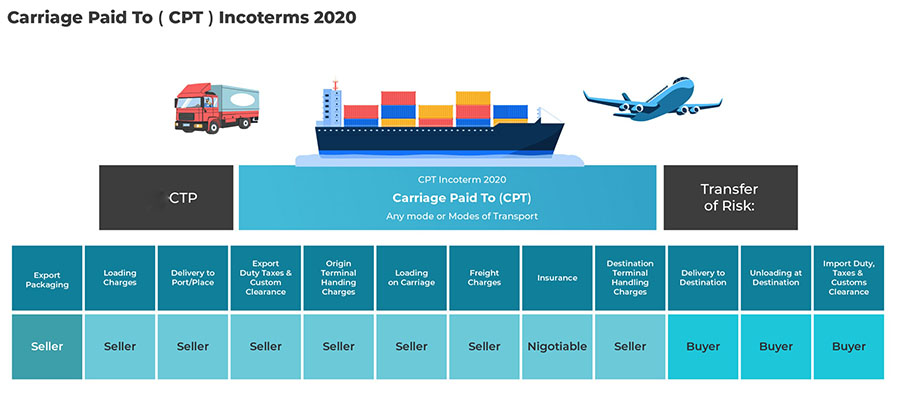
Under CPT terms, the seller is responsible for producing the garments, packaging them, completing export customs clearance in China, and paying for the main carriage (freight) to a named destination such as a port, airport, or logistics hub. This means the seller controls and pays for the transportation cost up to the agreed delivery point.
However, the most important characteristic of CPT is that risk transfers early. Even though the seller pays for shipping, the risk transfers to you as the buyer once the goods are handed over to the first carrier in the origin country.
CPT Example in Real Apparel Trade
For example, if you are buying 20,000 hoodies from a garment factory in Dongguan under CPT Los Angeles terms:
The seller first completes production, packaging, and export customs clearance in China. After that, the seller books the international freight and pays for transportation to Los Angeles, including coordination with shipping lines or airlines depending on the chosen transport method.
However, once the goods are handed over to the first carrier at the origin point in China, the risk immediately transfers to you, even though the seller is still paying for the transportation cost.
During the transit process:
- If goods are lost or damaged after carrier handover → it is your risk
- If goods arrive safely at Los Angeles port → you handle import clearance and local delivery
The most important feature of CPT is the separation of cost responsibility and risk responsibility: Seller pays for freight and Buyer bears transport risk early
This means CPT is not about full protection or door-to-door safety, but about simplifying logistics cost management while keeping an early risk transfer structure.
In apparel sourcing, you can choose CPT when you want the seller to handle shipping arrangements but still maintain flexibility in insurance and downstream logistics decisions.
Responsibilities of Buyer and Seller
In CPT (Carriage Paid To) trade terms, the responsibilities of the buyer and seller are clearly divided, but they are not aligned in the same way as cost and risk. This is why CPT is often misunderstood in international apparel sourcing.
Seller’s Responsibilities (Your Supplier in China)
Under CPT terms, the seller takes full responsibility for the production and transportation arrangement side of the transaction. In apparel trade, this means your supplier will:
- Produce the garments according to your order specifications
- Handle fabric sourcing, cutting, sewing, finishing, and quality control
- Complete packaging and export preparation
- Arrange inland transportation from factory to port or airport in China
- Complete export customs clearance
- Book and pay for international freight to the agreed destination
In simple terms, the seller is responsible for getting your goods shipped and paying for the transportation cost up to the destination point you agreed on.
However, it is important to note that although the seller pays for shipping, they do not carry the transportation risk after handing goods to the first carrier.
Buyer’s Responsibilities (Your Role as Importer)
For you as the buyer, CPT reduces the burden of arranging freight, but you still have important responsibilities in the logistics chain:
- Bear the transportation risk once goods are handed to the first carrier in China
- Arrange and pay for import customs clearance in your country
- Pay import duties, taxes, and related government fees
- Organize inland transportation from destination port to your warehouse or facility
- Arrange insurance if you want protection during transit (not mandatory under CPT)
In simple terms, you do not pay for international freight, but you are still responsible for what happens to the goods during transportation and after arrival.
This means that even though CPT looks like a “seller-arranged shipping” term, you still need to actively manage risk exposure through insurance and reliable logistics coordination.
Advantages and Disadvantages of CPT
In CPT trade terms, the benefits and limitations for both buyers and sellers are closely linked to the fact that cost responsibility and risk responsibility are separated, which directly affects how each party manages the supply chain.
Advantages for Buyers (You as the Importer):
- You do not need to arrange international freight, because the seller handles shipping to the destination
- Logistics coordination is simplified, especially for air or multimodal apparel shipments
- Suitable when you want faster execution without negotiating with multiple carriers
In practice, CPT allows you to focus more on product sourcing and less on shipping operations.
Disadvantages for Buyers(You as the Importer):
- You bear the transportation risk once goods are handed to the first carrier
- You have limited control over freight cost and shipping route selection
- Insurance is not automatically included, so you must arrange it separately if needed
This means even though shipping is “paid by the seller,” you are still exposed to risk during transit.
Advantages for Sellers (Your Supplier in China):
- The seller can control freight arrangements and choose logistics partners
- Useful for building long-term shipping contracts with carriers
- Easier to offer competitive “all-in shipping quotations” to buyers
This helps suppliers provide a more complete service package in export sales.
Disadvantages for Sellers (Your Supplier in China):
- The seller must prepay international freight costs, which increases financial pressure
- More responsibility in coordinating transportation and documentation
- If freight is miscalculated, the seller bears the cost difference
In apparel export, this means the supplier must carefully manage logistics pricing and carrier selection to avoid cost risks.
What Does CPT Price Include?
In international apparel sourcing, the CPT price is not just a product price, but a combined quotation that includes both manufacturing cost and transportation cost up to the agreed destination point. Understanding what is included in CPT pricing is important for you to correctly evaluate supplier quotations and compare different trade terms.
Under CPT terms, the seller calculates the total price by combining production costs and logistics costs up to the named destination, but excluding insurance. This means the price you receive already includes freight, but not protection against transit risk.
In simple terms, CPT price = product cost + inland logistics + export clearance + international freight (no insurance included).
For example, if you are purchasing 20,000 T-shirts from a supplier in China under CPT Los Angeles terms, the CPT price may include:
- Fabric and garment production cost
- Cutting, sewing, printing, and packaging
- Quality control and finishing
- Inland trucking from factory to port in China
- Export customs clearance and documentation
- International freight from China to Los Angeles
All of these combined form the CPT quotation that the seller provides to you.
However, it is important to note that insurance is not included in CPT pricing, which means you need to decide separately whether to purchase cargo insurance to protect your goods during transit.
Who Pays for Under CPT ?
In CPT (Carriage Paid To) trade terms, the payment responsibility is split between the seller and the buyer, and understanding this division is essential when evaluating apparel sourcing quotations from China.

Seller’s Payment Responsibilities (Your Supplier)
Under CPT terms, the seller is responsible for most of the production and transportation-related costs up to the agreed destination point. In apparel trade, this means your supplier will typically pay for:
- Garment production costs (fabric, cutting, sewing, finishing)
- Packaging and quality inspection
- Inland transportation from factory to port or airport in China
- Export customs clearance and documentation
- International freight from China to the named destination
Buyer’s Payment Responsibilities (You as the Importer)
Although CPT looks like a “seller-paid shipping” term, you still have important financial responsibilities on your side:
- Import customs clearance in your country
- Import duties and taxes
- Insurance (if you choose to purchase cargo protection)
- Inland transportation from destination port to warehouse or final location
- Any local handling or distribution costs after arrival
CPT vs CIF vs CIP vs CFR in Apparel Trade
In international apparel sourcing, CPT, CIF, CIP, and CFR are all trade terms that involve seller-arranged transportation, but they differ significantly in terms of risk transfer, insurance coverage, and transport mode applicability. Understanding these differences helps you choose the right term based on your control needs and risk tolerance.
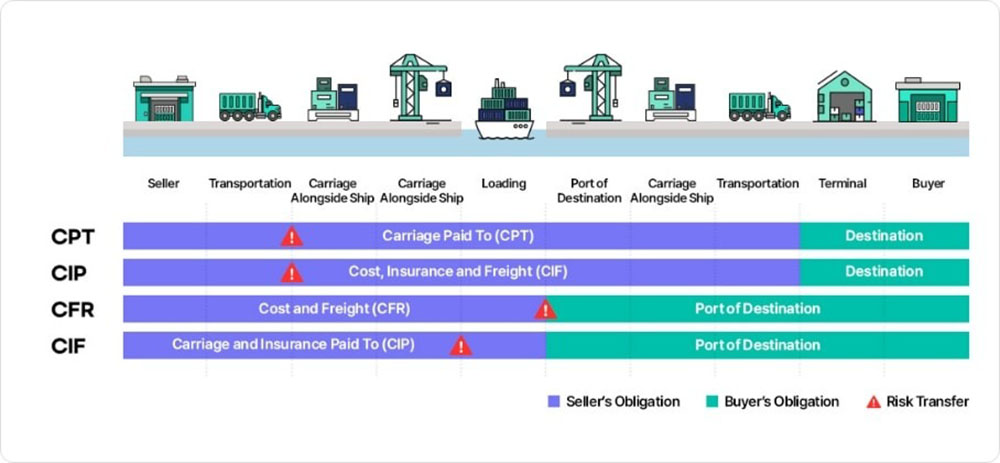
CPT vs CFR
The key difference is: CFR (Cost and Freight) is only used for sea or inland waterway transport, CPT (Carriage Paid To) can be used for any transport mode (sea, air, rail, multimodal)
In both cases, risk transfers when goods are handed to the first carrier or loaded on board (depending on transport structure), meaning you as the buyer still bear transit risk even though freight is paid by the seller.
CPT vs CIF
CPT and CIF differ mainly in insurance coverage and transport limitation: CIF includes insurance + sea freight, CPT includes freight only (no insurance)
In apparel trade, CIF is commonly used for ocean shipments like bulk garment containers, while CPT is often used for air freight or multimodal shipping where insurance needs to be arranged separately by you.
CPT vs CIP
CPT and CIP are the closest pair, but the key difference is: CPT: no insurance included , CIP: insurance is mandatory and arranged by the seller
For you as a buyer, CIP reduces risk exposure during transit because the seller must provide insurance coverage, while CPT requires you to decide whether to insure the shipment yourself.
Conclusion
CPT (Carriage Paid To) is a widely used international trade term in modern apparel sourcing, especially for shipments that involve air freight, sea freight, or multimodal logistics. It provides a clear structure where the seller handles production and transportation costs up to the destination, while the buyer takes responsibility for import procedures and transit risk after handover to the first carrier.
As an apparel buyer, understanding CPT is essential because it directly affects how you evaluate supplier quotations, manage logistics risk, and control overall landed cost in real import operations. Choosing the right trade term helps you balance cost efficiency, shipping convenience, and risk management in global garment sourcing.
As a professional garment manufacturing company, we have extensive experience in apparel production and international export, and we are able to provide comprehensive solutions to support your business across product development, manufacturing, and global logistics coordination. If you need any assistance or have any questions regarding CPT or apparel sourcing from China, please feel free to contact us at any time.