Many buyers assume sweatshirts must contain polyester or blended fibers to work well. That idea comes from the fact that many commercial sweatshirts do use blends for cost, recovery, or easier care. But that does not mean 100% cotton sweatshirts are impossible or impractical. In fact, some of the most respected sweatshirt programs in the market are built on high-quality all-cotton fabric.
Yes, sweatshirts can absolutely be 100% cotton. In many premium and comfort-focused categories, 100% cotton sweatshirts are valued for their natural hand feel, breathability, softness, and authentic casualwear appeal. However, whether 100% cotton is the best choice depends on the sweatshirt’s purpose, because pure cotton may need stronger fabric construction and better finishing to control shrinkage, recovery, and long-term shape retention.
At Fusionknits, we see 100% cotton sweatshirts as a strong product direction when the fabric quality, knit structure, and garment finishing are developed correctly. Pure cotton is not automatically better than every blend, but it is absolutely a valid and often premium material choice in sweatshirt manufacturing. The key is not only whether the garment is 100% cotton. The key is how well that cotton system performs in real wear.
Why Do Some People Think Sweatshirts Cannot Be 100% Cotton?
This idea usually comes from the commercial market. Many sweatshirts sold in mass retail use cotton-polyester blends, so people start to assume that a sweatshirt must be blended to work properly. That is not true. It only reflects one common production approach.
Some people think sweatshirts cannot be 100% cotton because many commercial sweatshirts use blended fleece for better recovery, lower cost, and easier wash stability. Since blends are very common, buyers sometimes mistake “common” for “required,” even though pure cotton sweatshirts are widely made and widely worn.
From a manufacturing perspective, the confusion is understandable. Blends are popular because they help solve practical issues such as shrinkage control, durability, and shape retention. But those benefits do not cancel the value of cotton. They simply explain why the market includes both options.
At Fusionknits, we often explain that sweatshirt material decisions are not about one right answer. They are about product role. A 100% cotton sweatshirt and a cotton-poly sweatshirt can both be successful, but they solve slightly different priorities.
Why the market creates this confusion
- Blended sweatshirts are very common
- Mass retail often favors easier-care fabrics
- Buyers often compare price before fabric logic
- Polyester blends are seen as more stable
- Many schoolwear and promotional sweatshirts use blends
Why this does not mean cotton is unsuitable
Common does not mean necessary
A blended sweatshirt is popular, but that does not make it the only workable option.
Premium markets often use more cotton
Many better sweatshirt programs value the feel and authenticity of pure cotton.
Fabric engineering matters more than assumption
A strong cotton sweatshirt can outperform a weak blend.
| Market belief | Better product reality |
|---|---|
| Sweatshirts need polyester | Not true |
| Blends are the only stable option | Not true |
| 100% cotton is too weak | Depends on fabric quality and construction |
What Does a 100% Cotton Sweatshirt Usually Feel Like?
This is one of the biggest reasons people choose cotton in the first place. Pure cotton often gives a sweatshirt a more natural, softer, and more authentic casualwear feeling than many synthetic-rich alternatives.

A 100% cotton sweatshirt usually feels softer, more natural, and less synthetic than many blends. Depending on the knit structure, it can feel plush and cozy in fleece form or cleaner and more breathable in loopback or French terry form.
At Fusionknits, this natural hand feel is one of the main reasons premium customers continue to prefer cotton-rich and pure-cotton sweatshirts. Cotton often carries a more honest comfort story. It feels approachable, familiar, and easier against the skin. That matters a lot in a repeat-wear category like sweatshirts.
Common feel characteristics of 100% cotton sweatshirts
- Soft natural touch
- Good casual comfort
- Less synthetic surface feel
- More breathable than some heavier blends
- Strong premium-basic identity
Why customers often respond well to cotton
It feels familiar
Most consumers already trust cotton in daily apparel.
It feels more natural
This can increase perceived comfort and product warmth in a non-technical way.
A good all-cotton sweatshirt often feels more intentional and authentic.
| Cotton sweatshirt trait | Customer effect |
|---|---|
| Natural softness | Better first-touch comfort |
| Familiar hand feel | Easier trust |
| Less synthetic feel | Stronger premium casual impression |
What Fabric Structures Are Used in 100% Cotton Sweatshirts?
A 100% cotton sweatshirt is not one fixed fabric. It can be made in several sweatshirt constructions, and each one changes the product’s feel, warmth, and commercial role.
100% cotton sweatshirts are commonly made in brushed fleece, French terry, and loopback cotton constructions. Each structure creates a different product effect, with brushed fleece offering more warmth, French terry offering better all-season balance, and loopback cotton offering a cleaner and often more premium feel.
At Fusionknits, structure matters as much as fiber content. A pure-cotton fleece sweatshirt will feel very different from a pure-cotton loopback crewneck. The fiber label may be the same, but the final product can belong to very different markets.
Common 100% cotton sweatshirt structures
- Brushed cotton fleece
- French terry
- Loopback cotton
- Heavier knit sweatshirt jersey in some markets
Why structure matters so much
It changes comfort
A fleece interior feels warmer and softer than a loopback interior.
It changes seasonality
French terry is often more versatile than heavy fleece.
It changes category identity
Loopback cotton often feels more premium and refined.
| Cotton structure | Best product role |
|---|---|
| Brushed fleece | Warm comfort sweatshirt |
| French terry | Everyday all-season sweatshirt |
| Loopback cotton | Premium breathable sweatshirt |
Are 100% Cotton Sweatshirts Considered High Quality?
They can be, and often they are. But cotton alone is not enough to guarantee quality. The full fabric system still matters. A weak cotton sweatshirt is still a weak sweatshirt. A strong cotton sweatshirt can be excellent.
Yes, 100% cotton sweatshirts can be considered high quality, especially when they use better cotton fiber, strong knit density, good finishing, and balanced construction. Pure cotton often appears in premium basics because it offers a cleaner natural feel and a more authentic casualwear identity.
At Fusionknits, we do not judge sweatshirt quality by the words “100% cotton” alone. We look at cotton quality, fabric density, recovery, surface control, neckline stability, and wash behavior. A high-quality pure-cotton sweatshirt should keep enough softness and enough structure over time. That is what makes it truly premium.
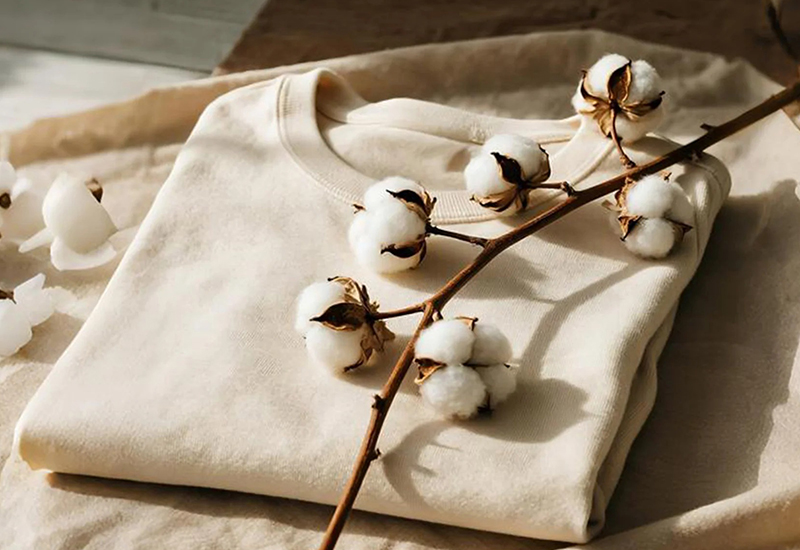
What makes a 100% cotton sweatshirt high quality
- Better cotton fiber
- Strong knit density
- Good brushing or loopback structure
- Better shrink control
- Better neckline and rib balance
- Better wash finish
It supports authenticity
The product feels more natural and less engineered.
Customers often associate pure cotton with a cleaner casualwear story.
It works well in well-developed silhouettes
A good pattern and strong cotton fabric can create excellent results.
| Quality factor | Why it matters in 100% cotton |
|---|---|
| Better fiber | Better softness and stability |
| Better knit density | Better shape control |
| Better finishing | Better wash behavior |
| Better pattern balance | Better long-term wear |
What Are the Advantages of 100% Cotton Sweatshirts?
Cotton remains popular because it solves several product needs naturally. It can feel softer, more breathable, and more comfortable in a way that aligns strongly with what many customers want from a sweatshirt.
The main advantages of 100% cotton sweatshirts are natural softness, strong comfort, breathability, broad consumer trust, and a more authentic casualwear feel. They are especially attractive in premium basics, washed garments, and comfort-focused product lines.
At Fusionknits, we often recommend 100% cotton when a brand wants a stronger natural-material story or a softer premium basic identity. Cotton also works especially well in washed and garment-dyed programs because it takes on a more character-driven visual result in many cases.
Main advantages of 100% cotton
- Natural hand feel
- Better breathability
- Strong comfort perception
- Strong premium-basic appeal
- Familiar and trusted material story
- Good compatibility with garment washes
Why these advantages matter commercially
Customers often seek natural fibers
Cotton remains one of the easiest materials to trust.
Comfort is a core sweatshirt value
Cotton supports this very well.
The product can feel more authentic
Especially in vintage, washed, and premium casual collections.
| Cotton advantage | Product benefit |
|---|---|
| Natural softness | Better comfort story |
| Breathability | Better daily wear feel |
| Strong material recognition | Easier market acceptance |
| Wash compatibility | Better vintage or garment-dyed potential |
What Are the Limitations of 100% Cotton Sweatshirts?
Cotton is strong in many ways, but it is not perfect. If the product is not developed carefully, pure cotton can show some weaknesses faster than a good blend.

The main limitations of 100% cotton sweatshirts are usually lower recovery, higher shrink risk, and potentially weaker long-term shape retention compared with some well-engineered blends. Pure cotton may also feel heavier when wet and may require more careful finishing to perform well after repeated washing.
At Fusionknits, these are not reasons to reject cotton. They are reasons to engineer it correctly. A poor-quality 100% cotton sweatshirt may shrink, twist, or lose structure too fast. But these issues are more about fabric and finishing quality than about the idea of cotton itself.
Common limitations of pure cotton
- Higher shrink risk
- Lower elastic recovery
- More sensitivity to weak finishing
- Potentially faster shape loss in weak knits
- Heavier moisture absorption
Why these limits matter
Sweatshirts are repeat-wash garments
Any weakness will show up over time.
Structure matters in modern fits
Oversized and premium silhouettes need enough stability.
Better finishing becomes more important
Cotton needs strong development discipline to perform at a high level.
| Cotton limitation | Product risk |
|---|---|
| Shrinkage | Fit inconsistency |
| Lower recovery | Weaker long-term shape |
| Moisture absorption | Heavier feel when damp |
| Weak finishing | Faster quality drop |
Are 100% Cotton Sweatshirts Better Than Cotton-Poly Blends?
Not always. The better answer depends on what the sweatshirt is designed to do. A premium natural-feel basic may be stronger in pure cotton. A high-volume everyday commercial sweatshirt may be stronger in a blend.
100% cotton sweatshirts are not always better than cotton-poly blends. Pure cotton is often better for natural comfort, breathability, and premium casualwear. Cotton-poly blends are often better for durability, recovery, lower shrink risk, and broader everyday practicality. The better option depends on product purpose, not on one fixed rule.
At Fusionknits, we usually compare cotton and blends by category role. If the brand wants stronger natural-fiber storytelling and a premium washed look, cotton may be the best answer. If the brand wants reliable commercial performance and easier care at scale, a blend may be smarter.
When 100% cotton is often better
- Premium basics
- Washed sweatshirts
- Natural-material brand stories
- Cleaner premium casualwear
- Brands focused on cotton comfort
When cotton-poly is often better
Broader commercial basics
The product usually needs easier repeat performance.
Schoolwear and promotional categories
Stability and durability often matter more than natural-fiber purity.
High-volume casualwear
Blends often give more cost and performance flexibility.
| Product goal | Better material direction |
|---|---|
| Premium natural feel | 100% cotton |
| Broad durability and stability | Cotton-poly blend |
| Vintage-washed casualwear | Often 100% cotton |
| School or team sweatshirt | Often cotton-poly blend |
Are 100% Cotton Sweatshirts Easy to Care For?
They are usually easy enough for general use, but they require respect for the fabric. Cotton is washable and practical, but harsh care can reduce the value of the garment more quickly than necessary.
100% cotton sweatshirts are generally easy to care for, but they should be washed with attention to shrinkage, color retention, and fabric recovery. Mild detergent, controlled washing temperatures, and lower drying heat usually help them perform much better over time.
At Fusionknits, care discipline is especially important for all-cotton garments because the customer often expects a long lifespan. A strong cotton sweatshirt should not be difficult to own, but it should be treated as a repeat-wear garment that deserves reasonable maintenance.
Better care habits for 100% cotton sweatshirts
- Wash with similar garments
- Use mild detergent
- Avoid excessive heat
- Turn inside out when appropriate
- Dry with lower heat or air dry when possible
- Follow garment-specific care instructions
Why care matters more in pure cotton
Cotton reacts more visibly to heat and agitation
This can affect shrinkage and shape.
Better care protects surface quality
The garment keeps a cleaner appearance longer.
A better-looking sweatshirt stays wearable for more time.
| Care habit | Benefit |
|---|---|
| Lower heat | Better shrink control |
| Gentle wash | Better surface life |
| Correct sorting | Less abrasion |
| Proper drying | Better shape retention |
What Type of Brand Should Choose 100% Cotton Sweatshirts?
Pure cotton is not for every sweatshirt program, but it can be a very strong answer for the right kind of brand. The best match usually comes when the brand is clear about what it wants the sweatshirt to communicate.
Brands that focus on premium basics, natural comfort, washed casualwear, minimalist everyday luxury, or authentic cotton-led casualwear are often strong candidates for 100% cotton sweatshirts. These brands usually benefit from the fabric’s natural hand feel, breathable comfort, and cleaner material story.
At Fusionknits, 100% cotton is often a strong fit for brands that want the product to feel calm, real, and premium rather than overly technical or mass-commercial. It also works well when the brand wants to build trust through fabric honesty and tactile quality.
Brands that often suit 100% cotton best
- Premium basics brands
- Minimalist casualwear labels
- Vintage-wash and garment-dye brands
- Natural-material-focused collections
- Elevated lounge and comfortwear programs
Why this material fits these brands
The product story stays clear
Cotton supports a natural and easy-to-understand value promise.
The hand feel helps the brand identity
Customers often connect cotton with comfort and authenticity.
The sweatshirt becomes more tactile
Touch matters a lot in premium casual categories.
| Brand type | Why 100% cotton fits |
|---|---|
| Premium basics | Better natural hand feel |
| Vintage casualwear | Better wash and character story |
| Minimal lifestyle | Cleaner material identity |
| Natural-fiber brand | Stronger message consistency |
How Should Buyers Decide If 100% Cotton Is Right for Their Sweatshirt?
The strongest decision comes from asking what the sweatshirt needs to do, not from asking which fiber sounds best. Product role should always come first.
Buyers should choose 100% cotton for sweatshirts when the goal is natural comfort, premium feel, better breathability, and a more authentic casualwear identity. If the product instead needs stronger recovery, lower shrink risk, easier commercial durability, or lower maintenance risk, a strong blend may be more suitable.
At Fusionknits, we usually recommend a practical review process. What price level does the product need to support? Is the sweatshirt premium or broad commercial? Is natural feel more important than easier recovery? Will the garment be heavily washed or more lifestyle-worn? These questions usually make the answer much clearer.
Better buyer questions
- Is the sweatshirt premium or broad commercial?
- Does the customer care strongly about natural fibers?
- How important is shape retention after repeated wear?
- Will the garment be garment-dyed or heavily washed?
- Is the product meant to feel soft and natural or more stable and easy-care?
Why this process works
It keeps the decision product-led
The material matches the true goal of the garment.
It reduces material mismatch
The sweatshirt performs more honestly in use.
It improves collection planning
Different product tiers can use different fabric logic clearly.
| Buyer priority | Better direction |
|---|---|
| Natural premium feel | 100% cotton |
| Easy commercial stability | Cotton-poly blend |
| Washed casual identity | Often 100% cotton |
| Stronger recovery needs | Often blend |
Conclusion
Yes, sweatshirts can absolutely be 100% cotton, and in many premium and comfort-focused categories they are a very strong material choice. Pure cotton sweatshirts are valued for their natural softness, breathability, familiar hand feel, and authentic casualwear character. They can be made in brushed fleece, French terry, or loopback constructions depending on the product role.
However, 100% cotton is not automatically the best answer for every sweatshirt. It may need stronger knit density, better finishing, and more careful wash control to manage shrinkage, recovery, and long-term shape retention. That is why the full fabric system matters more than the fiber label alone.
At Fusionknits, we see 100% cotton sweatshirts as a strong option when the product is designed with the right purpose and developed with enough discipline. They are especially effective in premium basics, washed casualwear, and natural-material programs. The best sweatshirt material decision is always product-led. When buyers understand what the sweatshirt needs to do, they can decide whether 100% cotton is the right answer or whether a blend will perform better for that specific role.