In international trade, especially in global apparel sourcing, buyers and sellers frequently use Incoterms such as EXW, FOB, CIF, and other three-letter trade terms during negotiation and contract discussions. These terms define how responsibilities, costs, and risks are divided between both parties in the shipping process.
For many new buyers, these trade terms can be confusing at first—you may not clearly understand what each term means in shipping, who is responsible for transportation, or which option is most suitable for your order when sourcing garments from overseas suppliers.
In practice, Incoterms are widely used and flexible in international trade agreements. Even small changes in responsibility allocation between you and your supplier can shift the trade structure from one term to another, which directly affects pricing and logistics arrangements.
This article explains the 11 most commonly used international trade terms from a practical garment manufacturing perspective, helping you clearly understand how each term works in real apparel export operations.
What Are Incoterms ?
Incoterms, short for International Commercial Terms, are a set of standardized trade rules published by the International Chamber of Commerce (ICC) that define the responsibilities of buyers and sellers in international trade.
In global apparel sourcing, these rules clearly explain who is responsible for production, transportation, insurance, export clearance, and import duties, as well as the exact point where risk transfers from seller to buyer during the shipping process.
For example, when you are importing garments such as T-shirts or hoodies from China, Incoterms help determine whether the supplier only delivers goods to the factory gate (EXW), to a shipping port (FOB), or all the way to your destination warehouse (DAP or DDP). They also define whether you or the supplier is responsible for freight costs and cargo insurance.
In simple terms, Incoterms are the “rules of responsibility” in international trade—they standardize how global buyers and sellers cooperate, reduce misunderstandings, and ensure both parties clearly understand their obligations in the supply chain.
What Are the 11 International Trade Terms?
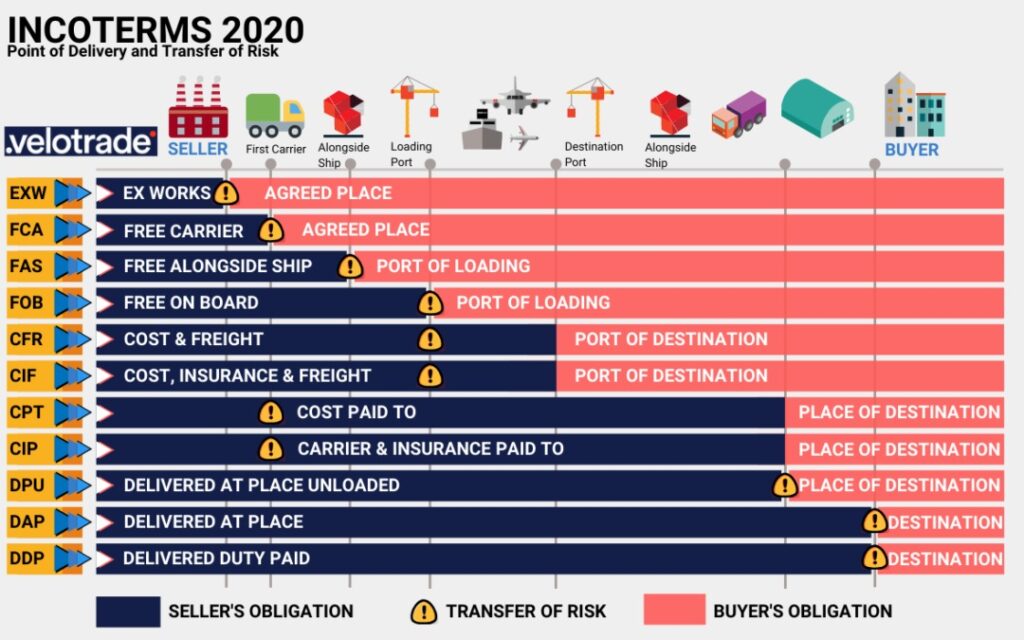
In international trade, the 11 Incoterms (International Commercial Terms) are standardized shipping rules published by the International Chamber of Commerce (ICC). They define how responsibilities, costs, and risks are divided between buyers and sellers during global transactions.
In apparel sourcing and garment manufacturing, these 11 terms are used to clearly determine:
- Who is responsible for production and packaging
- Who pays for inland transport and export clearance
- Who arranges international freight and insurance
- When risk transfers from seller to buyer
- Where delivery is considered completed
11 Types of Incoterms:
EXW(Ex Works)
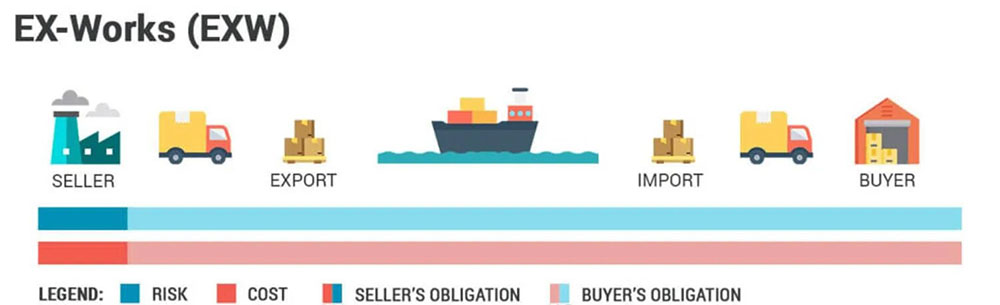
EXW (Ex Works) is the trade term that gives the maximum responsibility to the buyer and the minimum obligation to the seller in international apparel sourcing.
Under EXW terms, the seller’s responsibility is limited to simply producing and packaging the garments and making them available at the factory location. From that point onward, you as the buyer take full control of the entire logistics chain, including inland transportation in China, export customs clearance, international freight booking, insurance, and import procedures in your destination country.
In apparel trade, EXW is often used when buyers want full control over logistics or when they already have established freight forwarders in China. However, it is also one of the most operationally complex terms for inexperienced buyers because it requires coordination with Chinese export procedures and local transport arrangements.
FOB (Free On Board)
FOB (Free On Board) is one of the most widely used trade terms in global apparel sourcing, especially when buying garments such as T-shirts, hoodies, and sweatpants from China. It represents a balanced responsibility structure between the seller and the buyer, and is considered the standard model in most international garment export transactions.
Under FOB terms, the seller is responsible for producing the goods, arranging packaging, handling inland transportation in China, completing export customs clearance, and delivering the goods to the designated port. The seller’s responsibility ends once the goods are loaded onto the vessel nominated by the buyer. From that point onward, you as the buyer take control of international shipping, insurance, and import clearance.
For example, if you are purchasing 20,000 hoodies from a garment factory in Dongguan under FOB Shenzhen terms, the cost breakdown typically includes:
- Fabric and production cost
- Printing, sewing, packaging, and QC
- Inland trucking from factory to Shenzhen port
- Export declaration and port handling charges
All of these combined form the FOB price, which represents the total cost delivered to the port of shipment.
Once the goods are loaded onto the vessel at Shenzhen Port, the responsibility and risk transfer to you. From this stage, you will arrange ocean freight, insurance, import customs clearance, and final delivery to your warehouse.
For FOB price, FOB price = Product cost + China domestic logistics + export clearance,it does not include international shipping or insurance, which is why it is often used as a transparent baseline for comparing supplier manufacturing costs in China.
CIF (Cost, Insurance, and Freight)
CIF (Cost, Insurance, and Freight) is a commonly used trade term in apparel sourcing when buyers prefer the supplier to manage international shipping arrangements. In garment trade from China, CIF is often used for standard export shipments such as T-shirts, hoodies, and casual wear where buyers want a simpler logistics process.
Under CIF terms, the seller is responsible for production, packaging, inland transportation in China, export customs clearance, arranging ocean freight, and purchasing basic cargo insurance. The seller delivers the goods to the destination port specified by you, but the key point is that risk does not fully transfer at destination arrival. Instead, risk transfers once the goods are loaded onto the vessel at the port of origin.
In simple terms, CIF means the seller ships the goods and insures them up to your destination port, but you still handle import clearance and inland delivery.
if you are buying 20,000 T-shirts from a factory in China under CIF Los Angeles terms, the cost structure typically includes:
- Fabric and production cost
- Printing, sewing, packaging, and QC
- Inland trucking from factory to port in China
- Export customs clearance
- Ocean freight from China to Los Angeles Port
- Basic cargo insurance
All of these combined form the CIF price, which is the total cost delivered to your destination port.
Once the goods are loaded onto the vessel in China, the risk is transferred to you as the buyer, even though the seller has already arranged freight and insurance. If damage or loss occurs during shipping, claims are usually handled through the insurance policy.
CIF price is essentially: CIF price = FOB cost + ocean freight + insurance
Compared with FOB, CIF adds international logistics costs into the seller’s quotation, making it more convenient but less transparent in freight control for the buyer.
FCA (Free Carrier)
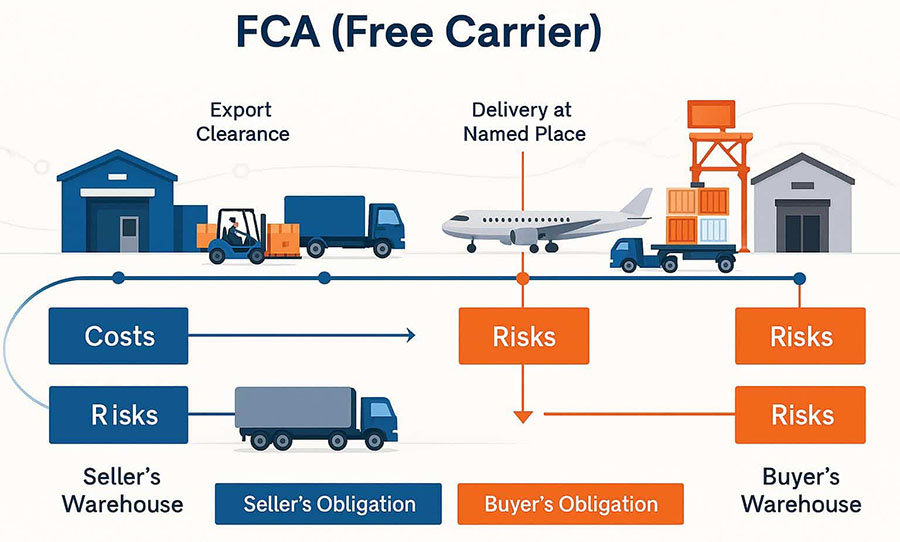
FCA (Free Carrier) is a flexible international trade term that is widely used in modern apparel sourcing, especially when shipments involve different transport modes such as air freight, sea freight, or consolidated logistics.
Under FCA terms, the seller is responsible for producing the garments, packaging them, and completing export customs clearance in China. The seller then delivers the goods to a carrier or logistics point nominated by you, which could be a freight forwarder’s warehouse, airport terminal, or shipping hub. Once the goods are handed over to the carrier, the responsibility and risk transfer to you as the buyer.
In simple terms, FCA means the seller delivers goods to your appointed logistics partner, and from that point onward, you take control of the main transportation process.
FCA gives more control over international freight decisions while still allowing the supplier to handle export procedures in the origin country. However, it also requires coordination with your nominated carrier to ensure smooth handover of goods.
FAS (Free Alongside Ship)
FAS (Free Alongside Ship) is an Incoterm used in international trade where the seller delivers goods alongside the vessel at the designated port of shipment. In apparel sourcing, it is rarely used compared to FOB or CIF, but it still represents a clear responsibility structure in maritime shipping.
FAS means the seller delivers the goods to the port side of the ship, but you are responsible for loading them onto the vessel and handling everything afterward.For you as a buyer, this means you must coordinate with a shipping line or freight forwarder who will handle the loading process and international transport. This makes FAS more complex in practice, especially in apparel trade where containerized shipments are the standard.
Compared with FOB, FAS shifts the loading responsibility earlier in the process, meaning you take over control before the goods are actually on board the vessel. This increases your operational involvement at the port level.
CFR (Cost and Freight)
CFR (Cost and Freight) is a commonly used maritime trade term in international apparel sourcing, especially when you are purchasing garments from China and want the supplier to handle international shipping without including insurance.
Under CFR terms, the seller is responsible for producing the garments, packaging, inland transportation to the port, export customs clearance, and arranging ocean freight to your nominated destination port. This means the supplier controls the entire shipping arrangement up to the port of arrival in your country.
CFR means the seller pays for shipping to your destination port, but does not cover cargo insurance.
The key difference is that although freight is included in the price, you still need to arrange insurance yourself to protect your goods during sea transportation. This makes CFR slightly riskier compared to CIF, because any damage or loss during transit is not automatically covered by the seller’s insurance arrangement.
In terms of risk transfer, CFR works the same way as FOB and CIF: risk transfers once the goods are loaded onto the vessel at the port of origin, not when they arrive at your destination port. This is an important point you should pay attention to when calculating total landed risk exposure.
CPT (Carriage Paid To)
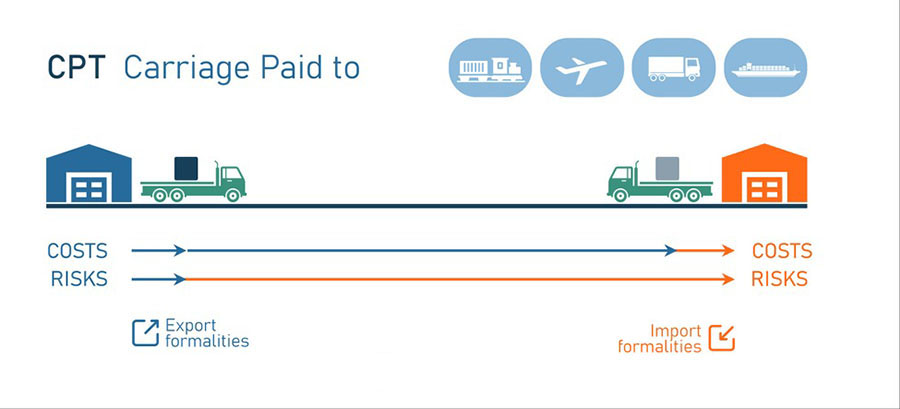
CPT (Carriage Paid To) is a flexible international trade term that is widely used in modern apparel logistics, especially when you are shipping garments such as T-shirts, hoodies, or sweatpants through air freight, sea freight, or multimodal transport.
Under CPT terms, the seller is responsible for producing the goods, packaging, export customs clearance in China, and paying for the main transportation cost to the destination specified by you. This means the supplier arranges and pays for the freight to the agreed delivery location, but does not take responsibility for insurance unless it is separately agreed.
CPT means the seller pays for shipping to a destination point, but you are responsible for insurance and import procedures.
One important point to understand is that risk does not transfer at the destination arrival, but instead transfers earlier—once the goods are handed over to the first carrier (for example, a shipping line, airline, or logistics provider in China). This is a key difference you should pay attention to when comparing CPT with CIF or DAP.
Compared with CFR, CPT is more flexible because it can be used for all transport modes, not only sea freight. This makes it suitable for modern apparel supply chains where air shipments or multimodal logistics are commonly used for faster delivery.
CIP (Carriage and Insurance Paid To)
CIP (Carriage and Insurance Paid To) is a commonly used international trade term in modern apparel sourcing, especially when you are shipping garments such as T-shirts, hoodies, jackets, or sportswear through air freight, sea freight, rail, or multimodal logistics.
Under CIP terms, the seller is responsible for producing the goods, packaging, export customs clearance in China, arranging and paying for the main transportation, and purchasing cargo insurance to cover the shipment up to the agreed destination. This means the supplier takes care of both freight and insurance, giving you a more complete logistics service compared to CPT.
CIP means the seller pays for shipping and insurance to your destination, but you still handle import clearance and local delivery.
One important point is that risk still transfers early in the process. Even though the seller pays for insurance, risk transfers once the goods are handed over to the first carrier, not when the goods arrive at your destination.
DPU (Delivered at Place Unloaded)
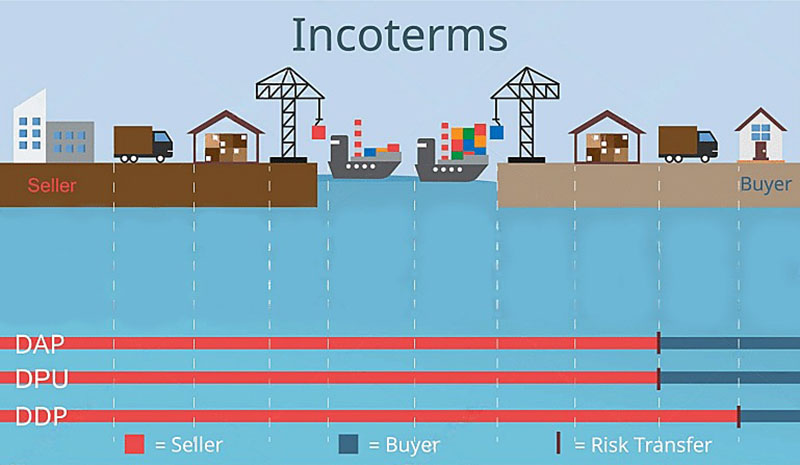
DPU (Delivered at Place Unloaded) is an international trade term that defines a destination-based delivery model in global apparel sourcing. It is commonly used when you want the seller to take responsibility for delivering goods all the way to your designated location and unloading them.
Under DPU terms, the seller is responsible for production, packaging, export customs clearance in China, inland transportation, international shipping, and delivery to the named destination. A key feature of DPU is that the seller must also unload the goods at the destination place, which makes it one of the few Incoterms where unloading is included in the seller’s responsibility.
DPU means the seller delivers and unloads the goods at your destination, while you handle import customs clearance and any related taxes or duties.
This term significantly reduces your logistics workload because the seller manages almost the entire transportation chain from factory to destination. However, you still need to complete import clearance and arrange what happens after unloading, such as warehousing or final distribution.
In terms of risk transfer, under DPU, the risk remains with the seller until the goods are delivered and successfully unloaded at the destination location. This is a key difference compared to terms like CPT or CIP, where risk transfers much earlier in the shipment process.
DAP (Delivered at Place)
DAP (Delivered at Place) is a widely used destination-based trade term in international apparel sourcing, especially when you want the supplier to take responsibility for delivering goods all the way to your specified location.
Under DAP terms, the seller is responsible for production, packaging, export customs clearance in China, inland transportation, international shipping, and delivery to your named destination address. However, unlike DPU, the seller is not responsible for unloading the goods, which means you will need to arrange unloading upon arrival.
DAP means the seller delivers the goods to your destination, but you are responsible for unloading, import customs clearance, and import duties. DAP significantly simplifies the logistics process because you do not need to manage international freight or coordinate multiple transport stages. The supplier handles the entire transportation chain up to your destination, which reduces your operational workload and coordination risk.
In terms of risk transfer, under DAP, the risk remains with the seller until the goods arrive at your designated place and are ready for unloading. This means you are not responsible for transportation risks during the journey, but you do take responsibility once the goods reach the destination point.
DDP (Delivered Duty Paid)
DDP (Delivered Duty Paid) is the most buyer-friendly international trade term in apparel sourcing, especially when you want the supplier to take full responsibility for the entire logistics process from factory to your final destination.
Under DDP terms, the seller is responsible for production, packaging, export customs clearance in China, international freight, insurance (if applicable), import customs clearance, import duties, taxes, and final delivery to your warehouse or specified address. This means the supplier manages the entire supply chain end-to-end, including both origin and destination procedures.
In simple terms, DDP means the seller delivers the goods directly to your door, fully cleared and duty paid, with almost no operational involvement required from you.
DDP is the most convenient option because it removes nearly all logistics complexity. You do not need to coordinate freight forwarders, handle customs documentation, or manage import taxes. However, because the supplier controls the entire process, the total cost is usually higher compared to terms like FOB or EXW.
In terms of risk transfer, under DDP, the seller bears almost all risks until the goods are delivered to your final destination. Only after successful delivery does the responsibility fully transfer to you.
Prepaid vs Collect Freight in Apparel Trade
In international apparel sourcing, one of the most practical distinctions you need to understand is whether freight is prepaid or collect, because this directly affects how you control shipping costs and manage cash flow in your import process.
When freight is prepaid (freight prepaid), it means the seller pays for the international transportation in advance and includes the shipping cost in the quotation. In this case, you will see terms like CIF, CFR, CPT, or CIP. For you as a buyer, this simplifies the transaction because you receive a more “all-in” price structure, but you have less visibility and control over the actual freight cost paid to the shipping line.
On the other hand, when freight is collect (freight collect), it means you as the buyer pay the shipping cost directly to the carrier or freight forwarder once the goods are shipped or arrive at the destination port. This is common under FOB, FCA, or EXW terms. In this structure, you have more control over the logistics provider, shipping routes, and freight negotiation.
For you as an apparel buyer, the key difference is not only who pays the freight, but also who controls the logistics decision-making. Prepaid freight offers simplicity and convenience, while collect freight provides better cost transparency and optimization opportunities.
Conclusion
International trade terms are the foundation of global apparel sourcing. They define how responsibility, cost, and risk are distributed between buyers and sellers, and directly affect how your garments move from production in China to final delivery in your country. Whether you are using EXW, FOB, CIF, or DDP, each term represents a different level of logistics control and operational responsibility, and choosing the right one is essential for managing cost efficiency and supply chain stability.
Understanding these 11 Incoterms helps you avoid misunderstandings in pricing and shipping arrangements, and allows you to make more informed sourcing decisions in real apparel trade operations.
As a professional garment manufacturing company, we have extensive experience in apparel production and international export, and we are able to provide comprehensive solutions to support your business across product development, manufacturing, and global shipping coordination. If you need any assistance or have any questions regarding international trade terms or apparel sourcing, please feel free to contact us at any time.