
In international import and export trade, DDP (Delivered Duty Paid), DDU (Delivered Duty Unpaid), and DAP (Delivered at Place) are commonly used logistics terms that define how goods are delivered from the seller to the buyer. However, in real apparel sourcing and global shipping practice, many buyers and even some sellers do not fully understand these terms, which often leads to confusion in cost calculation, customs handling, and delivery responsibility.
In actual cross-border trade operations, misunderstanding these Incoterms can result in unexpected import taxes, delayed customs clearance, or unclear responsibility when goods arrive at destination ports or warehouses. Therefore, So whether you are a buyer or seller, knowing these variations —especially these door-to-door shipping terms—is essential for make an a good sourcing decisions and avoid unnecessary logistics risks.
This article explains DDP, DDU, and DAP from a practical apparel manufacturing and export perspective, helping you clearly understand how each term works in real international logistics, how costs are structured, and how responsibilities are divided between buyers and sellers.
What is DDP?
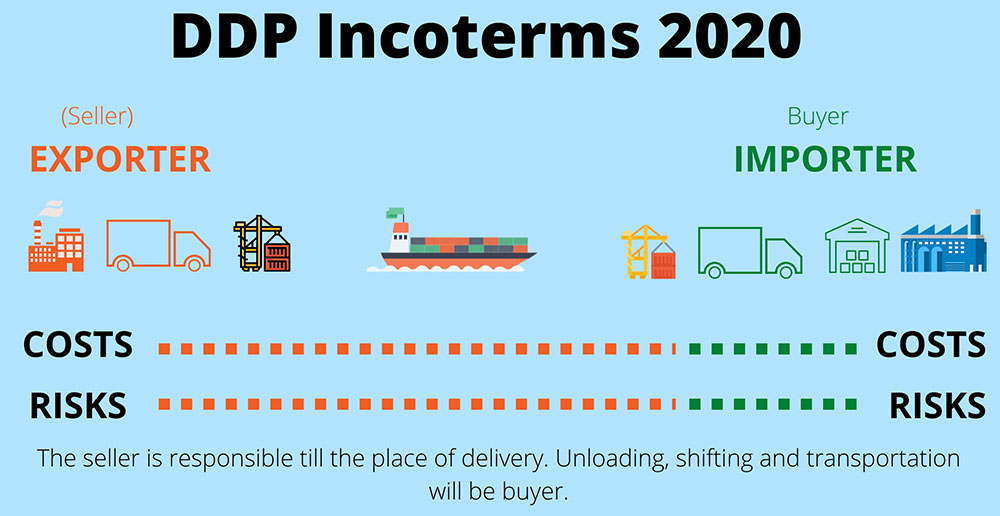
DDP (Delivered Duty Paid) is one of the most comprehensive and buyer-friendly Incoterms in international logistics, especially widely used in apparel sourcing for e-commerce sellers and brand owners who prefer a fully managed shipping solution. Under DDP terms, the seller is responsible for delivering the goods directly to your final destination, such as your warehouse, fulfillment center, or retail location, and the seller also bears all costs and risks throughout the entire transportation process.
This includes production, packaging, export customs clearance in China, international freight, import customs clearance in your country, payment of import duties and taxes, and final delivery to your door. In other words, DDP represents a fully door-to-door service with almost zero logistics burden on your side.
For example, if you are importing 8,000 hoodies from a factory in Dongguan to a warehouse in Los Angeles under DDP terms, the supplier will manage the entire logistics chain. The factory first completes production, packaging, and export declaration in China, then arranges international shipping by sea or air, and continues to handle import customs clearance in the United States, including tariff payments and compliance procedures.
After customs clearance is completed, the goods are delivered directly to your warehouse in Los Angeles. At no point in this process do you need to coordinate freight forwarding, customs brokers, or tax payments.
This makes DDP the most convenient but also usually the highest-cost Incoterm, as all logistics risks and fees are bundled into the seller’s quotation.
What is DDU?
DDU (Delivered Duty Unpaid) is an older but still commonly used door-to-door shipping term in international trade, especially in informal apparel sourcing discussions. Although DDU has been officially replaced by DAP under modern Incoterms rules, many suppliers and buyers still use it in practice when describing shipping arrangements.
Under DDU terms, the seller is responsible for delivering the goods all the way to your destination country, including production, packaging, export customs clearance in China, and international transportation. However, once the goods arrive in the destination country, the buyer is responsible for import customs clearance, import duties, and taxes before receiving the shipment.
For example, if you are importing 10,000 T-shirts from a factory in Guangzhou to a warehouse in New York under DDU terms, the supplier will manage production, export declaration, and international shipping from China to the United States.
Once the shipment arrives at the US port, you will need to:
- Arrange customs clearance through a local broker
- Pay import duties and taxes
- Submit required import documentation
- Handle clearance before the goods can be released
Only after customs clearance is completed can the goods be delivered from the port to your warehouse.
The most important feature of DDU is the clear split between international transport and import clearance responsibility
What is DAP?
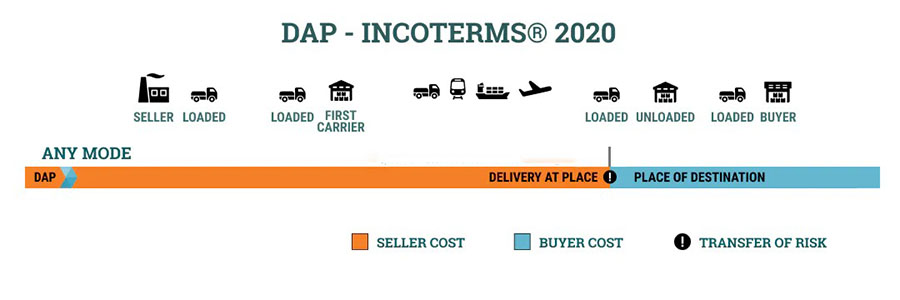
DAP (Delivered at Place) is a widely used international trade term in modern apparel sourcing, where the seller is responsible for delivering goods to a named destination agreed with the buyer, such as a warehouse, distribution center, or logistics hub in the buyer’s country. Under DAP terms, the seller covers almost all logistics costs and risks until the goods arrive at the specified destination, but the buyer is responsible for import customs clearance and import duties/taxes.
Compared with older trade terms like DDU, DAP is the standardized version under Incoterms 2010 and 2020, but in real trade practice, both terms are still commonly used to describe similar “door-to-door but tax-excluded” shipping arrangements.
For example, if you are importing 12,000 sweatshirts from a factory in Hangzhou to a warehouse in Chicago under DAP terms, the supplier will manage production, packaging, export customs clearance in China, and international transportation to the United States.
Once the goods arrive at the destination port or warehouse area in Chicago, you will be responsible for:
- Import customs declaration
- Payment of import duties and taxes
- Coordination with a customs broker for clearance
After customs clearance is completed, the goods can be released and delivered to your warehouse.
The key feature of DAP is the clear separation between transport responsibility and import tax responsibility.Compared with DDP, DAP reduces seller responsibility at destination customs, while still providing a full door-to-door logistics structure before import clearance.
Why DAP Replaced DDU?
DAP was introduced in Incoterms 2010 to replace DDU (Delivered Duty Unpaid) and unify several outdated trade terms into a clearer and more standardized system.
The main reasons for replacing DDU with DAP include:
- Standardization: DAP simplifies multiple older terms (DDU, DAF, DES) into one unified rule
- Clearer terminology: “Delivered at Place” clearly defines delivery location without ambiguity
- Modern logistics compatibility: DAP better fits multimodal transportation systems (sea, air, rail, and door-to-door logistics)
- Reduced contract confusion: eliminates inconsistent use of DDU across different countries and contracts
In simple terms, DAP replaced DDU because it provides a more modern, clearer, and globally standardized framework for international logistics.
Key Difference in DDP vs DAP (DDU)
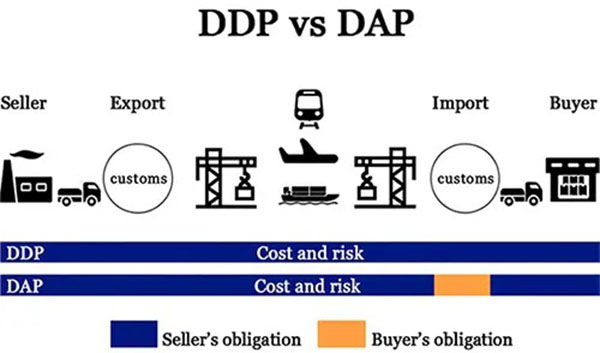
In international apparel sourcing, DDP (Delivered Duty Paid) and DAP (Delivered at Place) are often confused because both are door-to-door shipping terms. However, the most important and only critical difference between them is who is responsible for import customs clearance and import taxes in the destination country.
This single difference directly affects your total landed cost, operational workload, and customs risk when importing garments from China.
DDP vs DAP in Apparel Import Real Example:
To clearly understand the practical difference between DDP and DAP, let’s take a real apparel sourcing scenario as an example.
Assume you are importing 2000 hoodies from a factory in Dongguan, China to your warehouse in Los Angeles, USA.
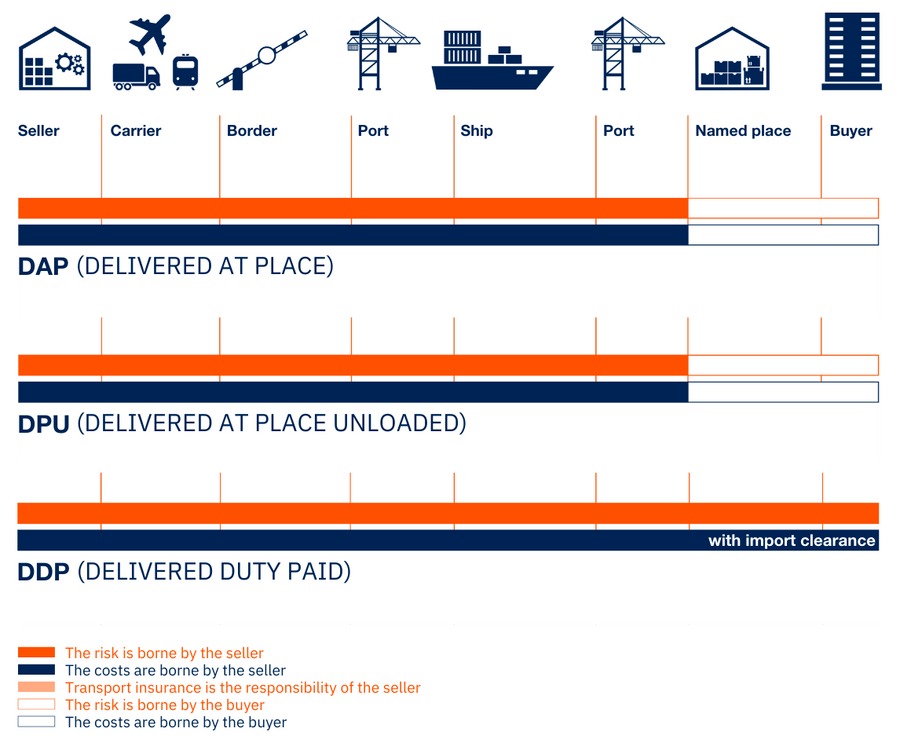
Under DDP terms, the supplier takes full responsibility for the entire logistics chain. The factory not only completes production and export customs clearance in China, but also arranges international shipping, handles US import customs clearance, pays all import duties and taxes, and finally delivers the goods directly to your warehouse. In this case, your role is very simple—you do not need to communicate with customs brokers, calculate tariffs, or manage any logistics procedures. The supplier essentially converts the entire cross-border process into a single delivered price, which reduces operational complexity but usually increases the total quotation because all risks and costs are bundled into the seller’s responsibility.
Under DAP terms, the logistics flow is similar at first stage because the supplier still handles production, export clearance, and international shipping to the US destination. However, the key difference appears when the goods arrive in the United States. At this point, the shipment will be held at customs until you complete import clearance procedures and pay the required duties and taxes. If there are delays in documentation or tax payment, the delivery process may be postponed, even though the goods have already arrived in the destination country.
This comparison shows an important operational reality:
- DDP shifts all customs and tax complexity to the seller, giving you maximum simplicity and predictability
- DAP reduces seller responsibility at destination customs, but requires you to actively manage import clearance before final delivery
In actual apparel sourcing, this difference directly affects your workflow. If you prefer a fully managed “hands-off” shipping experience, DDP is more suitable. If you want more control over import taxation and customs handling in your country, DAP provides more flexibility but requires higher operational involvement.
How to Calculate DDP and DAP (DDU) Prices?
In international apparel sourcing, understanding how DDP and DAP (DDU) prices are calculated is very important because the quotation you receive from suppliers is not just a product price—it is a combined cost of production, logistics, and customs-related expenses. In practice, sellers usually do not break down every cost item separately; instead, they present a single total price that already includes most or all transportation and handling expenses depending on the Incoterm.
To understand this clearly, let’s use the example above.Assume you are purchasing 2000 hoodies from Dongguan, China to be shipped to your warehouse in Los Angeles, USA under DDP terms. The supplier first calculates the product manufacturing cost, for example $5 per piece, which equals $10,000 in total production cost. Then the seller adds all logistics-related expenses, which may include inland transportation from factory to Guangzhou port, export customs clearance fees, international sea freight to Los Angeles, import customs clearance costs, import duties and VAT, destination handling charges, and final delivery to your warehouse.
In this case, the seller may bundle all logistics and tax-related costs into a single shipping cost, for example $20,000. Therefore, the total DDP quotation becomes:
DDP price = (2,000 × $5) + $20,000 = $30,000
In real practice, some suppliers may not present it in two parts. Instead, they distribute all costs into a single unit price, for example quoting $15 per piece, which already includes production and all logistics costs. In that case, the calculation becomes:
DDP price = 2,000 × $15 = $30,000
Now, if we convert this into a DAP (or DDU) structure, the key difference is that import duties and taxes are excluded from the seller’s responsibility. For example, if the total import duties and taxes in the destination country are $3,300, then this amount will not be included in the seller’s quotation under DAP terms.
Therefore, the DAP pricing structure can be understood as:
DAP price = DDP price − import duties & taxes
DAP price = $30,000 − $3,300 = $26,700
The most important thing to understand is that DDP and DAP pricing are not fixed numbers—they are comprehensive cost structures built from multiple logistics components. Even if suppliers present you with a simple unit price, it usually includes a combination of production cost, inland transport, export clearance, international freight, and (in the case of DDP) import taxes.
Therefore, when comparing quotations from different suppliers, you should always clarify whether import duties and customs fees are included, otherwise the “cheapest price” may not reflect your true final cost.
When to Use DDP and DAP (DDU)?
Choosing between DDP and DAP (DDU) is not only a pricing decision, but also a decision about how much logistics responsibility and customs involvement you want to take on. Since shipping from China to your country involves multiple stages—factory pickup, export clearance, international freight, import customs clearance, duties, and final delivery—the choice of Incoterms directly affects your workload, cost control, and operational risk.
In practice, DDP is most suitable when you want a fully simplified, door-to-door solution. For example, if you are a new apparel brand owner or an Amazon seller importing 5,000 hoodies from China to a US warehouse, and you do not have experience dealing with customs brokers or import tax procedures, DDP allows you to avoid all operational complexity. The supplier will handle everything from production to final delivery, including import duties and customs clearance. This means you can focus entirely on sales and marketing, while the logistics process is fully managed on your behalf.
On the other hand, DAP (or DDU) is more suitable when you want cost flexibility and are able to handle import clearance yourself. For example, if you are an experienced importer in Europe or the US and you already work with a local customs broker, you may choose DAP when importing 10,000 T-shirts from China to your warehouse in Chicago. Under this structure, the supplier still delivers the goods to your destination, but you take responsibility for customs clearance and import taxes once the shipment arrives. This allows you to control tax handling directly and potentially optimize import costs depending on your local regulations.
One important mistake many importers make is comparing only the quoted price. For example, DAP may look cheaper at first, but once you add import duties and customs handling fees, the total cost can sometimes be close to or even higher than DDP.
Therefore, in real apparel trade, the correct decision is not based on the lowest quote, but on the total landed cost plus your operational capability to handle customs clearance efficiently.
Truck vs Express Which Is Better in Door-to-Door Delivery?
In international apparel logistics under DDP and DAP (DDU) door-to-door shipping terms, once goods arrive in the destination country, the final stage of transportation is usually handled by either truck delivery or express courier delivery. This last-mile decision is not only about speed, but also about cost efficiency, cargo volume, and overall supply chain planning. Choosing the right method can significantly impact your total landed cost and delivery experience.
In real trade practice, sea freight combined with truck delivery is generally more cost-effective for medium to large shipments. For example, when shipping from China to the United States, a consolidated sea freight shipment followed by truck delivery typically takes around 30–40 days, with a cost of approximately $1.2–$1.8 per kilogram equivalent (depending on volume and route efficiency). This method is widely used for bulk apparel orders such as hoodies, sweatpants, or T-shirt production runs, where cost control is more important than delivery speed. The truck segment is used for palletized cargo distribution from port or warehouse to your final destination, making it suitable for larger and heavier shipments.
On the other hand, sea freight combined with express delivery is more suitable for smaller shipments that require faster handling. In the same China-to-USA route, this method usually takes around 20–30 days, with a higher cost of approximately $2–$3 per kilogram. Although the unit cost is higher than truck delivery, express services provide faster last-mile delivery and better tracking accuracy, which is particularly important for e-commerce sellers who need faster replenishment cycles.
For example, when you are shipping a small batch of 50–100 kg of clothing to an Amazon FBA warehouse in the US. In this case, using sea freight combined with express delivery is often more efficient than traditional trucking. Freight forwarders in China may consolidate cargo from multiple buyers into one container, ship it to a US warehouse (such as in Los Angeles), and then partner with local express couriers to distribute goods directly to different Amazon fulfillment centers. This “consolidation + express split delivery” model helps reduce costs while maintaining reasonable delivery speed.
In contrast, if you are shipping a larger order of several CBM or full container loads, truck delivery becomes more practical because it avoids high per-kg express costs and provides stable bulk distribution after arrival.
Ultimately, in DDP and DAP logistics structures, both truck and express play important roles in the final-mile delivery stage, and the most efficient solution depends on balancing cost, speed, and shipment size in your apparel supply chain.
Conclusion
DDP, DAP, and DDU are essential Incoterms in global apparel trade, especially when importing garments from China. Each term represents a different level of responsibility, cost structure, and logistics involvement.
Understanding these terms helps you better evaluate supplier quotations, avoid hidden costs, and build a more stable supply chain for your clothing business.
As a professional garment manufacturing company, we have extensive experience in apparel production and global export logistics. We support international buyers with end-to-end solutions including product development, manufacturing, quality control, and shipping coordination. If you need help with DDP, DAP, or apparel sourcing from China, feel free to contact us anytime.