Many buyers use the phrase “tight neck T-shirts,” but that term is not precise in apparel manufacturing. If the neckline name is unclear, product development can quickly go in the wrong direction, especially when fit, collar height, and neck opening are all important.
Tight neck T-shirts are usually called crew neck T-shirts when the neckline sits close to the base of the neck. If the neck rises higher and covers more of the neck, they are more often called mock neck T-shirts, high-neck T-shirts, or sometimes turtleneck-style tees depending on the collar height.
At Fusionknits, we treat neckline terminology as a technical issue, not just a styling detail. A small difference in naming can change the pattern, rib construction, sewing method, and the final product appearance.
What does “tight neck T-shirt” usually mean in apparel terms?
The phrase sounds simple, but in manufacturing it can describe more than one neckline type. That is why it needs to be translated into a proper product term before sampling starts.
In apparel terms, “tight neck T-shirt” usually means either a crew neck T-shirt with a close-fitting round opening or a mock neck T-shirt with a higher collar. The exact meaning depends on whether the fabric sits at the base of the neck or rises above it.
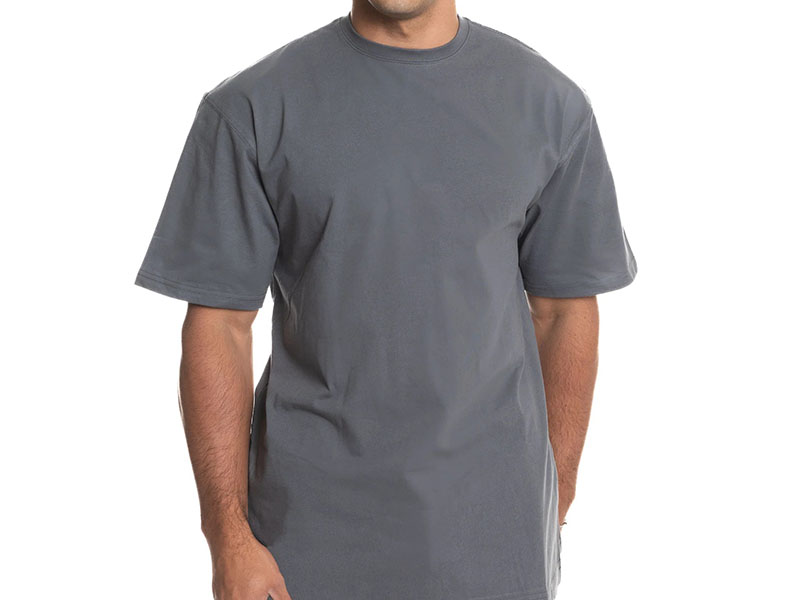
A crew neck is generally described as a round, collarless neckline that sits snugly at the base of the neck. A mock neck, by contrast, sits higher and covers more of the neck, but does not fold over like a full turtleneck.
From a factory point of view, this difference matters immediately. A close crew neck usually needs a smaller neck opening and a well-balanced rib band. A mock neck needs more collar height, more structure, and different sewing control.
Two meanings that buyers often mix together
- A close crew neck that feels tight around the base of the neck
- A mock neck or high neck that visibly rises up the neck
Why this confusion is common
People describe feeling, not structure
Most buyers first explain how the neckline feels on the body, not what the neckline is called.
Retail language is not always technical
Many sellers use “tight neck,” “high neck,” and “close neck” loosely, even when the actual category is different.
Small visual differences create big technical changes
A few centimeters of collar height can shift a T-shirt from crew neck to mock neck territory.
A simple way to interpret the phrase
| What the buyer means | Most likely apparel term |
|---|---|
| Round neck sitting close to the throat | Crew neck |
| Neckline higher than a standard tee | High neck or mock neck |
| Collar covering much of the neck | Mock neck or turtleneck-style tee |
That is why manufacturers should not sample from a vague phrase alone. The neckline needs to be defined in technical terms before development moves forward.
Are most tight neck T-shirts actually crew necks?
In most everyday T-shirt discussions, the answer is yes. When people say they want a T-shirt with a tighter neck, they usually mean a crew neck with a smaller neck opening and a firmer collar.

Most tight neck T-shirts are actually crew necks. In standard apparel language, a crew neck is the most common close-fitting T-shirt neckline because it is round, collarless, and sits snugly at the base of the neck.
Apparel references consistently describe the crew neck this way. It is the standard neckline most people associate with a classic T-shirt.
At Fusionknits, this is the neckline we most often develop when buyers ask for a “tight collar T-shirt” or a “small neck opening tee.” In most of those cases, they do not want a high collar. They want a standard T-shirt silhouette with a more compact neckline.
What makes a crew neck feel tighter
- Smaller neck opening
- Higher front neckline
- Firmer rib band
- Better collar recovery
- Slightly thicker neck rib in some styles
Why buyers prefer a tighter crew neck
Cleaner appearance
A smaller opening often makes the shirt look sharper and more structured.
Better shape retention
A firm crew neck usually holds its appearance better after repeated washing.
Stronger fashion direction
Heavyweight, streetwear, and premium basic T-shirts often use tighter crew necks for a more deliberate look.
What a standard close crew neck usually looks like
| Design point | Typical effect |
|---|---|
| High round opening | More coverage at the neck |
| Compact neck width | Tighter visual line |
| Rib neckband | Better recovery and support |
| Balanced shoulder-neck ratio | Cleaner upper-body shape |
So in most real buying situations, “tight neck T-shirt” usually means a crew neck, not a mock neck.
When is a tight neck T-shirt called a mock neck instead?
A T-shirt stops being a standard crew neck when the neck construction starts to rise above the base of the neck in a noticeable way. At that point, the name usually changes.
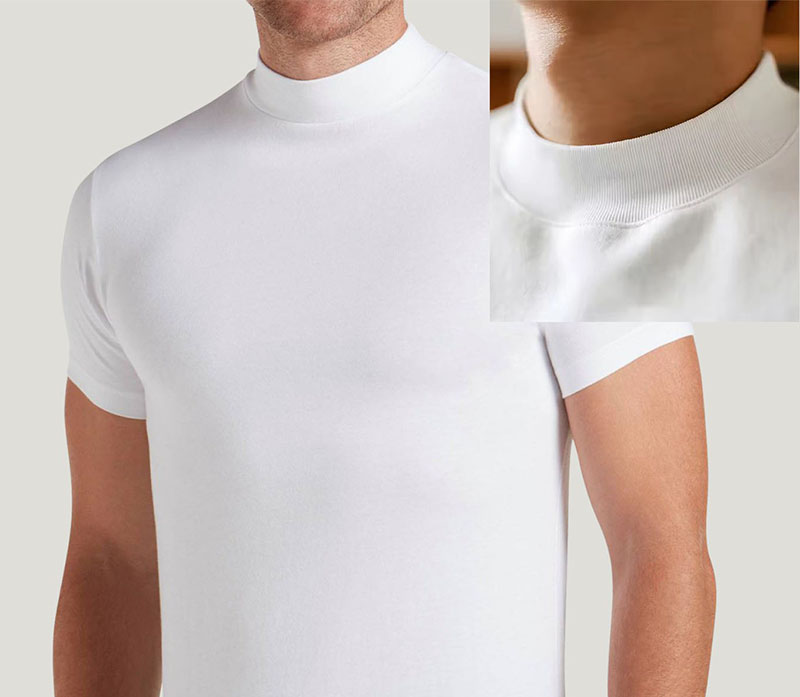
A tight neck T-shirt is usually called a mock neck when the collar rises above the base of the neck and lightly covers part of it, but does not fold over. A mock neck sits higher than a crew neck and lower than a full turtleneck.
That distinction is consistent across apparel explanations. Cambridge defines a mock turtleneck as a high round collar that does not fold over, and apparel style sources describe mock necks as higher than crew necks but lower than turtlenecks.
At Fusionknits, we classify mock neck T-shirts separately because the construction is different enough to affect pattern work and sewing control. The neckband is not just tighter. It is taller.
Signs that the style is a mock neck
- Collar height rises above the collarbone area
- Neckband looks more vertical than flat
- The neckline gives visible neck coverage
- The collar does not fold like a turtleneck
Why the distinction matters in product development
Collar height changes the category
A few extra centimeters can move the style away from a classic T-shirt look.
The sewing method changes
Mock necks often need different collar joining and shape control.
The fit expectation changes
A customer buying a crew neck and a customer buying a mock neck are usually looking for different silhouettes.
Crew neck vs. mock neck at a glance
| Feature | Crew neck | Mock neck |
|---|---|---|
| Neck position | Base of neck | Higher on neck |
| Collar height | Low | Medium |
| Fold-over collar | No | No |
| Visual impression | Classic tee | More structured or fashion-forward |
So if the neckline is truly higher, the correct term is often not crew neck anymore. It becomes mock neck or high neck.
What is the difference between a crew neck, high neck, mock neck, and turtleneck?
These terms are often mixed together in casual conversation, but in manufacturing they refer to different neckline heights and structures.
A crew neck sits close to the base of the neck, a high neck is a broader term for a neckline that rises higher than standard, a mock neck covers part of the neck without folding over, and a turtleneck covers more of the neck with a collar that typically folds over.
The crew neck is the standard close-fitting round neckline. Mock neck definitions consistently place it higher than a crew neck and below a turtleneck. “High neck” is often used more loosely in retail language and can overlap with mock neck depending on the brand.
At Fusionknits, we usually treat “high neck” as a direction term and “mock neck” as a more technical product term when the collar is clearly raised but not fold-over.
How these necklines compare
Crew neck
The classic T-shirt neckline. Round, close, and low compared with higher-neck styles.
High neck
A general term. Usually means more neck coverage than a standard crew neck.
Mock neck
A short raised collar that does not fold over.
Turtleneck
A higher collar that usually folds over and covers much more of the neck.
Why factories need the exact term
- Pattern shape changes
- Rib or collar height changes
- Sewing operations change
- Neck measurement tolerances change
- Styling position changes
Neckline comparison table
| Neckline | Height | Fold-over | Most common use |
|---|---|---|---|
| Crew neck | Low | No | Standard T-shirts |
| High neck | Medium | Usually no | Fashion tees, elevated basics |
| Mock neck | Medium | No | Structured knit tops and tees |
| Turtleneck | High | Usually yes | Sweaters, knit tops, fashion basics |
This is why the correct term matters. A neckline may feel “tight” in all four cases, but the product category is not the same.
Why do some crew neck T-shirts feel tighter than others?
Even within the crew neck category, not every neckline feels the same. A T-shirt can be called a crew neck and still feel loose, balanced, or very close to the throat depending on how it is developed.
Some crew neck T-shirts feel tighter than others because of differences in neck opening size, front neck drop, rib width, rib tension, collar height, and fabric recovery. A tighter feel usually comes from a smaller opening and a firmer neck construction.
At Fusionknits, we see this all the time in sample comments. A buyer may approve the body fit but reject the neckline because it feels too open. In those cases, the issue is not the neckline category. It is the neckline engineering.
Factors that affect how tight a crew neck feels
- Width of the neck opening
- Depth of the front neck drop
- Rib height
- Rib fabric quality
- Rib tension during sewing
- Fabric shrinkage after wash
- Shoulder-to-neck proportion
Why collar recovery matters so much
A weak rib stretches out
This makes the neckline look wider over time.
A stronger rib keeps the shirt looking cleaner
This is especially important in heavyweight and premium basic tees.
Recovery changes the wearer’s impression
A shirt may fit well overall but still feel cheap if the neck loses structure.
Common reasons a crew neck feels too loose
| Issue | Result |
|---|---|
| Neck opening too wide | Loose neckline appearance |
| Front neck drop too deep | Less coverage at the throat |
| Weak rib quality | Collar stretches out faster |
| Poor sewing tension | Uneven neckline shape |
So a buyer asking for a “tight neck tee” may not need a different neckline category. They may only need a stronger crew neck construction.
How should manufacturers develop a tight neck T-shirt correctly?
A tight neck T-shirt needs more than a smaller hole at the top of the garment. The neckline has to be balanced with the body fit, shoulder line, fabric type, and washing performance.

Manufacturers develop a tight neck T-shirt correctly by controlling neck opening size, collar height, rib quality, rib ratio, sewing tension, and wash stability. A good tight neckline should look compact without feeling distorted or uncomfortable.
At Fusionknits, we treat neckline development as a fit control point. If the neckline is too tight, it can feel restrictive. If it is too loose, it loses the clean look the buyer wanted.
Key points we check during development
- Neck width
- Front neck drop
- Back neck shape
- Rib height
- Rib stretch and recovery
- Collar seam smoothness
- Wash result after sample testing
Why sample review is essential
Tight necklines are sensitive
Small changes in pattern or rib ratio can create visible differences.
Fabric type changes the result
A soft light jersey and a heavy compact jersey will not hold the same collar shape.
Wash testing matters
Some collars tighten or relax after finishing and laundering.
Development priorities for a tighter neckline
| Development point | Why it matters |
|---|---|
| Accurate neck opening | Protects fit balance |
| Good rib recovery | Keeps collar shape stable |
| Controlled sewing tension | Prevents waving or distortion |
| Wash-tested sample | Confirms final performance |
This is why neckline requests should be translated into measurements and sample standards, not only style words.
What should buyers ask for if they want a T-shirt with a tighter neck?
Many neckline problems begin because the request is too vague. “Tight neck” gives a direction, but it does not give enough detail for clean development.
If buyers want a T-shirt with a tighter neck, they should ask for either a higher and tighter crew neck or a mock neck, depending on the look they want. They should also specify neck opening, collar height, rib quality, and sample feel rather than relying on general wording alone.
At Fusionknits, we usually guide buyers to define the request in one of two ways. If they want a classic T-shirt, we keep the style as a crew neck and tighten the opening. If they want visible neck coverage, we move toward a mock neck or high-neck style.
Useful ways to describe the request
- “I want a tight crew neck, not a wider basic crew neck.”
- “I want a high-neck T-shirt.”
- “I want a mock neck tee with visible collar height.”
- “I want a smaller neck opening and firmer rib.”
- “I want the collar to stay tight after washing.”
What buyers should confirm before approval
Category
Is it still a crew neck, or is it actually a mock neck?
Collar height
Does the buyer want base-of-neck coverage or raised-neck coverage?
Rib performance
Will the rib stay compact after repeated washing?
Sample feel
Does the neckline feel comfortably close or too restrictive?
A practical buyer checklist
| Buyer need | Best way to specify it |
|---|---|
| Standard tee with tighter neck | Tight crew neck |
| Tee with raised collar | Mock neck or high neck |
| Better collar recovery | Stronger rib and wash test |
| Cleaner fashion look | Smaller opening and balanced collar height |
That kind of clarity makes development faster and reduces the risk of getting the wrong neckline category.
Why does correct neckline terminology matter in wholesale apparel development?
In wholesale manufacturing, vague product language creates unnecessary revisions. The neckline is a small area, but it has a big effect on sampling, fit approval, and product identity.
Correct neckline terminology matters because it affects pattern making, sampling, rib sourcing, sewing construction, and final product expectations. Using the right term helps buyers and factories communicate more accurately and reduce development mistakes.
At Fusionknits, neckline naming is part of technical accuracy. A buyer may think they are asking for a “tight neck T-shirt,” but the factory still needs to know whether the target is a close crew neck or a true mock neck. That decision changes the garment route.
Why technical naming improves production
- Fewer sample revisions
- Better fit alignment
- Clearer trim planning
- More accurate cost control
- Stronger consistency in bulk production
What changes when the term changes
Crew neck request
Usually means standard T-shirt construction with compact neckline adjustment.
Mock neck request
Usually means raised collar, more structure, and a different visual category.
Why this matters commercially
| Technical clarity | Business result |
|---|---|
| Better sampling accuracy | Faster approvals |
| Better neckline consistency | Stronger final product image |
| Better factory understanding | Lower development risk |
| Better product naming | Clearer communication with customers |
That is why a good manufacturer should not just accept the phrase “tight neck.” It should translate that phrase into the correct apparel term before production moves forward.
Conclusion
Tight neck T-shirts are usually called crew neck T-shirts when the neckline sits close at the base of the neck, and mock neck or high-neck T-shirts when the collar rises higher and covers more of the neck. The right term depends on the actual neckline height, not only on how close the shirt feels around the throat.
From a manufacturing point of view, this distinction matters because it changes the pattern, collar construction, rib development, and final product appearance.
At Fusionknits, we believe neckline terminology should always be defined clearly at the sample stage, because a tight crew neck and a mock neck may sound similar in casual language, but they are not the same product in apparel development.