
T-shirts are now one of the most widely worn garments worldwide, but their popularity grew gradually through cultural, practical, and fashion-driven factors. From workwear to a symbol of casual style, the T-shirt has a unique story of evolution.
T-shirts became popular because they were practical, affordable, and versatile. Their rise was accelerated by military use, mass production, celebrity influence, youth culture, and branding. Over decades, T-shirts transformed from an undergarment to a global fashion staple.
At Fusionknits, understanding this journey helps us design modern T-shirts that resonate with both comfort and cultural relevance.

Where did the T-shirt originate?
The T-shirt as we know it evolved from 19th-century undergarments worn in Europe and the United States. Men wore simple, lightweight, one-piece cotton undershirts beneath uniforms and work clothes.
The T-shirt originated as an undergarment, designed for comfort and ease of movement. Its shape resembled the letter “T,” which gave the garment its name. Cotton and other breathable fibers made it ideal for labor-intensive environments.
In early industrial contexts, workers and soldiers preferred these lightweight garments. The T-shirt’s simplicity, practicality, and low cost made it ideal for functional use. Initially, it was invisible, worn beneath other clothing.
Early T-shirt characteristics
- Lightweight cotton knit
- Short sleeves
- Crew neckline
- Straight, simple silhouette
Why it was practical
- Affordable and mass-producible
- Easy to wash
- Comfortable under heavier garments
- Allowed freedom of movement for labor or military duties
This early functional phase laid the foundation for its later cultural adoption.
How did the military popularize the T-shirt?
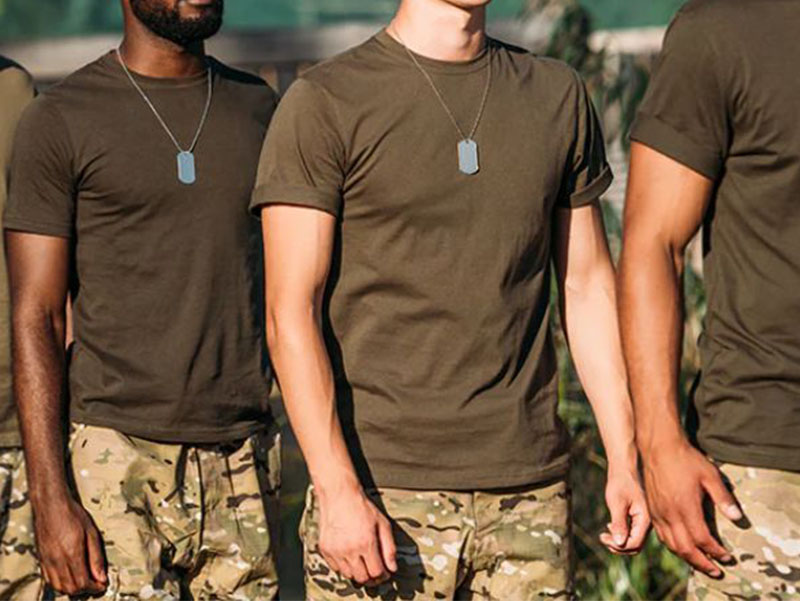
World War I and World War II were pivotal for T-shirt popularity. Soldiers in the U.S. Navy and Army were issued lightweight cotton undershirts as standard uniform components.

The military popularized the T-shirt because it provided a practical, comfortable layer that was easy to launder and could be worn under uniforms. Returning soldiers brought this style into civilian life, where it quickly became a casual garment.
During the wars, the T-shirt’s practical appeal was widely recognized. Veterans introduced the style at home, often wearing them casually in summer or as sportswear.
Military factors that accelerated popularity
- Standardized design for mass production
- Durable and breathable cotton
- Crew-neck design suited for layering
- Short sleeves for comfort in warm climates
Transition to civilian use
| Military feature | Civilian adoption |
|---|---|
| Lightweight cotton | Everyday casual wear |
| Short sleeves | Summer and leisurewear |
| Crew neck | Standard casual T-shirt |
| Mass production | Affordable clothing for the public |
The military’s role gave the T-shirt both exposure and credibility as a functional garment.
How did Hollywood and pop culture influence T-shirt popularity?
Movies, music, and youth culture dramatically elevated the T-shirt from functional wear to fashion statement.
Hollywood and pop culture popularized T-shirts by using them as iconic symbols. Actors like Marlon Brando and James Dean wore fitted T-shirts in films, turning a simple garment into a symbol of rebellion, coolness, and youth.
During the 1950s, T-shirts began appearing on magazine covers, movie posters, and street fashion. They signaled casual freedom, defiance of formal attire, and a modern lifestyle.
Key pop culture influences
- Film stars: Brando in A Streetcar Named Desire, Dean in Rebel Without a Cause
- Musicians: Rock and roll culture embraced T-shirts as performance attire
- Youth culture: Teenagers adopted T-shirts for identity expression
Cultural impact
| Influence | Effect |
|---|---|
| Hollywood films | Fashionable, “cool” image |
| Music icons | Streetwear and youth identity |
| Print and graphics | Personal expression and branding |
By the 1960s, T-shirts were no longer just undergarments—they were visible symbols of style and personality.
How did branding and graphics accelerate T-shirt popularity?
T-shirts became even more popular as a canvas for logos, slogans, and graphic designs. Companies, musicians, and political movements all used T-shirts for communication.
Branding and graphics accelerated T-shirt popularity because they turned a basic garment into a medium for expression. Logos, slogans, and art allowed individuals to showcase identity, support causes, or promote ideas.
At Fusionknits, we often see that T-shirts are the most direct way for brands to connect with consumers, because the garment itself becomes a moving billboard.
Types of graphic influence
- Company logos and promotional tees
- Concert and band T-shirts
- Political or social activism slogans
- Artistic designs and limited editions
Impact on consumer culture
| Graphic type | Popularity effect |
|---|---|
| Logo tees | Branding and visibility |
| Concert tees | Fan identity and loyalty |
| Political slogans | Social statement |
| Artistic designs | Fashion and collectibility |
Graphic T-shirts helped make the style universal, appealing to all ages, genders, and cultural groups.
How did manufacturing and mass production make T-shirts more accessible?
Industrial textile production and advancements in cotton processing enabled the T-shirt to become a mass-market item.
Mass production and affordable cotton manufacturing made T-shirts widely accessible. Factories could produce large volumes of uniform T-shirts at low cost, making them standard wardrobe items worldwide.
Technologies such as circular knitting machines, automated sewing, and bleaching processes allowed companies to meet growing demand from youth, military, and casual fashion markets.
Manufacturing factors
- Cotton supply expansion
- Automated knitting and sewing
- Pre-dyed fabrics and colorfast printing
- Economies of scale for affordability
Resulting accessibility
| Manufacturing factor | Impact on popularity |
|---|---|
| Mass production | Lower retail price |
| Standard sizes | Ready-to-wear for all ages |
| Consistent quality | Consumer trust in fit and feel |
| High availability | Ubiquity in fashion and daily wear |
These advances ensured that T-shirts were no longer niche; they became a staple in everyday wardrobes.
How did youth and counterculture movements drive popularity?
Youth subcultures embraced T-shirts as symbols of identity and rebellion. Hippies, punks, and later skate and street cultures all relied on T-shirts as visual statements.

Youth and counterculture movements increased T-shirt popularity by turning it into an identity marker. Bands, slogans, and DIY graphics made T-shirts a symbol of personal and cultural affiliation.
At Fusionknits, we see that these cultural influences still affect T-shirt design today, especially in print, cut, and styling choices.
Subculture influence examples
- 1960s: Hippie tie-dye and political slogans
- 1970s: Punk band T-shirts and DIY graphics
- 1980s: Skate culture and streetwear logos
- 1990s–2000s: Hip-hop branding and pop culture references
Cultural influence chart
| Era | T-shirt style | Cultural effect |
|---|---|---|
| 1960s | Tie-dye, slogans | Anti-establishment, political activism |
| 1970s | Punk graphics | DIY identity, rebellion |
| 1980s | Skate/brand logos | Lifestyle and performance image |
| 1990s–2000s | Pop/hip-hop branding | Consumer identity and mass appeal |
These movements reinforced the T-shirt’s role as both fashion and communication.
How did sports and casualwear trends affect T-shirt adoption?
Athletic wear, outdoor activities, and casual dress codes made T-shirts the default choice for comfort and mobility.
Sports and casualwear trends boosted T-shirt popularity by emphasizing comfort, breathability, and freedom of movement. Cotton and cotton blends became preferred fabrics for training, leisure, and daily casual attire.
By the mid-20th century, universities, athletic programs, and casual lifestyle brands were using T-shirts extensively. Logos, mascots, and team names appeared, further embedding the garment into popular culture.
Sports and casual influence
- College and varsity T-shirts with logos
- Fitness and gym culture adoption
- Casual dress codes replacing formal shirts
- Outdoor and leisure activities promoting lightweight, breathable cotton
Impact on general adoption
| Factor | Effect |
|---|---|
| Comfort and mobility | Increased daily wear |
| Team and school branding | Mass-market visibility |
| Casual dress trends | Replaced formal shirts in informal settings |
| Universal sizing | Easy adoption across demographics |
The T-shirt became the go-to garment for practical comfort combined with casual style.
How did international and global trends contribute?
T-shirts spread globally as American culture, movies, and branding reached international audiences.
Globalization and American cultural exports contributed to T-shirt popularity by spreading movies, music, and brand marketing worldwide. International consumers adopted T-shirts as symbols of casual fashion and lifestyle.
At Fusionknits, we see that global exposure created demand for local production of T-shirts to match trends originating in the U.S. and Europe.
Globalization influences
- Hollywood films showing casual American style
- Music bands touring internationally with branded T-shirts
- International fashion adopting casual T-shirt looks
- Mass retail and franchised brands exporting T-shirt culture
Global adoption impact
| Trend | Effect |
|---|---|
| Movie influence | Fashionable and aspirational |
| Music and pop culture | Broad appeal for youth and fans |
| Retail and branding | Local production to meet demand |
| Casual lifestyle | Integration into daily wear globally |
This global reach cemented the T-shirt as an international wardrobe staple.
Why are T-shirts still so popular today?
Today, T-shirts remain ubiquitous because they are versatile, customizable, affordable, and culturally significant.
T-shirts are still popular today because they combine comfort, affordability, fashion flexibility, and expressive potential. They can be plain, branded, printed, or styled, allowing them to appeal to a wide range of consumers.
At Fusionknits, we continue to innovate in fabric quality, printing techniques, cut, and styling to meet modern expectations while respecting the T-shirt’s rich cultural history.
Key modern factors
- Comfortable cotton, cotton blends, and technical fabrics
- Customization for branding and fashion
- Affordable production and pricing
- Fashionable cuts and vintage-inspired designs
- Social, political, or artistic messaging
Modern consumer appeal
| Factor | Appeal |
|---|---|
| Comfort | Daily wearability |
| Affordability | Mass-market access |
| Style flexibility | Suitable for fashion trends |
| Personal expression | Graphics and slogans |
| Branding opportunity | Promotional and retail visibility |
Conclusion
T-shirts became popular due to a combination of practicality, affordability, cultural influence, and global reach. From their origins as functional undergarments, T-shirts evolved through military use, mass production, celebrity influence, youth subcultures, graphic design, sportswear, and globalization. Each stage contributed to their versatility, accessibility, and cultural significance.
Today, T-shirts continue to dominate wardrobes worldwide because they offer a unique combination of comfort, style, and self-expression. They serve as canvases for branding, political or social statements, and personal fashion choices. They are embraced across ages, genders, and cultures, and their adaptability ensures they remain relevant through every fashion cycle.
At Fusionknits, we leverage this understanding of history to design T-shirts that honor the heritage of the garment while meeting modern needs. By combining quality fabrics, thoughtful cuts, and customization options, we help brands and consumers experience T-shirts as both a staple of comfort and a medium of personal expression. The popularity of the T-shirt is not accidental—it is the result of decades of cultural, industrial, and stylistic evolution that continue to influence fashion today.