

In international garment trade, CIF (Cost, Insurance and Freight) is one of the most commonly used Incoterms when buyers want a more “delivery-inclusive” purchasing structure from suppliers. Compared with FOB, CIF shifts more responsibility to the seller, especially in terms of arranging shipping and insurance up to the destination port.
Under CIF terms, the seller is responsible for producing the goods, handling export procedures, arranging ocean freight, and purchasing marine insurance. However, risk transfer still happens much earlier—once the goods are loaded onto the vessel at the port of shipment, the risk shifts from seller to buyer. This separation between cost responsibility and risk transfer is one of the most important concepts in CIF and often causes confusion among new importers.
Understanding CIF clearly is essential for both buyers and suppliers. This article focuses on explaining CIF in detail, including its practical meaning in garment sourcing, operational workflow, cost structure, advantages and limitations, and its comparison with other Incoterms.
What Is CIF in International Maritime Trade?
CIF (Cost, Insurance and Freight) is an Incoterm used only for sea freight and inland waterway transport. It means the seller is responsible for the cost of goods, ocean freight to the destination port, and basic marine insurance during transit.
In simple terms, CIF means:
The seller delivers the goods to the vessel, pays for shipping to destination port, and provides basic insurance coverage during transportation.
Under CIF terms:
Seller responsibilities include:
- Garment production
- Export packaging and labeling
- Inland trucking to port
- Export customs clearance
- Ocean freight booking and payment
- Basic marine insurance arrangement
Buyer responsibilities include:
- Import customs clearance
- Import duties and taxes
- Inland transportation after arrival
However, it is important to understand that risk does not transfer at destination port. Instead, risk transfers when goods are loaded onto the vessel at the origin port
How CIF Is Structured in Real Garment Export Operations
In real garment export operations, CIF is a seller-managed logistics structure, where the factory not only produces the garments but also coordinates international shipping and insurance on behalf of the buyer.
A typical CIF workflow in apparel trade includes:
- Production completed at the factory
- Export packing and labeling
- Customs clearance in the origin country
- Delivery to port and vessel loading
- Booking and payment of ocean freight by the seller
- Purchase of basic marine insurance
- Shipment to destination port
From the buyer’s perspective, this reduces operational complexity because shipping and insurance are handled directly by the supplier.
CIF Advantages and Limitations
Advantages of CIF:
- Simplifies the purchasing process by combining product cost, freight, and insurance into a single quotation
- Reduces the need for buyers to manage shipping operations or coordinate with freight forwarders
- Suitable for buyers who lack logistics experience or prefer supplier-managed sourcing
- Makes early-stage cost estimation easier for budgeting and product planning
Limitations of CIF:
- Buyers have limited control over shipping lines, routes, and freight cost optimization
- Logistics decisions are fully managed by the seller, reducing transparency in freight pricing
- Insurance provided is usually basic coverage and may not fully match buyer risk preferences
- Risk still transfers at the port of loading, which is often misunderstood in practice
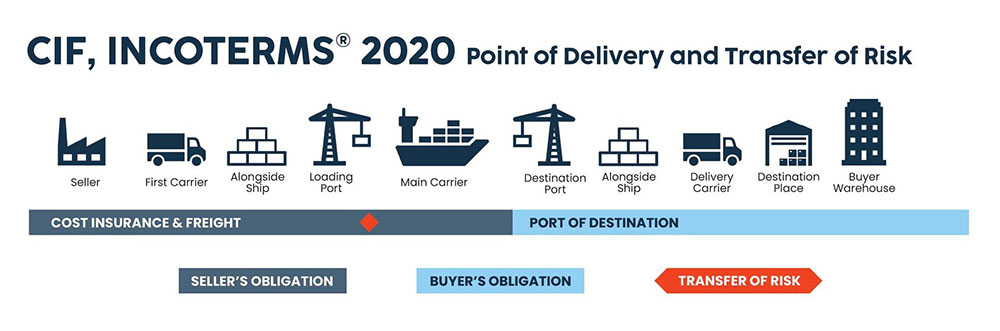
Using CIF Incoterms requires a clear understanding of cost allocation, logistics control, and risk transfer timing in international trade execution.
How CIF Pricing Works in Apparel Trade
CIF price refers to a bundled quotation that includes production cost, ocean freight, and basic marine insurance delivered to the destination port. In garment sourcing, CIF pricing is often used as a simplified “landed-to-port” cost structure.
Unlike FOB pricing, CIF does not require the buyer to arrange shipping or insurance separately. However, this convenience comes with reduced transparency in freight cost breakdown and logistics control.
CIF pricing structure:
- Manufacturing cost (fabric, labor, trims, QC)
- + Inland logistics and export handling
- + Ocean freight to destination port
- + Basic marine insurance
= CIF total price
CIF price = FOB cost + freight + insurance
If a European fashion brand places an order for bulk cotton T-shirts from a garment factory in China and receives two quotations:
- FOB Shenzhen price (production + delivery to port only)
- CIF Rotterdam price (production + freight + insurance to Rotterdam port)
If the buyer chooses CIF:
The factory will:
- Produce garments in China
- Handle export customs clearance
- Book ocean freight to Rotterdam
- Purchase basic marine insurance
- Deliver goods to Rotterdam port
The buyer will:
- Handle import customs clearance in Europe
- Pay import duties and VAT
- Arrange inland transportation from port to warehouse
This structure is often used when buyers prefer a simplified sourcing process without managing logistics directly.
CIF vs Other Common Incoterms in Apparel Trade (FOB, EXW, DDP, DPU)
In apparel sourcing, CIF is often compared with other widely used Incoterms such as FOB, EXW, DDP, and DPU. The key differences mainly lie in who controls logistics, who pays for shipping, and where responsibility and risk are transferred.
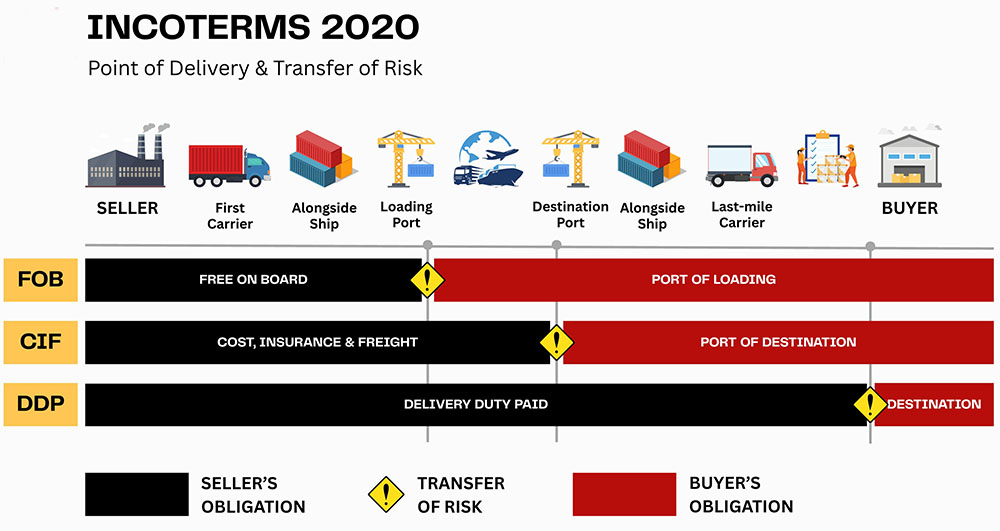
CIF vs FOB:
- CIF: Seller arranges and pays ocean freight and insurance to destination port
- FOB: Buyer arranges shipping and insurance after goods are loaded onto vessel
- Key difference: CIF = seller-controlled shipping, FOB = buyer-controlled shipping
CIF vs EXW (Ex Works):
- CIF: Seller handles production, export clearance, freight, and insurance
- EXW: Buyer takes full responsibility from factory gate, including export and shipping
- Key difference: CIF = high seller responsibility, EXW = maximum buyer responsibility
CIF vs DDP (Delivered Duty Paid):
- CIF: Seller covers freight and insurance only to destination port; buyer handles import duties and final delivery
- DDP: Seller covers full process including import clearance, duties, and final delivery to buyer’s location
- Key difference: CIF stops at destination port, DDP is full door-to-door delivery
CIF vs DPU (Delivered at Place Unloaded):
- CIF: Seller delivers goods to destination port without unloading responsibility
- DPU: Seller delivers goods to named destination and is responsible for unloading
- Key difference: CIF ends at port, DPU extends to delivery location and unloading
In apparel trade, CIF is positioned as a middle-level responsibility term, sitting between buyer-heavy models like EXW/FOB and full seller-responsibility models like DDP/DPU. It is mainly used when buyers want simplified sourcing but still prefer a structured cost-including shipping model.
Conclusion
CIF is a trade structure that combines production, shipping, and insurance under seller responsibility while still transferring risk to the buyer at the point of loading. It provides convenience and simplicity for buyers but reduces control over logistics decisions.
In global apparel sourcing, understanding CIF clearly helps brands choose the right balance between cost control and operational simplicity.
We support global apparel brands across FOB, CIF, and other Incoterms, providing full manufacturing and export coordination to ensure smooth delivery from production to shipment.